Bridge destruction to reveal clues about 'fracture-critical' spans
July 28, 2011 by Emil Venere

Bridge destruction to reveal clues about 'fracture-critical' spans

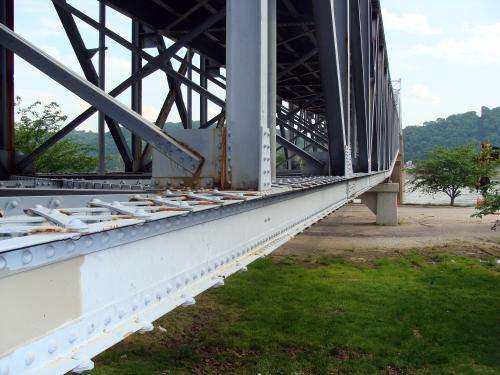
A Purdue civil engineer is taking advantage of the demolition of a bridge spanning the Ohio River to learn more about how bridges collapse in an attempt to reduce the annual cost of inspecting large spans. He will purposely damage this approach span leading to the Milton-Madison Bridge in southern Indiana, which is being demolished in stages. (Purdue School of Civil Engineering photo/Ryan Sherman)

A civil engineer at Purdue University is taking advantage of the demolition of a bridge spanning the Ohio River to learn more about how bridges collapse in efforts to reduce the annual cost of inspecting large spans.

"There is a whole family of bridges called fracture-critical," said Robert J. Connor, an associate professor of . "This means that if an important tension member breaks, it's thought the bridge will fall down."

However, modern analysis techniques could be used to learn whether such bridges really are fracture-critical, or whether other structural elements would share the load if a major piece failed.

"We are looking at 'after-fracture redundancy,' or whether a bridge does remain standing after a key element fails," Connor said. "There is a lot of interest now in this issue because bridges classified as fracture-critical are very expensive to inspect and are subjected to more rigorous inspection requirements that are somewhat arbitrary. However, as is well known, bridge owners have limited resources. But if we could show they have redundancy, that a bridge won't , more rational inspection strategies could be developed, allowing resources to be placed on the bridges that really should be inspected."

To test his hypothesis, Connor will purposely damage an approach span leading to the Milton-Madison Bridge in southern Indiana. The 82-year-old bridge, on U.S. Route 421 connecting Milton, Ky., and Madison, Ind., is being demolished in stages. A replacement bridge is scheduled for completion in 2012.

Federal law requires that the fracture-critical bridges be inspected every two years. Workers must perform a detailed "hands-on" inspection of such spans.

"A bridge over the Ohio River is almost a mile long, and the inspectors have to be arm's length away from any of these members identified as fracture-critical, looking for and whatnot," Connor said. "That's really expensive, and if there is no point in doing it because that member isn't going to fail that way, why are you doing it?"

Connor saw an opportunity in the span's demise.

"At any major river crossing you always have little bridges, called approach spans, leading to the big bridge," he said. "I said to myself, 'These are really good test specimens that they are just going to demolish when they put the new bridge in.'"

Connor suggested piling a load of sand onto one of the approach spans to simulate the weight of trucks and then cutting a critical member of the bridge with an explosive charge. He took his idea to an engineering consultant, Michael Baker Corp., and general contractor Walsh Construction, as well as officials from the Federal Highway Administration and Indiana and Kentucky state transportation departments.

The proposal was approved and federal funding provided.

Connor and his team of research engineers and a student have fitted the 100-foot approach span with 50 sensors and will damage a portion of the span and record the findings. The researchers will take high-speed video in addition to recording sensor data. The test is tentatively set for mid-August.

"We expect to be able to show whether, if one piece fails, the whole bridge won't fail because there are secondary load paths that kick in," said Connor, who has been involved in numerous steel bridge failure investigations, the most recent being the 2007 I-35W Mississippi River bridge collapse in Minneapolis.

Connor believes it is the first study of its kind on a truss that is in place.

Provided by Purdue University search and more info website

4.8 /5 (5 votes)  

Filter


Move the slider to adjust rank threshold, so that you can hide some of the comments.


Display comments: newest first

Nik_2213
Jul 28, 2011

Rank: 3 / 5 (1)
That's good thinking: All the finite-element modelling can't beat an actual test on a genuine, weathered bridge. I just hope they don't get a blizzard of flying rivets plus a tangled heap of girders. That would only prove they were right to replace the bridge...
Rank 4.8 /5 (5 votes)
Relevant PhysicsForums posts

More news stories

Browser wars flare in mobile space

The browser wars are heating up again, but this time the fight is for dominance of the mobile Internet.

Technology / Software

created 3 hours ago | popularity 5 / 5 (1) | comments 2

Probability of contamination from severe nuclear reactor accidents is higher than expected: study

Catastrophic nuclear accidents such as the core meltdowns in Chernobyl and Fukushima are more likely to happen than previously assumed. Based on the operating hours of all civil nuclear reactors and the number ...

Technology / Energy & Green Tech

created May 22, 2012 | popularity 3.6 / 5 (21) | comments 56 | with audio podcast

SpotterRF debuts Radar Backpack Kit (w/ Video)

(Phys.org) -- SpotterRF has announced a special radar backpack kit designed to enhance situational awareness for soldiers on the ground. The company says its special radar is designed for warfighters as part ...

Technology / Hi Tech & Innovation

created May 26, 2012 | popularity 5 / 5 (5) | comments 12 | with audio podcast report

HyperSolar shows dirty water no barrier to power world

(Phys.org) -- The Santa Barbara, California, company, HyperSolar, is set to transparently share the ups and downs of its research experiences toward the company’s ultimate vision, successfully producing ...

Technology / Energy & Green Tech

created May 24, 2012 | popularity 4.8 / 5 (15) | comments 17 | with audio podcast report

Tesla to launch electric sedan in US on June 22

Tesla Motors said Tuesday it would begin deliveries of "the world's first premium electric sedan" on June 22, slightly ahead of schedule.

Technology / Energy & Green Tech

created May 22, 2012 | popularity 4.5 / 5 (11) | comments 18


Nvidia trumpets Tegra 3 phone design wins for 2012

(Phys.org) -- Nvidia’s competitive war paint has a name, Tegra 3. On the heels of Nvidia announcements about lowering costs of its Tegra 3 processors and Nvidia-enabled tablets running Android Ice Cream ...

Scientist: Evolution debate will soon be history

(AP) -- Richard Leakey predicts skepticism over evolution will soon be history. Not that the avowed atheist has any doubts himself.

Dell tablet leak: 10.1-inch display, two-battery choice

(Phys.org) -- Headline after headline talks about vendors’ tablets in the wings as likely number-one contenders for the iPad. Such claims have justifiably been taken with a grain of salt, considering ...

Keep food safety in mind this memorial day weekend

(HealthDay) -- Picnics, parades and cookouts are as much a part of Memorial Day weekend as tributes to the United States' war veterans.

Family history of Alzheimer's affects functional connectivity

(HealthDay) -- Cognitively normal individuals with a family history of late-onset Alzheimer's disease (AD) may display lower resting state functional connectivity in the default mode network (DMN) of the brain, ...

Social welfare cuts ultimately come with heavy price, researchers say

(Phys.org) -- Slashing government funding for Medicaid, food stamps and other programs that serve the poor – while politically popular with some lawmakers and many conservatives – may do more harm ...