Researchers devise biomaterial that could be used in the detection of toxins and pollutants
July 1, 2011

TCD researchers devise biomaterial that could be used in the detection of toxins and pollutants

(PhysOrg.com) -- In research recently published in the leading international journal PNAS, Trinity researchers exploit the potential of a biomaterial to reveal the activity of important fat metabolising enzymes. The findings show that the biomaterial could possibly be used in the future detection of toxins, explosives, pollutants, and medicines.

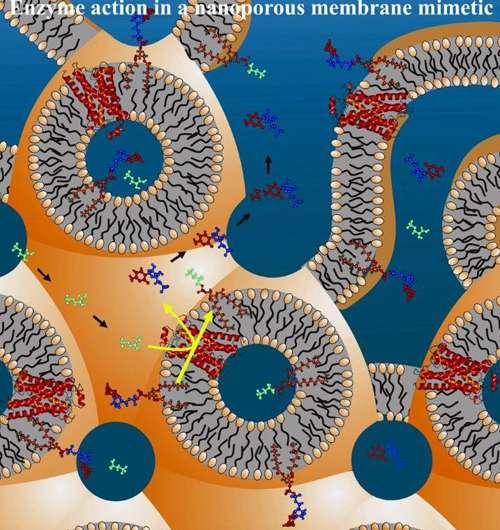
Detection devices have superior sensitivity when the sensor itself can be packaged at high density.  Certain proteins that are found in the membranes of cells can act as sensors.  However, the density with which cellular membranes can be packed in a sensor of a defined volume can limit the application.  In this study, use was made of a particular form of matter, referred to as a liquid crystal or mesophase, that behaved as a densely packed mimic for cellular membranes.

Certain naturally occurring lipids or fats, when combined with water spontaneously form liquid crystals.  One of these lipids called monoolein is a product of fat digestion.  The liquid crystalline cubic phase that monoolein forms, when wet, has the lipid arranged as a bilayer just two molecules thick that is bathed on either side by water.  This hydrated bilayer resembles the membrane that surrounds the cells in living organisms. The cubic phase is particularly notable as a liquid crystal in the extraordinary density with which it packages the membrane and the enormous surface area that it has. Thus, for example, a mere thimbleful of the cubic phase has enough surface area to cover a football field.

The research conducted by Trinity’s Professor of Membrane Structural and Functional Biology, Martin Caffrey and Research Associate Dr  Dianfan Li in the School of Medicine and School of Biochemistry & Immunology used the cubic phase; but the cubic phase made from hydrated fat alone was useless.  It needed to have a membrane protein sensor incorporated into it and the protein needed to be active.  The test sensor used in the research was a membrane protein, referred to as DgkA.  DgkA is an enzyme that interconverts the fatty components of natural cellular membranes.  The enzyme was produced in E. coli bacteria, using recombinant DNA technology, as an inactive or dead ‘scrambled egg’ type of insoluble aggregate.   ‘Life’ was breathed back into the enzyme by dissolving the aggregated protein in a soapy solution and inserting it into the membrane of the cubic phase.  In this new and quite artificial environment the researchers showed that the protein had regained its original native activity and that it could behave as a model sensor.

The research sets the stage for the exploitation of this most extraordinary of biomaterials.  These include its use in high density, high sensitivity biosensors for the detection of biological molecules such as hormones, proteins, carbohydrates, and lipids, as well as toxins, explosives, pollutants, and drugs. 

Provided by Trinity College Dublin search and more info website


Rank 5 /5 (3 votes)
Relevant PhysicsForums posts
  • Gibbs Free Energy Change/Entropy
    created2 hours ago
  • What's the rule to covalent character
    created4 hours ago
  • Schwartz reagent-- NMR/MS/IR
    created22 hours ago
  • High school chemistry EEI
    createdMay 25, 2012
  • oxidation of I- by KMnO4
    createdMay 25, 2012
  • Inversion temp
    createdMay 25, 2012
  • More from Physics Forums - Chemistry

More news stories

New CO2-removing catalyst can take the heat

(Phys.org) -- The current method of removing the greenhouse gas carbon dioxide (CO2) from the flues of coal-fired power plants uses so much energy that no one bothers to use it. So says Roger Aines, principal ...

Chemistry / Materials Science

created May 24, 2012 | popularity 5 / 5 (7) | comments 7 | with audio podcast

High-speed method to aid search for solar energy storage catalysts

Eons ago, nature solved the problem of converting solar energy to fuels by inventing the process of photosynthesis.

Chemistry / Materials Science

created May 25, 2012 | popularity 5 / 5 (3) | comments 4 | with audio podcast

Researchers demonstrate possible primitive mechanism of chemical info self-replication

(Phys.org) -- When scientists think about the replication of information in chemistry, they usually have in mind something akin to what happens in living organisms when DNA gets copied: a double-stranded molecule ...

Chemistry / Materials Science

created May 25, 2012 | popularity 5 / 5 (4) | comments 2 | with audio podcast

Building a better solar panel -- one molecule at a time

(Phys.org) -- One of the fundamental building blocks in modern chemistry, an organometallic chemical compound called ferrocene, has never been structurally defined - until now.

Chemistry / Materials Science

created May 25, 2012 | popularity 5 / 5 (3) | comments 0 | with audio podcast

Discarded data may hold the key to a sharper view of molecules

(Phys.org) -- There's nothing like a new pair of eyeglasses to bring fine details into sharp relief. For scientists who study the large molecules of life from proteins to DNA, the equivalent of new lenses have come in the ...

Chemistry / Biochemistry

created May 24, 2012 | popularity 4.7 / 5 (3) | comments 0 | with audio podcast


Nvidia trumpets Tegra 3 phone design wins for 2012

(Phys.org) -- Nvidia’s competitive war paint has a name, Tegra 3. On the heels of Nvidia announcements about lowering costs of its Tegra 3 processors and Nvidia-enabled tablets running Android Ice Cream ...

Browser wars flare in mobile space

The browser wars are heating up again, but this time the fight is for dominance of the mobile Internet.

Scientist: Evolution debate will soon be history

(AP) -- Richard Leakey predicts skepticism over evolution will soon be history. Not that the avowed atheist has any doubts himself.

Dell tablet leak: 10.1-inch display, two-battery choice

(Phys.org) -- Headline after headline talks about vendors’ tablets in the wings as likely number-one contenders for the iPad. Such claims have justifiably been taken with a grain of salt, considering ...

Keep food safety in mind this memorial day weekend

(HealthDay) -- Picnics, parades and cookouts are as much a part of Memorial Day weekend as tributes to the United States' war veterans.

Family history of Alzheimer's affects functional connectivity

(HealthDay) -- Cognitively normal individuals with a family history of late-onset Alzheimer's disease (AD) may display lower resting state functional connectivity in the default mode network (DMN) of the brain, ...