To an asteroid, and beyond
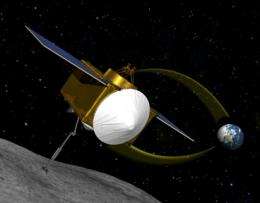
The asteroid 1999 RQ36 may not be a household name, but astronomers predict that in less than 200 years, it may make an unforgettable impact. According to radar and optical observations, the space rock, measuring some five football fields in diameter, has a 1 in 1,000 chance of crashing into Earth in the year 2182.
Astronomers are also interested in the asteroid's potential to reveal clues about Earth's origins. Based on spectral imaging data, 1999 RQ36 is likely made primarily of carbon and is a relatively untainted remnant of the early solar system, formed 4.56 billion years ago.
The asteroid is the target destination for OSIRIS-REx, a NASA spacecraft scheduled to launch in 2016. The spacecraft, being developed jointly by the University of Arizona, Lockheed Martin and NASA's Goddard Space Flight Center, aims to bring back a pristine sample of the asteroid by 2023. Now an instrument to be built by students from MIT and Harvard University may help the spacecraft determine where to find the oldest, purest asteroid samples.
NASA recently green-lighted a joint proposal by these MIT and Harvard students to build an X-ray imaging spectrometer, called REXIS (Regolith X-ray Imaging Spectrometer), to fly aboard OSIRIS-REx. The instrument will analyze the asteroid's surface for the presence of carbon, iron, oxygen and other life-forming elements.
"It's a chance to sample the original chemistry of everything that makes the Earth, and us," says Richard Binzel, professor of planetary sciences in MIT's Department of Earth, Atmospheric and Planetary Sciences, and an advisor to the student project. "So we're going to be very picky about trying to get the best sample possible."
The student instrument will accompany a suite of others aboard the spacecraft, including cameras that will map the asteroid's size, shape and surface composition. Other instruments will measure the effect of solar wind on the asteroid's orbit — information that may help astronomers plot the asteroid's path relative to the Earth.
David Miller, professor of space systems in MIT's Department of Aeronautics and Astronautics, says the project gives students a rare opportunity to "get their hands dirty" building space-ready hardware.
"In the early days of the space business, a lot of students got a chance to build stuff and launch it," Miller says. "These days, it's a very mature industry … and it's hard for students to really get the scars on their knuckles, trying to build these things."
The hands-on project will get under way this fall as part of the MIT Space Systems Engineering capstone class, co-taught by Miller along with Sara Seager, the Ellen Swallow Richards Professor of Extrasolar Planets, and Kerri Cahoy, assistant professor of aeronautics and astronautics. Students from both MIT and Harvard will be able to register for the class, and will likely fine-tune the design over several years.
Miller anticipates plenty of technical challenges along the way. For example, in order to get the best measurements, the X-ray spectrometer will be bolted to the outside of the spacecraft, meaning it will receive a high dose of radiation from the sun and cosmic rays on its trip to the asteroid. Longevity is also a concern: It will take four years for the spacecraft to reach its destination before it even begins to explore the asteroid's surface.
Miller plans to have the students build the instrument "multiple times, until we get it right." In the first year, students will design a functional mock-up of the instrument that is able to detect X-rays. In the second year, students will build a new and improved model, fit to the specifications of the main spacecraft. Miller says this model will then be put through a series of vibration tests that simulate launch conditions.
"The eight-minute ride to orbit is always the most dynamically harsh environment that any space vehicle feels," Miller says. "If it can survive well beyond those levels, we think we have a good design."
In the third year, students will engineer the flight unit — the instrument that will fly to the asteroid. In addition to the technical expertise students will gain through the project, Miller hopes they will learn some real-world lessons: They'll have to present progress reports to NASA and the OSIRIS-REx team, and deliver results on schedule.
Throughout the project, students from MIT and Harvard will work with scientists from MIT's Lincoln Laboratory and the Harvard College Observatory, as well as NASA and Lockheed Martin Space Systems in Denver.
"Going and bringing back this time capsule from the beginning of the solar system is absolutely a huge opportunity," Binzel says. "We launch in 2016, and the return is 2023, and by that time, students will be off doing other things, but they will always have a piece of this."
This story is republished courtesy of MIT News (web.mit.edu/newsoffice/), a popular site that covers news about MIT research, innovation and teaching.
Provided by Massachusetts Institute of Technology


