New Zealand's wayward penguin faces long swim home
June 29, 2011

New Zealand's wayward penguin faces long swim home (AP)

Enlarge

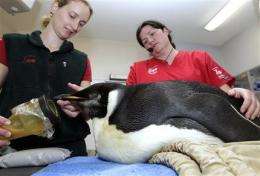
Wellington Zoo resident vet Dr. Baukje Lenting, left, and manager of veterinary science Dr. Lisa Argilla care for an Antarctic penguin that wound up stranded on a New Zealand beach at Wellington Zoo in Wellington, Wednesday, June 29, 2011. It may be months before the young emperor penguin - affectionately dubbed Happy Feet - fully recovers, and officials are uncertain about when or how it could return home about 2,000 miles (3,200 kilometers) away. (AP Photo/New Zealand Herald, Mark Mitchell) NEW ZEALAND OUT, AUSTRALIA OUT

(AP) -- A young emperor penguin that turned up on a New Zealand beach won't be getting a free ride all the way back to its Antarctic home - but the bird's human friends will at least help it get a little closer.

The penguin - affectionately dubbed Happy Feet - drew intense interest after being spotted on North Island's Peka Peka Beach, about 2,000 miles (3,200 kilometers) from its in Antarctica. The creature's health quickly declined when it began eating sand and sticks, but the bird is beginning to recover.

have been trying to figure out how the 3-foot (80 centimeter) -tall bird will return home. They initially dismissed the idea of transporting it to Antarctica because of logistical difficulties and the fear that it could transmit infections picked up during its New Zealand vacation to other penguins.

On Wednesday, an advisory group headed by the Department of Conservation decided officials will help the penguin get part of the way home by releasing it into the , southeast of New Zealand - and letting it swim the rest of the way.

"The reason for not returning the penguin directly to Antarctica is that emperor penguins of this age are usually found north of Antarctica on pack ice and in the ," the department's biodiversity spokesman Peter Simpson said.

The area where it will be released is on the northern edge of the region where young emperor penguins are known to live. Simpson said he was unsure how far the penguin would have to swim before reaching its final destination.

Happy Feet, nicknamed after the 2006 animated movie, was discovered on Peka Peka Beach last week - the first time an has been seen in the wild in New Zealand in 44 years. Experts aren't sure if it's male or female.

The penguin is recovering well at Wellington Zoo, where it underwent a on Monday to help flush out the sand it swallowed after apparently mistaking it for snow. Doctors managed to remove about half the sand from its digestive system, and zoo spokeswoman Kate Baker said X-rays showed the penguin was passing the rest of the sand naturally.

The creature appears to be doing well and is being kept in isolation in an air-conditioned room filled with large blocks of ice, Baker said.

"The plan from now on is to let him rest, feed him and X-ray him again on Friday or Saturday to see how much sand has passed," Baker said.

Officials are still hammering out logistics for the penguin's return trip home, and said it won't be released until its health has recovered. Until then, it will remain at the zoo.

©2011 The Associated Press. All rights reserved. This material may not be published, broadcast, rewritten or redistributed.


Rank not rated yet
Relevant PhysicsForums posts

More news stories

Scientist: Evolution debate will soon be history

(AP) -- Richard Leakey predicts skepticism over evolution will soon be history. Not that the avowed atheist has any doubts himself.

Biology / Evolution

created 14 hours ago | popularity 3.5 / 5 (14) | comments 33

More plant species responding to global warming than previously thought

(Phys.org) -- Far more wild plant species may be responding to global warming than previous large-scale estimates have suggested.

Biology / Ecology

created May 22, 2012 | popularity 4.6 / 5 (14) | comments 18 | with audio podcast

Thousands of shellfish found dead in Peru

Thousands of crustaceans were found dead off the coast of Lima following the mystery mass death of dolphins and pelicans, the Peruvian Navy said Friday.

Biology / Ecology

created May 26, 2012 | popularity 4.8 / 5 (4) | comments 7

For monogamous sparrows, it doesn't pay to stray (but they do it anyway)

It's quite common for a female song sparrow to stray from her breeding partner and mate with the male next door, but a new study shows that sleeping around can be costly.

Biology / Plants & Animals

created May 22, 2012 | popularity 5 / 5 (1) | comments 7 | with audio podcast

Study uncovers secret to speedy burrowing by razor clams

(Phys.org) -- If you look at a razor burrowing clam sitting in a bucket, you’d never guess that it could burrow itself down into the soil, much less do it with any speed. Razor clams look like fat straws, ...

Biology / Plants & Animals

created May 25, 2012 | popularity 1 / 5 (1) | comments 3 | with audio podcast report


Nvidia trumpets Tegra 3 phone design wins for 2012

(Phys.org) -- Nvidia’s competitive war paint has a name, Tegra 3. On the heels of Nvidia announcements about lowering costs of its Tegra 3 processors and Nvidia-enabled tablets running Android Ice Cream ...

Browser wars flare in mobile space

The browser wars are heating up again, but this time the fight is for dominance of the mobile Internet.

Dell tablet leak: 10.1-inch display, two-battery choice

(Phys.org) -- Headline after headline talks about vendors’ tablets in the wings as likely number-one contenders for the iPad. Such claims have justifiably been taken with a grain of salt, considering ...

Keep food safety in mind this memorial day weekend

(HealthDay) -- Picnics, parades and cookouts are as much a part of Memorial Day weekend as tributes to the United States' war veterans.

Family history of Alzheimer's affects functional connectivity

(HealthDay) -- Cognitively normal individuals with a family history of late-onset Alzheimer's disease (AD) may display lower resting state functional connectivity in the default mode network (DMN) of the brain, ...

Social welfare cuts ultimately come with heavy price, researchers say

(Phys.org) -- Slashing government funding for Medicaid, food stamps and other programs that serve the poor – while politically popular with some lawmakers and many conservatives – may do more harm ...