'Ultrawideband' could be future of medical monitoring
June 16, 2011

'Ultrawideband' could be future of medical monitoring

Enlarge

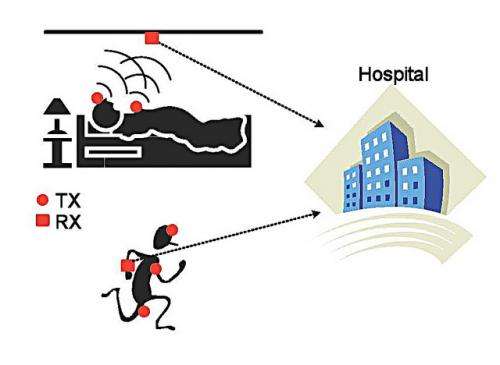
Body-area networks under development at Oregon State University may hold the future of medical monitoring. Data might first be transmitted at a low data rate to a local storage sensor, then received by a doctor at a high data rate. Such approaches may improve medical care, cut costs and help prevent or treat disease. (Graphic courtesy of Oregon State University)

New research by electrical engineers at Oregon State University has confirmed that an electronic technology called "ultrawideband" could hold part of the solution to an ambitious goal in the future of medicine – health monitoring with sophisticated "body-area networks."

Such networks would offer continuous, real-time health diagnosis, experts say, to reduce the onset of degenerative diseases, save lives and cut health care costs.

Some remote health monitoring is already available, but the perfection of such systems is still elusive.

The ideal device would be very small, worn on the body and perhaps draw its energy from something as minor as body heat. But it would be able to transmit vast amounts of health information in real time, greatly improve medical care, reduce costs and help to prevent or treat disease.

Sounds great in theory, but it's not easy. If it were, the X Prize Foundation wouldn't be trying to develop a Tricorder X Prize – inspired by the remarkable instrument of Star Trek fame – that would give $10 million to whoever can create a mobile wireless sensor that would give billions of people around the world better access to low-cost, reliable medical monitoring and diagnostics.

The new findings at OSU are a step towards that goal.
'Ultrawideband' could be future of medical monitoring
Enlarge

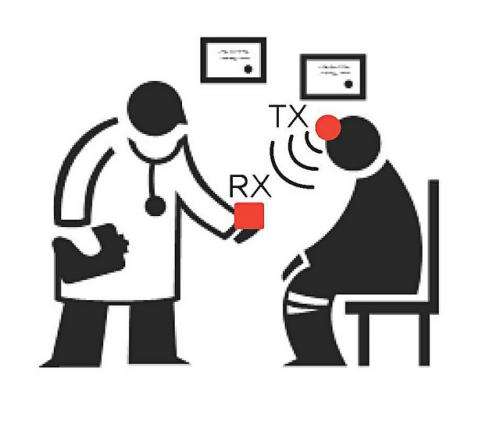
Body-area networks under development at Oregon State University may hold the future of medical monitoring. Data might first be transmitted at a low data rate to a local storage sensor, then received by a doctor at a high data rate. Such approaches may improve medical care, cut costs and help prevent or treat disease. (Graphic courtesy of Oregon State University)

"This type of sensing would scale a monitor down to something about the size of a bandage that you could wear around with you," said Patrick Chiang, an expert in wireless medical electronics and assistant professor in the OSU School of Electrical Engineering and Computer Science.

"The sensor might provide and transmit data on some important things, like heart health, bone density, blood pressure or insulin status," Chiang said. "Ideally, you could not only monitor issues but also help prevent problems before they happen. Maybe detect arrhythmias, for instance, and anticipate heart attacks. And it needs to be non-invasive, cheap and able to provide huge amounts of data."

Several startup companies such as Corventis and iRhythm have already entered the cardiac monitoring market.

According to the new analysis by OSU researchers, which was published in the EURASIP Journal on Wireless Communications and Networking, one of the key obstacles is the need to transmit large amounts of data while consuming very little energy.

They determined that a type of technology called "ultrawideband" might have that capability if the receiver getting the data were within a "line of sight," and not interrupted by passing through a human body. But even non-line of sight transmission might be possible using ultrawideband if lower transmission rates were required, they found. Collaborating on the research was Huaping Liu, an associate professor in School of Electrical Engineering and Computer Science.

"The challenges are quite complex, but the potential benefit is huge, and of increasing importance with an aging population," Chiang said. "This is definitely possible. I could see some of the first systems being commercialized within five years."

More information: http://ir.library. … e/1957/21692

Provided by Oregon State University search and more info website


Rank 5 /5 (1 vote)
Relevant PhysicsForums posts

More news stories

Browser wars flare in mobile space

The browser wars are heating up again, but this time the fight is for dominance of the mobile Internet.

Technology / Software

created 3 hours ago | popularity 5 / 5 (1) | comments 2

Probability of contamination from severe nuclear reactor accidents is higher than expected: study

Catastrophic nuclear accidents such as the core meltdowns in Chernobyl and Fukushima are more likely to happen than previously assumed. Based on the operating hours of all civil nuclear reactors and the number ...

Technology / Energy & Green Tech

created May 22, 2012 | popularity 3.6 / 5 (21) | comments 56 | with audio podcast

SpotterRF debuts Radar Backpack Kit (w/ Video)

(Phys.org) -- SpotterRF has announced a special radar backpack kit designed to enhance situational awareness for soldiers on the ground. The company says its special radar is designed for warfighters as part ...

Technology / Hi Tech & Innovation

created May 26, 2012 | popularity 5 / 5 (5) | comments 12 | with audio podcast report

HyperSolar shows dirty water no barrier to power world

(Phys.org) -- The Santa Barbara, California, company, HyperSolar, is set to transparently share the ups and downs of its research experiences toward the company’s ultimate vision, successfully producing ...

Technology / Energy & Green Tech

created May 24, 2012 | popularity 4.8 / 5 (15) | comments 17 | with audio podcast report

Tesla to launch electric sedan in US on June 22

Tesla Motors said Tuesday it would begin deliveries of "the world's first premium electric sedan" on June 22, slightly ahead of schedule.

Technology / Energy & Green Tech

created May 22, 2012 | popularity 4.5 / 5 (11) | comments 18


Nvidia trumpets Tegra 3 phone design wins for 2012

(Phys.org) -- Nvidia’s competitive war paint has a name, Tegra 3. On the heels of Nvidia announcements about lowering costs of its Tegra 3 processors and Nvidia-enabled tablets running Android Ice Cream ...

Scientist: Evolution debate will soon be history

(AP) -- Richard Leakey predicts skepticism over evolution will soon be history. Not that the avowed atheist has any doubts himself.

Dell tablet leak: 10.1-inch display, two-battery choice

(Phys.org) -- Headline after headline talks about vendors’ tablets in the wings as likely number-one contenders for the iPad. Such claims have justifiably been taken with a grain of salt, considering ...

Keep food safety in mind this memorial day weekend

(HealthDay) -- Picnics, parades and cookouts are as much a part of Memorial Day weekend as tributes to the United States' war veterans.

Family history of Alzheimer's affects functional connectivity

(HealthDay) -- Cognitively normal individuals with a family history of late-onset Alzheimer's disease (AD) may display lower resting state functional connectivity in the default mode network (DMN) of the brain, ...

Social welfare cuts ultimately come with heavy price, researchers say

(Phys.org) -- Slashing government funding for Medicaid, food stamps and other programs that serve the poor – while politically popular with some lawmakers and many conservatives – may do more harm ...