Twin-head cucumber system reduces start-up costs
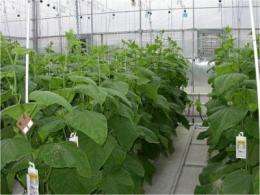
Cucumber plants looked the same 16 days after planting in both the twin-head (left row) and single-head (right row) systems. Credit: Photo by Xiuming Hao
Greenhouse vegetable production in North America has more than doubled in the past 10 years. While heavy investments have been made in modern greenhouses, improved cultivation technologies are essential for producers to realize the high productivity potential afforded by the improved facilities.
Gaining popularity in greenhouse vegetable production is a high-wire system in which cucumbers plants are trained into a single stem. The system allows for uniform foliar and light distribution and higher yield and quality, but requires much higher plant densities than the conventional "umbrella" system, often resulting in increased crop start-up costs. To help address these critical financial issues, researchers developed a new twin-head ''V'' high-wire cucumber system and compared it to the conventional single-head system. A report in HortTechnology detailed the performance of the twin-head system.
The researchers raised twin-head transplants by topping the seedlings after the appearance of the fourth true leaf; two strong lateral shoots were then allowed to develop and were trained into a ''V'' system after planting. Results of the 2-year experiments proved that the twin-head system achieved similar plant growth and fruit yield as the conventional single-head system on two long English seedless cucumber cultivars (Bodega and Myrthos) and two breeding lines. "While there was little difference in plant growth between the two systems, the twin-head system had a higher percentage of medium fruit and a lower percentage of small fruit than did the single-head system with cultivar 'Bodega' ", the scientists noted.
The twin-head system significantly reduced production costs. "The material and transportation costs for single-head and twin-head transplants were the same, but since the twin-head system used only half the number of transplants of the conventional single-head system, its transplant cost was reduced by almost half", explained the study's corresponding author Xiuming Hao.
"The twin-head ''V'' high-wire cucumber system achieved the same fruit yield as the conventional single-head system and also achieved better fruit grades in some cultivars while it significantly reduced transplant costs", concluded Hao. "In this research we have shown that the twin-head ''V'' high-wire cucumber system is a more cost-effective system than the conventional single head high-wire system."
More information: http://horttech.as … act/20/6/963
Provided by American Society for Horticultural Science
-
From lemons to lemonade: Reaction uses carbon dioxide to make carbon-based semiconductor,
32 comments
-
Thioridazine kills cancer stem cells in human while avoiding toxic side-effects of conventional cancer treatments,
3 comments
-
SpaceX private rocket blasts off for space station (Update),
42 comments
-
Climate scientists say they have solved riddle of rising sea,
31 comments
-
SpaceX capsule has 'new car' smell, astronauts say (Update),
2 comments
-
What would stain as translucent on light-coloured fabric?
14 hours ago
-
How do I identify different bacteria on culture plates?
May 26, 2012
-
Why Do Dogs do Strange things...
May 25, 2012
-
What does exophillic and endophillic mean in terms of mosquito and their control?
May 24, 2012
-
Semen stains glows under black lights (uv light)?
May 23, 2012
-
Question on Human Chromosome 2
May 23, 2012
- More from Physics Forums - Biology
More news stories
Scientist: Evolution debate will soon be history
(AP) -- Richard Leakey predicts skepticism over evolution will soon be history. Not that the avowed atheist has any doubts himself.
13 hours ago |
3.6 / 5 (12) |
31
Thousands of shellfish found dead in Peru
Thousands of crustaceans were found dead off the coast of Lima following the mystery mass death of dolphins and pelicans, the Peruvian Navy said Friday.
23 hours ago |
4.8 / 5 (4) |
7
More plant species responding to global warming than previously thought
(Phys.org) -- Far more wild plant species may be responding to global warming than previous large-scale estimates have suggested.
May 22, 2012 |
4.6 / 5 (14) |
18
|
For monogamous sparrows, it doesn't pay to stray (but they do it anyway)
It's quite common for a female song sparrow to stray from her breeding partner and mate with the male next door, but a new study shows that sleeping around can be costly.
May 22, 2012 |
5 / 5 (1) |
7
|
Study uncovers secret to speedy burrowing by razor clams
(Phys.org) -- If you look at a razor burrowing clam sitting in a bucket, youd never guess that it could burrow itself down into the soil, much less do it with any speed. Razor clams look like fat straws, ...
Nvidia trumpets Tegra 3 phone design wins for 2012
(Phys.org) -- Nvidias competitive war paint has a name, Tegra 3. On the heels of Nvidia announcements about lowering costs of its Tegra 3 processors and Nvidia-enabled tablets running Android Ice Cream ...
Browser wars flare in mobile space
The browser wars are heating up again, but this time the fight is for dominance of the mobile Internet.
Dell tablet leak: 10.1-inch display, two-battery choice
(Phys.org) -- Headline after headline talks about vendors tablets in the wings as likely number-one contenders for the iPad. Such claims have justifiably been taken with a grain of salt, considering ...
SpotterRF debuts Radar Backpack Kit (w/ Video)
(Phys.org) -- SpotterRF has announced a special radar backpack kit designed to enhance situational awareness for soldiers on the ground. The company says its special radar is designed for warfighters as part ...
SpaceX capsule has 'new car' smell, astronauts say (Update)
SpaceX's Dragon cargo vessel smells like a new car, said astronauts at the International Space Station after opening the hatches Saturday following the spacecraft's landmark mission to the orbiting lab.
Australia hails surprise super-telescope decision
Australia has hailed a surprise decision giving it a role in a radio telescope project aimed at revolutionising astronomy, vowing to draw on its decades of experience in space science.