Researchers discover 'superatoms' with magnetic shells
June 8, 2011

Researchers discover 'superatoms' with magnetic shells

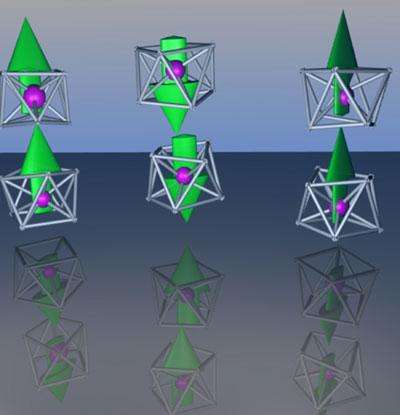
A proposed assembly of FeMg8 magnetic superatoms where the directions of magnetic moment is indicated by arrows. Image courtesy of Victor Medel/VCU.

(PhysOrg.com) -- A team of Virginia Commonwealth University scientists has discovered a new class of 'superatoms' – a stable cluster of atoms that can mimic different elements of the periodic table – with unusual magnetic characteristics.

The superatom contains magnetized magnesium atoms, an element traditionally considered as non-magnetic. The metallic character of magnesium along with infused magnetism may one day be used to create molecular electronic devices for the next generation of faster processors, larger memory storage and quantum computers.

In a study published online in the Early Edition of the , the team reports that the newly discovered cluster consisting of one iron and eight magnesium atoms acts like a tiny magnet that derives its strength from the iron and magnesium atoms. The combined unit matches the magnetic strength of a single iron atom while preferentially allowing electrons of specific spin orientation to be distributed throughout the cluster.

Through an elaborate series of theoretical studies, Shiv N. Khanna, Ph.D., a Commonwealth professor in the VCU Department of Physics, and his team examined the electronic and magnetic properties of clusters having one iron atom surrounded by multiple magnesium atoms. The team included instructor J. Ulises Reveles and Victor M. Medel, a post-doctoral associate, both from VCU; A. W. Castleman Jr., Ph.D., the Evan Pugh Professor of Chemistry and Physics, and Eberly Distinguished chair in Science in the Department of Chemistry at Penn State University; and Prasenjit Sen and Vikas Chauhan from the Harish-Chandra Research Institute in Allahabad, India.

"Our research opens a new way of infusing magnetic character in otherwise non-magnetic elements through controlled association with a single magnetic atom. An important objective was to discover what combination of atoms would lead to a species that is stable as we put multiple units together," said Khanna.

"The combination of magnetic and conducting attributes was also desirable. Magnesium is a good conductor of electricity and, hence, the superatom combines the benefit of magnetic character along with ease of conduction through its outer skin," he said.

The team found that when the cluster had eight magnesium atoms it acquired extra stability due to filled electronic shells that were far separated from the unfilled shells. An atom is in a stable configuration when its outermost shell is full and far separated from unfilled shells, as found in inert gas atoms. Khanna said that such phenomena commonly occur with paired electrons which are non-magnetic, but in this study the magnetic electronic shell showed stability.

According to Khanna, the new cluster had a magnetic moment of four Bohr magnetons, which is almost twice that of an iron atom in solid iron magnets. A magnetic moment is a measure of the magnetic strength of the cluster. Although the periodic table has more than one hundred elements, there are only nine elements that exhibit magnetic character in solid form.

"A combination such as the one we have created here can lead to significant developments in the area of "molecular electronics" where such devices allow the flow of electrons with particular spin orientation desired for applications such as quantum computers. These molecular devices are also expected to help make denser integrated devices, higher data processing, and other benefits," said Reveles.

Khanna and his team are conducting preliminary studies on the assemblies of the new superatoms and have made some promising observations that may have applications in spintronics. Spintronics is a process using electron spin to synthesize new devices for memory and data processing.

Provided by Virginia Commonwealth University search and more info website

Filter


Move the slider to adjust rank threshold, so that you can hide some of the comments.


Display comments: newest first

dirk_bruere
Jun 08, 2011

Rank: not rated yet
I am getting a strong feeling... maybe, just maybe, adding neodymium and boron to the iron might result in something interesting.
TheFlynn
Jun 08, 2011

Rank: 1 / 5 (7)
Sounds like they're just doing thought experiments... Nothing solid, yet. Must be fun having access to all this grant money.
Isaacsname
Jun 09, 2011

Rank: not rated yet
Could this research be used to reliably manufacture three-dimensional photonic crystals ? I need them for my spaceship....
DavidMcC
Jun 10, 2011

Rank: not rated yet
Could this research be used to reliably manufacture three-dimensional photonic crystals ? I need them for my spaceship....

You might also need them for their magnetic properties, to deflect cosmic rays.
BTW, where are you planning on going with your spaceship?
DavidMcC
Jun 10, 2011

Rank: not rated yet
... Oops, sorry, solar flares more than cosmic rays.
Rank 5 /5 (14 votes)
Relevant PhysicsForums posts

More news stories

Is a classical electrodynamics law incompatible with special relativity?

(Phys.org) -- The laws of classical electromagnetism that were developed in the 19th century are the same laws that scientists use today. They include Maxwell’s four equations along with the Lorentz la ...

Physics / General Physics

created May 24, 2012 | popularity 4.7 / 5 (16) | comments 42 | with audio podcast feature

Landmark calculation clears the way to answering how matter is formed

(Phys.org) -- An international collaboration of scientists, including Thomas Blum, associate professor of physics, is reporting in landmark detail the decay process of a subatomic particle called a kaon – ...

Physics / General Physics

created May 25, 2012 | popularity 4.2 / 5 (21) | comments 47 | with audio podcast

Lying in wait for WIMPs: Researchers seek to dramatically increase sensitivity of Large Underground Xenon detector

Although it's invisible, dark matter accounts for at least 80 percent of the matter in the universe. No one knows what it is, but most scientists would bet on weakly interacting massive particles, or WIMPs.

Physics / General Physics

created May 23, 2012 | popularity 4 / 5 (7) | comments 15 | with audio podcast

Hawaii lab turns laser-powered bubbles into microrobots

(Phys.org) -- A team of scientists from the University of Hawaii are working on microrobots created from bubbles of air in a saline solution. The bubbles take on their title of “robots” as a laser ...

Physics / General Physics

created May 23, 2012 | popularity 5 / 5 (4) | comments 2 | with audio podcast weblog

Sound increases the efficiency of boiling

Scientists at the Georgia Institute of Technology achieved a 17-percent increase in boiling efficiency by using an acoustic field to enhance heat transfer. The acoustic field does this by efficiently removing vapor bubbles ...

Physics / Soft Matter

created May 24, 2012 | popularity 5 / 5 (2) | comments 2


Nvidia trumpets Tegra 3 phone design wins for 2012

(Phys.org) -- Nvidia’s competitive war paint has a name, Tegra 3. On the heels of Nvidia announcements about lowering costs of its Tegra 3 processors and Nvidia-enabled tablets running Android Ice Cream ...

Browser wars flare in mobile space

The browser wars are heating up again, but this time the fight is for dominance of the mobile Internet.

Scientist: Evolution debate will soon be history

(AP) -- Richard Leakey predicts skepticism over evolution will soon be history. Not that the avowed atheist has any doubts himself.

Dell tablet leak: 10.1-inch display, two-battery choice

(Phys.org) -- Headline after headline talks about vendors’ tablets in the wings as likely number-one contenders for the iPad. Such claims have justifiably been taken with a grain of salt, considering ...

SpotterRF debuts Radar Backpack Kit (w/ Video)

(Phys.org) -- SpotterRF has announced a special radar backpack kit designed to enhance situational awareness for soldiers on the ground. The company says its special radar is designed for warfighters as part ...

SpaceX capsule has 'new car' smell, astronauts say (Update)

SpaceX's Dragon cargo vessel smells like a new car, said astronauts at the International Space Station after opening the hatches Saturday following the spacecraft's landmark mission to the orbiting lab.