The story behind Paolo's space station photos
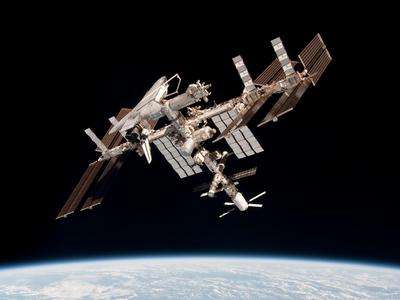
(PhysOrg.com) -- When the Soyuz TMA-20 spacecraft undocked from the International Space Station, ESA astronaut Paolo Nespoli had a special job to do: capture unique images of the orbital outpost with the Shuttle and Europe’s ATV ferry attached. Paolo tells us about those precious minutes.
Seen on a TV screen on 23 May, it all looked very easy and smooth: Soyuz stopped about 200 m away and the Station tilted to present a better view. Paolo took his photos through a small window in the Soyuz orbital module before returning to his seat in the descent module alongside crewmates Dmitri Kondratyev and Catherine Coleman for the landing.
“This was a complex and delicate manoeuvre that could have caused serious problems if not executed properly, but I felt it was worth the risk,” says Paolo, who had only few seconds to admire the view.
Complex undertaking for great photos
“Taking these pictures was not as straightforward as aiming the camera and shooting,” explains Paolo.
“When we undocked, we were already strapped in our seats wearing spacesuits. Our suits and the three hatches between the landing and orbital modules were leak-checked and normally after undocking the seals are not any more broken because retesting them costs oxygen – and there is not so much of it onboard.”
The only problem was that the window where the pictures needed to be taken was in the orbital module – already then partly depressurised.
Paolo had to remove his gloves, unstrap from his seat, carefully float to the hatch, repressurise the forward module and open the hatch.
“I had to slide over Dmitry, paying attention not to hit the manual controls, and go up to the orbital module where I had prepared the cameras before hatch closure.”
Paolo recorded stills and video, alternating them while paying attention to the composition: “The position of the Earth, the reflections on the glass of the window, and I had to make sure that the lens was in the centre of the window.
“I really prayed that these would be good, since I was conscious of their value. But what was done was done – and I quickly forgot them when I had to concentrate on redoing correctly the hatch and suit leak checks and pick up the reentry and landing procedures.”
Now feeling great
After the landing, Paolo looked exhausted when he was pulled from the Soyuz, but now he is feeling good. Staying in Houston, he is exercising two hours a day and his muscles are recovering.
“We have continued with collecting scientific data on how we are readapting to gravity, and we have already started the long series of technical debriefings.
“It’s good to be back and seeing in person my wife and my two year-old daughter, who is getting used to the fact that I have legs and don’t live inside a television set.”
For Paolo, taking the historic photos was an honour. “Since I was a kid, photography has been a hobby dear to me and all through my life photography had brought me to unusual places and made me live unexpected experiences.
“Like a photographer who has a gorgeous model in front of him, I was more concentrated on getting a good technical and artistic product than admiring it.
“I saw the view when changing from still to video images, but I purposely limited looking because I know I would have been mesmerised by the beauty of it.”
“Dreams are possible. We all should keep dreaming since even the most impossible dream sometimes can become a reality.”
Provided by European Space Agency


