Do steaks make you big?
June 15, 2011

Do steaks make you big?

Enlarge

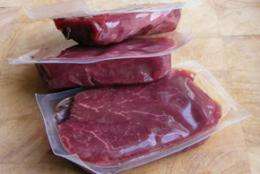
Credit: Footos Van Robin http://www.flickr.com/people/fotoosvanrobin/

(PhysOrg.com) -- Adjusting the intake of high protein foods like meat, eggs and milk products could determine whether you become a rugby player or marathon runner and may help you lose weight, according to new research published this month in the Journal of Biological Chemistry.

Dr. Stefan Broer, head of the molecular nutrition group in the ANU College of Medicine, Biology and Environment at The Australian National University, said the study by a group of ANU and Sydney researchers could potentially lead to the development of new weight-loss drugs.

“When it comes to controlling your , everybody thinks about reducing sugar and fat. But we also eat a lot of so we wanted to find out how it influences your body weight,” he said.

To investigate the problem, the team generated mice that could not digest protein as well as a normal mouse and measured a wide variety of physiological and physical properties.

“During digestion, your stomach and intestine breaks down protein into smaller subunits called amino acids,” Dr. Broer said.

“So we focused on mice that could not transport amino acids from the intestine into the cells of the body and therefore could not properly process proteins.

“One of the first things we noticed was that the animals were quite a bit smaller in size than normal mice, which suggests that eating more protein can increase our body size and possibly our sporting potential in the long term.

“When we gave these mice diets of different protein content, we found that they could not control their body weight, losing up to 20% in a couple of days. This indicates that varying protein intake in the short term affects our body weight.”

Dr. Broer said the study also revealed an influence of protein in our nutrition on insulin release, which controls the metabolism of sugar and fat in our bodies.

“This could explain some of the weight loss observed in the animals on different diets because we found that on a high protein diet a significant loss of fat occurred.

“This information may have potential in the future development of weight loss treatments.”

Provided by Australian National University

4.5 /5 (10 votes)  

Filter


Move the slider to adjust rank threshold, so that you can hide some of the comments.


Display comments: newest first

Feldhacker
Jun 15, 2011

Rank: 1.5 / 5 (2)
Wow, some of the worst conclusions of a poor study that I've ever seen.
wealthychef
Jun 15, 2011

Rank: 5 / 5 (2)
Wow, eating protein could help grow muscle? Who would ever have thought it? How about every muscle-head in every gym in the world already knows this? Why is this news? Maybe the article is just poorly written, or I'm missing some subtleties, but this seems obvious.
Au-Pu
Jun 15, 2011

Rank: 3 / 5 (1)
To the two meat heads above everyone knows that protein is necessary to build muscles because protein is made of amino acids what they have shown is that a high protein diet SIGNIFICANTLY reduces fat (that is without having to become a gym junkie) and that high protein diets effect insulin production, some thing that needs to be followed up.
Perhaps if the pair of you could develop a few neurons you may be better off as it may allow you to read and understand the articles.
jmcanoy1860
Jun 29, 2011

Rank: not rated yet
what they have shown is that a high protein diet SIGNIFICANTLY reduces fat.


Actually, weight loss with high protein diets is also well known. Look up any diet recommendation on the internet. The good ones not only recommend high protein for both muscle gain and weight loss but also will supply several references. The influence of protein (rather amino acids) on insulin levels is also well known. Rather, the lack of glucose, sucrose, and fructose. This is not new information.
cisono
Jul 03, 2011

Rank: not rated yet
Very poorly written article.
Rank 4.5 /5 (10 votes)
Relevant PhysicsForums posts
  • Gibbs Free Energy Change/Entropy
    created4 hours ago
  • What's the rule to covalent character
    created6 hours ago
  • Schwartz reagent-- NMR/MS/IR
    createdMay 26, 2012
  • High school chemistry EEI
    createdMay 25, 2012
  • oxidation of I- by KMnO4
    createdMay 25, 2012
  • Inversion temp
    createdMay 25, 2012
  • More from Physics Forums - Chemistry

More news stories

New CO2-removing catalyst can take the heat

(Phys.org) -- The current method of removing the greenhouse gas carbon dioxide (CO2) from the flues of coal-fired power plants uses so much energy that no one bothers to use it. So says Roger Aines, principal ...

Chemistry / Materials Science

created May 24, 2012 | popularity 5 / 5 (9) | comments 8 | with audio podcast

High-speed method to aid search for solar energy storage catalysts

Eons ago, nature solved the problem of converting solar energy to fuels by inventing the process of photosynthesis.

Chemistry / Materials Science

created May 25, 2012 | popularity 5 / 5 (3) | comments 4 | with audio podcast

Researchers demonstrate possible primitive mechanism of chemical info self-replication

(Phys.org) -- When scientists think about the replication of information in chemistry, they usually have in mind something akin to what happens in living organisms when DNA gets copied: a double-stranded molecule ...

Chemistry / Materials Science

created May 25, 2012 | popularity 5 / 5 (4) | comments 2 | with audio podcast

Building a better solar panel -- one molecule at a time

(Phys.org) -- One of the fundamental building blocks in modern chemistry, an organometallic chemical compound called ferrocene, has never been structurally defined - until now.

Chemistry / Materials Science

created May 25, 2012 | popularity 5 / 5 (3) | comments 0 | with audio podcast

Discarded data may hold the key to a sharper view of molecules

(Phys.org) -- There's nothing like a new pair of eyeglasses to bring fine details into sharp relief. For scientists who study the large molecules of life from proteins to DNA, the equivalent of new lenses have come in the ...

Chemistry / Biochemistry

created May 24, 2012 | popularity 4.7 / 5 (3) | comments 0 | with audio podcast


Nvidia trumpets Tegra 3 phone design wins for 2012

(Phys.org) -- Nvidia’s competitive war paint has a name, Tegra 3. On the heels of Nvidia announcements about lowering costs of its Tegra 3 processors and Nvidia-enabled tablets running Android Ice Cream ...

Browser wars flare in mobile space

The browser wars are heating up again, but this time the fight is for dominance of the mobile Internet.

Scientist: Evolution debate will soon be history

(AP) -- Richard Leakey predicts skepticism over evolution will soon be history. Not that the avowed atheist has any doubts himself.

Dell tablet leak: 10.1-inch display, two-battery choice

(Phys.org) -- Headline after headline talks about vendors’ tablets in the wings as likely number-one contenders for the iPad. Such claims have justifiably been taken with a grain of salt, considering ...

Keep food safety in mind this memorial day weekend

(HealthDay) -- Picnics, parades and cookouts are as much a part of Memorial Day weekend as tributes to the United States' war veterans.

Social welfare cuts ultimately come with heavy price, researchers say

(Phys.org) -- Slashing government funding for Medicaid, food stamps and other programs that serve the poor – while politically popular with some lawmakers and many conservatives – may do more harm ...