New species of deep-sea worms named as part of contest
June 15, 2011 By Jessica Crawford

New species of deep-sea worms named as part of contest

Enlarge

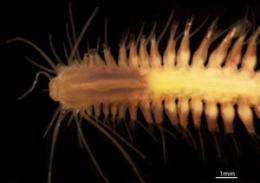
Podarkeopsis falenothiras

Fuzzicawuzzicus, Hispidafigulus, Imapickyeaterincali...

Ask the public’s help in naming two new of deep-sea worms, and you’re bound to get a few off-the-wall suggestions. These were some of the unique names submitted for Birch Aquarium at Scripps’ Name a Species Contest, which concluded last week.

After a week of online voting, a teenager from San Marcos and a first-grade classroom from La Jolla were chosen by the public to name the worms, recently discovered by researchers at UCSD's Scripps Institution of Oceanography. The winning names were announced at Birch Aquarium on World Oceans Day, June 8. They will become the official scientific names of the species.

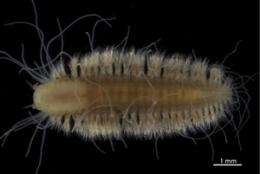
Laura McIntyre, 19, from San Diego, will name the deep-sea worm belonging to the genus Vrijenhoekia. McIntyre submitted the species name ketea, the Latin word for “sea monsters.” A first-grade classroom at The Children’s School in La Jolla was selected to name the second worm belonging to the genus Podarkeopsis. Students submitted the species name falenothiras, the Greek word for “whale hunter.”

“The more you can do to get the word out about marine animals, the better it is,” said McIntyre, who learned about the contest from a newspaper article. “I thought it was a really awesome way to do it for World Oceans Day.”
New species of deep-sea worms named as part of contest
Enlarge

Vrijenhoekia ketea

Traditionally, the person who first describes a newfound plant or animal is entitled to name it, but Scripps invited the public to share in the process. In May, more than 165 species names were submitted for the two worms. Names were received from 22 states as well as from Greece and Taiwan. Participants were asked to follow proper naming conventions as detailed in the International Code of Zoological Nomenclature, as well as provide a description of how they came up with their suggestion.

Scientists from the Scripps Marine Invertebrate Phylogenetics Lab, who discovered the species, selected three finalists for each species. Last week, more than 1,100 votes were cast for the finalists. Votes came in from a dozen countries, including Indonesia, Italy, Japan and South Africa.

“I thought it was a great opportunity to teach (the students) about how scientists name things, and they were all very excited,” Children’s School first-grade teacher Kim Lohnas said.

Scripps scientists, in association with the Monterey Bay Aquarium Research Institute, discovered the worms living upon whale carcasses that had fallen to the ocean floor off Monterey, Calif. These “whale falls” spawn unique communities of marine animals that can feed off the carcass for decades.

The worms, which measure only a few centimeters in length, are part of the family Hesionidae. Only 10 hesionids have been described from the deep sea, and only one has been described from a whale fall. In total, Scripps scientists discovered six new species of on whale falls.

First envisioned in 1992 at the Earth Summit in Rio de Janeiro, Day is an annual opportunity to honor our ocean and personal connection to the sea.

Provided by University of California - San Diego search and more info website


Rank not rated yet
Relevant PhysicsForums posts

More news stories

Scientist: Evolution debate will soon be history

(AP) -- Richard Leakey predicts skepticism over evolution will soon be history. Not that the avowed atheist has any doubts himself.

Biology / Evolution

created 15 hours ago | popularity 3.4 / 5 (16) | comments 46

More plant species responding to global warming than previously thought

(Phys.org) -- Far more wild plant species may be responding to global warming than previous large-scale estimates have suggested.

Biology / Ecology

created May 22, 2012 | popularity 4.6 / 5 (14) | comments 18 | with audio podcast

Thousands of shellfish found dead in Peru

Thousands of crustaceans were found dead off the coast of Lima following the mystery mass death of dolphins and pelicans, the Peruvian Navy said Friday.

Biology / Ecology

created May 26, 2012 | popularity 4.8 / 5 (4) | comments 7

For monogamous sparrows, it doesn't pay to stray (but they do it anyway)

It's quite common for a female song sparrow to stray from her breeding partner and mate with the male next door, but a new study shows that sleeping around can be costly.

Biology / Plants & Animals

created May 22, 2012 | popularity 5 / 5 (1) | comments 7 | with audio podcast

Study uncovers secret to speedy burrowing by razor clams

(Phys.org) -- If you look at a razor burrowing clam sitting in a bucket, you’d never guess that it could burrow itself down into the soil, much less do it with any speed. Razor clams look like fat straws, ...

Biology / Plants & Animals

created May 25, 2012 | popularity 1 / 5 (1) | comments 3 | with audio podcast report


Nvidia trumpets Tegra 3 phone design wins for 2012

(Phys.org) -- Nvidia’s competitive war paint has a name, Tegra 3. On the heels of Nvidia announcements about lowering costs of its Tegra 3 processors and Nvidia-enabled tablets running Android Ice Cream ...

Browser wars flare in mobile space

The browser wars are heating up again, but this time the fight is for dominance of the mobile Internet.

Dell tablet leak: 10.1-inch display, two-battery choice

(Phys.org) -- Headline after headline talks about vendors’ tablets in the wings as likely number-one contenders for the iPad. Such claims have justifiably been taken with a grain of salt, considering ...

Keep food safety in mind this memorial day weekend

(HealthDay) -- Picnics, parades and cookouts are as much a part of Memorial Day weekend as tributes to the United States' war veterans.

Social welfare cuts ultimately come with heavy price, researchers say

(Phys.org) -- Slashing government funding for Medicaid, food stamps and other programs that serve the poor – while politically popular with some lawmakers and many conservatives – may do more harm ...

Is a classical electrodynamics law incompatible with special relativity?

(Phys.org) -- The laws of classical electromagnetism that were developed in the 19th century are the same laws that scientists use today. They include Maxwell’s four equations along with the Lorentz la ...