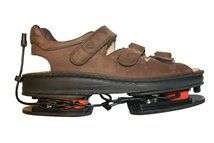
The smart shoe
Researchers from University of Twente's MIRA research institute, The Netherlands, have developed a shoe that can show exactly how a person walks. The shoe contains a range of sensors which measure the foot's movements and the forces exerted on the ground. The shoe has primarily been developed to help the rehabilitation of stroke patients who are coping with paralysis on one side of the body. In the long term, the researchers expect to achieve many more applications, for example in sport at the highest level. Xsens, a University of Twente spin-off company, is bringing the shoe onto the market.
Many patients who have suffered a stroke are left with a degree of paralysis on one side of the body. During their rehabilitation process, they often have to learn to walk all over again. For successful rehabilitation, it is useful to be able to determine exactly how someone is walking at a given moment. What precise movements are being made? How much force is being exerted on the ground and at which moments? Until now, such analysis could only take place at an expensive specialized movement laboratory. Such state-of-the-art facilities are few and far between.
Researchers from the University of Twente's MIRA research institute have now developed a shoe which contains all the technology needed to carry out such an analysis, enabling it to take place at any rehabilitation centre or nursing home. The shoe contains four sensor modules, at the heel and the front of the foot. In turn, these modules contain a range of sensors which measure such aspects as force and movement. The data collected by the shoe can be sent to a computer through a wireless connection.
The shoe has been developed by the University of Twente in cooperation with Xsens, a spin-off company of the university, and Roessingh Research and Development. Xsens is bringing the shoe onto the market under the name ForceShoe. In the years to come, within the framework of the European project Interaction, a new shoe will be developed which patients can also use at home in their everyday lives.
In addition to rehabilitation, Prof. Peter Veltink believes that a range of other applications are possible. "Ergonomics is an interesting area, for example. You can use the shoe to form an objective impression of the physical burden placed on people in their work situation. This is something that insurance companies are very interested in." Prof. Veltink also sees long-term possibilities in top-level sport. "But for this application we have to find a way to further reduce the size of the sensor modules. That's an innovation we are currently working on."
Provided by
University of Twente
-
From lemons to lemonade: Reaction uses carbon dioxide to make carbon-based semiconductor,
32 comments
-
Thioridazine kills cancer stem cells in human while avoiding toxic side-effects of conventional cancer treatments,
3 comments
-
SpaceX private rocket blasts off for space station (Update),
42 comments
-
Climate scientists say they have solved riddle of rising sea,
31 comments
-
SpaceX capsule has 'new car' smell, astronauts say (Update),
2 comments
-
Need a rigid insulation material???
12 hours ago
-
magnets or EMF in car bumpers to protect from fender bender
May 26, 2012
-
length of wire in a coil of known dimensions?
May 25, 2012
-
India Engineering Powerhouse
May 25, 2012
-
electromagnet core dereference between hard and soft iron
May 25, 2012
-
Measuring water pressure in an open tank
May 24, 2012
- More from Physics Forums - General Engineering
More news stories
Browser wars flare in mobile space
The browser wars are heating up again, but this time the fight is for dominance of the mobile Internet.
4 hours ago |
5 / 5 (1) |
2
Probability of contamination from severe nuclear reactor accidents is higher than expected: study
Catastrophic nuclear accidents such as the core meltdowns in Chernobyl and Fukushima are more likely to happen than previously assumed. Based on the operating hours of all civil nuclear reactors and the number ...
Technology / Energy & Green Tech
May 22, 2012 |
3.6 / 5 (22) |
56
|
SpotterRF debuts Radar Backpack Kit (w/ Video)
(Phys.org) -- SpotterRF has announced a special radar backpack kit designed to enhance situational awareness for soldiers on the ground. The company says its special radar is designed for warfighters as part ...
HyperSolar shows dirty water no barrier to power world
(Phys.org) -- The Santa Barbara, California, company, HyperSolar, is set to transparently share the ups and downs of its research experiences toward the companys ultimate vision, successfully producing ...
Tesla to launch electric sedan in US on June 22
Tesla Motors said Tuesday it would begin deliveries of "the world's first premium electric sedan" on June 22, slightly ahead of schedule.
Technology / Energy & Green Tech
May 22, 2012 |
4.5 / 5 (11) |
18
Nvidia trumpets Tegra 3 phone design wins for 2012
(Phys.org) -- Nvidias competitive war paint has a name, Tegra 3. On the heels of Nvidia announcements about lowering costs of its Tegra 3 processors and Nvidia-enabled tablets running Android Ice Cream ...
Scientist: Evolution debate will soon be history
(AP) -- Richard Leakey predicts skepticism over evolution will soon be history. Not that the avowed atheist has any doubts himself.
Dell tablet leak: 10.1-inch display, two-battery choice
(Phys.org) -- Headline after headline talks about vendors tablets in the wings as likely number-one contenders for the iPad. Such claims have justifiably been taken with a grain of salt, considering ...
Keep food safety in mind this memorial day weekend
(HealthDay) -- Picnics, parades and cookouts are as much a part of Memorial Day weekend as tributes to the United States' war veterans.
Social welfare cuts ultimately come with heavy price, researchers say
(Phys.org) -- Slashing government funding for Medicaid, food stamps and other programs that serve the poor while politically popular with some lawmakers and many conservatives may do more harm ...
Is a classical electrodynamics law incompatible with special relativity?
(Phys.org) -- The laws of classical electromagnetism that were developed in the 19th century are the same laws that scientists use today. They include Maxwell’s four equations along with the Lorentz la ...
.jpg)