New data still have scientists in dark over dark matter
June 7, 2011

New data still have scientists in dark over dark matter

Enlarge

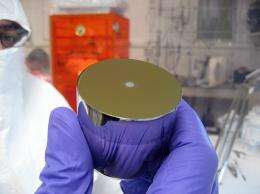
Juan Collar, associate professor in physics, holds one of the early germanium detector prototypes similar to the one being used in the Coherent Germanium Neutrino Technology (CoGeNT) experiment, situated nearly half a mile deep in the Soudan Mine in Minnesota. Such underground locations help screen out false dark-matter signals from other natural sources of radiation. Detectors of this kind are used because of their sensitivity to weak levels of radiation. Courtesy of CoGeNT Collaboration

(PhysOrg.com) -- A dark-matter experiment deep in the Soudan mine of Minnesota now has detected a seasonal signal variation similar to one an Italian experiment has been reporting for more than a decade.

The new , recorded by the Coherent Neutrino Technology (CoGeNT) experiment, is exactly what theoreticians had predicted if turned out to be what physicists call Weakly Interacting (WIMPs).

“We cannot call this a WIMP signal. It’s just what you might expect from it,” said Juan Collar, associate professor in physics at the University of Chicago. Collar and John Orrell of Pacific Northwest National Laboratory, who lead the CoGeNT collaboration, are submitting their results in two papers to Physical Review Letters.

WIMPS might have caused the signal variation, but it also might be a random fluctuation, a false reading sparked by the experimental apparatus itself or even some exotic new phenomenon in atomic physics, Collar said.

Dark matter accounts for nearly 90 percent of all matter in the universe, yet its identity remains one of the biggest mysteries of modern science. Although dark matter is invisible to telescopes, astronomers know it is there from the gravitational influence it exerts over galaxies.

Theorists had predicted that dark matter experiments would detect an annual modulation because of the relative motion of the Earth and sun with respect to the plane of the Milky Way galaxy.
New data still have scientists in dark over dark matter
Enlarge

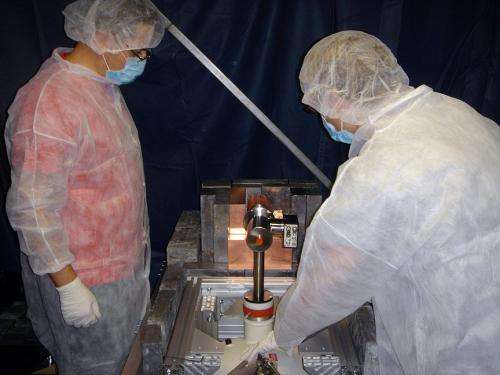
University of Chicago physicist Juan Collar (left) and University of Washington graduate student Mike Marino inspect the CoGeNT experiment at the Soudan Mine in Minnesota. CoGeNT has detected a seasonal signal variation during its first year of operation. This is what scientists would expect if dark matter is made of Weakly Interacting Massive Particles (WIMPs), but the CoGeNT collaboration considers the results to be inconclusive. Courtesy of CoGeNT Collaboration

The sun moves in the plane of the galaxy on the outskirts of one of its spiral arms at a speed of 220 kilometers per second (136 miles per second). The Earth orbits the sun at 15 kilometers per second (18.5 miles per second). During winter, Earth moves in roughly the opposite direction of the sun’s movement through the galaxy, but during summer, their motion becomes nearly aligned in the same direction. This alignment increases Earth’s net velocity through a galactic halo of dark matter particles, whose existence scientists have inferred from numerous astronomical observations.

Like a cloud of gnats

WIMPs would be moving in random directions in this halo, at velocities similar to the sun’s. “You find yourself in a situation similar to a car moving through a cloud of gnats,” Collar explained. “The faster the car goes, the more gnats will hit the front windshield.”

CoGeNT seems to have detected an average of one WIMP particle interaction per day throughout its 15 months of operation, with a seasonal variation of approximately 16 percent. Energy measurements are consistent with a WIMP mass of approximately 6 to 10 times the mass of a proton.

These results could be consistent with those of the Italian DArk MAtter (DAMA) experiment, which has detected a seasonal modulation for years. “We are in the very unfortunate situation where you cannot tell if we are barely excluding DAMA or barely in agreement. We have to clarify that,” Collar said.

In particle physics, he further cautioned, agreement between two or three experiments doesn’t necessarily mean much. The pentaquark is a case in point. Early this century, approximately 10 experiments found hints of evidence for the pentaquark, a particle consisting of five quarks, when no other known particle had more than three. But as time went on, new experiments were unable to see it.

“It’s just incredible,” said UChicago physics Professor Jonathan Rosner. “People still speculate on whether it’s real.”

Collar and his colleagues have calculated the probability that their finding is a fluke to be five-tenths of a percent, or 2.8 sigma in particle physics parlance.

“It’s not an exact science yet, unfortunately,” Collar said. “But with the information we have, the usual set of assumptions that we make about the halo and these particles, their behavior in this halo, things seem to be what you would expect.”

Other dark-matter experiments, including Xenon100, have not detected the seasonal signal that CoGeNT and DAMA have reported.

“If you really wanted to see an effect, you could argue that the Xenon100 people don’t have the sensitivity to Juan’s result,” said Rosner, who is not a member of the CoGeNT collaboration. “On the other hand, they’ve done a number of studies of what their sensitivity is at low energies and they believe they’re excluding this result.”

Interrupted by fire

CoGeNT operated from December 2009 until interrupted by a fire in the Soudan mine in March 2011. Fifteen months of data collection is a relatively brief period for a dark-matter experiment. In fact, Collar and his colleagues decided to examine the data now only because the fire had stopped the experiment, at least temporarily.

The fire did not directly affect the experiment, but the CoGeNT team has not been able to examine the detector because of clean-up efforts. The detector may no longer work, or if it does work, it may now have different properties.

“This effect that we’re seeing is touch-and-go. It’s something where you have to keep the detector exquisitely stable,” Collar said. If a single key characteristic of the detector has changed, such as its electronic noise, “We may be unable to look for this modulation with it from now on.”

The putative mass of the WIMP particles that CoGeNT possibly has detected ranges from six to 10 billion electron volts, or approximately seven times the mass of a proton. “To look for WIMPs 10 times heavier is hard enough. If they’re this light, it becomes a nightmare,” Collar said.

More information:
The papers are available at:

http://arxiv.org/abs/1106.0650
http://arxiv.org/abs/1106.0653

Provided by University of Chicago search and more info website

4.1 /5 (14 votes)  

Filter


Move the slider to adjust rank threshold, so that you can hide some of the comments.


Display comments: newest first

LKD
Jun 07, 2011

Rank: 4.9 / 5 (7)
"WIMPS might have caused the signal variation, but it also might be a random fluctuation, a false reading sparked by the experimental apparatus itself or even some exotic new phenomenon in atomic physics, Collar said."

I am always happy to see scientific principles being upheld and regarded honorably. Thank you for refraining from undo speculation or touted assumptions to perform honest scientific experiment.
El_Nose
Jun 07, 2011

Rank: not rated yet
this is another old story rehashed -- the first time i read this was last month -- i am sure it will come back up in a couple weeks with a new headline but the same information
Cave_Man
Jun 07, 2011

Rank: 1 / 5 (1)
I thought that college girl found all or most of the missing matter using some infrared telescope. Was I imagining it or was it missing matter and not dark matter??
LKD
Jun 07, 2011

Rank: 5 / 5 (3)
I thought that college girl found all or most of the missing matter using some infrared telescope. Was I imagining it or was it missing matter and not dark matter??


It was in regard to unconfirmed allocation of traditional matter. It doesn't account for Dark attraction observed in galaxies. They are separate problems, I am afraid.
Skultch
Jun 07, 2011

Rank: not rated yet
Could these detections be particles from the Sun instead of a galactic halo? Isn't the Earth closer to the Sun in the summer or winter, thereby intersecting more WIMP paths?
sigfpe
Jun 07, 2011

Rank: 5 / 5 (2)
Skultch,

The Earth is slightly closer to the sun in summer or winter (depending on whether you live in the Southern or Northern hemisphere) but it's only about 1% closer which wouldn't account for a 16% variation.
Vendicar_Decarian
Jun 07, 2011

Rank: not rated yet
And the relative phase in the yearly modulation of the two detectors is?

Are the detectors in phase, or out of phase?
MorituriMax
Jun 07, 2011

Rank: 2 / 5 (3)
During winter, Earth moves in roughly the opposite direction of the suns movement through the galaxy, but during summer, their motion becomes nearly aligned in the same direction. This alignment increases Earths net velocity through a galactic halo of dark matter particles, whose existence scientists have inferred from numerous astronomical observations.


Oh My God! They've discovered evidence of the aether!!!
TabulaMentis
Jun 07, 2011

Rank: not rated yet
From the article:
"Energy measurements are consistent with a WIMP mass of approximately 6 to 10 times the mass of a proton."


This is about what I would expect from a dark matter particle. I wonder where this leaves MACHOs and RAMBOs?
pupsik
Jun 08, 2011

Rank: 1 / 5 (1)
"In dark", correct. Theoretical astrophysics and cosmology are in the same state as history of the 20th Century, political science and freedom of speech.
Polemos
Jun 11, 2011

Rank: not rated yet
I have solved those problems long ago. See here: 2012wiki.com/index.php?title=The_end_of_the_world
Vendicar_Decarian
Jun 12, 2011

Rank: not rated yet
"I thought that college girl found all or most of the missing matter using some infrared telescope." - ahem

No, that was wrong. It turns out that in reality she just found the transcripts of her chats with a Wiener.
Rank 4.1 /5 (14 votes)
Relevant PhysicsForums posts
  • [Drift velocity] Factors affecting velocity
    created2 hours ago
  • does cold gasoline have less energy
    created2 hours ago
  • distribution of molecules throughout the atmosphere
    created4 hours ago
  • The Global Positioning System !
    created5 hours ago
  • A Question relating Power
    created6 hours ago
  • Writing a book so im learning about things, i have some general questions please read
    created9 hours ago
  • More from Physics Forums - General Physics

More news stories

Is a classical electrodynamics law incompatible with special relativity?

(Phys.org) -- The laws of classical electromagnetism that were developed in the 19th century are the same laws that scientists use today. They include Maxwell’s four equations along with the Lorentz la ...

Physics / General Physics

created May 24, 2012 | popularity 4.7 / 5 (16) | comments 42 | with audio podcast feature

Landmark calculation clears the way to answering how matter is formed

(Phys.org) -- An international collaboration of scientists, including Thomas Blum, associate professor of physics, is reporting in landmark detail the decay process of a subatomic particle called a kaon – ...

Physics / General Physics

created May 25, 2012 | popularity 4.2 / 5 (21) | comments 47 | with audio podcast

Lying in wait for WIMPs: Researchers seek to dramatically increase sensitivity of Large Underground Xenon detector

Although it's invisible, dark matter accounts for at least 80 percent of the matter in the universe. No one knows what it is, but most scientists would bet on weakly interacting massive particles, or WIMPs.

Physics / General Physics

created May 23, 2012 | popularity 4 / 5 (7) | comments 15 | with audio podcast

Hawaii lab turns laser-powered bubbles into microrobots

(Phys.org) -- A team of scientists from the University of Hawaii are working on microrobots created from bubbles of air in a saline solution. The bubbles take on their title of “robots” as a laser ...

Physics / General Physics

created May 23, 2012 | popularity 5 / 5 (4) | comments 2 | with audio podcast weblog

Sound increases the efficiency of boiling

Scientists at the Georgia Institute of Technology achieved a 17-percent increase in boiling efficiency by using an acoustic field to enhance heat transfer. The acoustic field does this by efficiently removing vapor bubbles ...

Physics / Soft Matter

created May 24, 2012 | popularity 5 / 5 (2) | comments 2


Nvidia trumpets Tegra 3 phone design wins for 2012

(Phys.org) -- Nvidia’s competitive war paint has a name, Tegra 3. On the heels of Nvidia announcements about lowering costs of its Tegra 3 processors and Nvidia-enabled tablets running Android Ice Cream ...

Browser wars flare in mobile space

The browser wars are heating up again, but this time the fight is for dominance of the mobile Internet.

Scientist: Evolution debate will soon be history

(AP) -- Richard Leakey predicts skepticism over evolution will soon be history. Not that the avowed atheist has any doubts himself.

Dell tablet leak: 10.1-inch display, two-battery choice

(Phys.org) -- Headline after headline talks about vendors’ tablets in the wings as likely number-one contenders for the iPad. Such claims have justifiably been taken with a grain of salt, considering ...

Keep food safety in mind this memorial day weekend

(HealthDay) -- Picnics, parades and cookouts are as much a part of Memorial Day weekend as tributes to the United States' war veterans.

Social welfare cuts ultimately come with heavy price, researchers say

(Phys.org) -- Slashing government funding for Medicaid, food stamps and other programs that serve the poor – while politically popular with some lawmakers and many conservatives – may do more harm ...