Time to let science drive Great Lakes policy on Asian carp, experts say
June 30, 2011

Time to let science drive Great Lakes policy on Asian carp, experts say

Enlarge

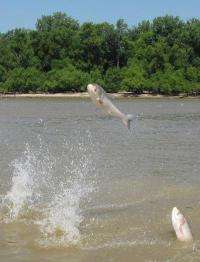
This is an Asian carp. Credit: LouisvilleUSAC (courtesy of Flickr Creative Commons)

The threat Asian carp pose to the Great Lakes community may be politically controversial, but pales in comparison to the costs and danger of continuing to wring hands over established facts. It's time, a Michigan State University fisheries expert says, to let science drive policy and put knowledge into action.

"You know it's big when academics and the management community say we don't need five more years of study," said Bill Taylor, University Distinguished professor in global fisheries sustainability at Michigan State University and a member of MSU's Center for Systems Integration and Sustainability. "The costs of hydrological separation are high, but it's a one-time expense and remediation in the Great Lakes from these will eventually make separation look cheap."

Taylor is one of four Great Lakes and researchers publishing a paper which breaks down four recent assertions that downplay the threat of the invasive Asian and questions the need to investigate ways to physically separate the Great Lakes and Mississippi River basins to prevent the further spread of harmful non-native species.

Dividing the Waters: The Case for Hydrologic Separation of the North American Great Lakes and Mississippi River Basins is published today in the Journal of Great Lakes Research. In addition to Taylor, it is authored by Jerry Rasmussen of Natural Resource Management Associates in Le Claire, Iowa; Henry Regier, University of Toronto; and Richard Sparks, a senior scientist at the National Great Rivers Research and Education Center, Godfrey, Ill.

The authors conclude that the threats posed by the Asian carp and other invasive species remain high and warrant action to prevent further ecological and economic harm to the Great Lakes ecosystem.

The paper examines recent claims by policy makers that:

  • Existing electric barriers are effective in preventing the spread of the Asian carp.
  • It is too late to prevent an Asian carp invasion.
  • Asian carp will not thrive in the Great Lakes.
  • Asian carp are not likely to cause serious damage to the Great Lakes.
Implications that more study is needed are exasperating the science community, Taylor said. Science has done its job by reaching thoughtful and clear conclusion. Now, he said, is a time for action – or at the least a clear decision not to take action.

"I am tired of studying what we already know is going to happen," Taylor said. "We've watched this coming on for 10 years. We know what's going to happen."

Taylor said science clearly points to the likelihood that invasive Asian carp, which are voracious feeders, will prove to be highly effective food competitors to native fish species. It's not the vast open areas of the Great Lakes he sees as threatened, but rather the lakes near shore areas, wetlands and tributaries – rivers that now serve as rich habitat for diverse and highly productive fish communities, including our economically important game fish.

"The are going to whack the tributaries," Taylor said. "They're going to eat all the food – they eat anything they get in their mouth and that means they'll eat the food base that our resident fish would normally eat. They will change the food web and dominate our streams and near shore regions in the basin."

Congress, according to the paper, can play an important role in addressing the invasive species problem by passing legislation mandating the U.S. Army Corps of Engineers to complete a study that offers a permanent solution based on the best scientific information and engineering technology available.

Provided by Michigan State University search and more info website

Filter


Move the slider to adjust rank threshold, so that you can hide some of the comments.


Display comments: newest first

TBW
Jun 30, 2011

Rank: 5 / 5 (1)
Study after study after study. All this fiddling while Rome burns is definitely pissing a lot of people off. Asian carp will completely destroy the great lakes sport fishery.
S_Bilderback
Jun 30, 2011

Rank: not rated yet
Why can't we have something like Walleye or Lake Trout be an invasive species? =(
Rank not rated yet
Relevant PhysicsForums posts

More news stories

Scientist: Evolution debate will soon be history

(AP) -- Richard Leakey predicts skepticism over evolution will soon be history. Not that the avowed atheist has any doubts himself.

Biology / Evolution

created 15 hours ago | popularity 3.4 / 5 (16) | comments 46

More plant species responding to global warming than previously thought

(Phys.org) -- Far more wild plant species may be responding to global warming than previous large-scale estimates have suggested.

Biology / Ecology

created May 22, 2012 | popularity 4.6 / 5 (14) | comments 18 | with audio podcast

Thousands of shellfish found dead in Peru

Thousands of crustaceans were found dead off the coast of Lima following the mystery mass death of dolphins and pelicans, the Peruvian Navy said Friday.

Biology / Ecology

created May 26, 2012 | popularity 4.8 / 5 (4) | comments 7

For monogamous sparrows, it doesn't pay to stray (but they do it anyway)

It's quite common for a female song sparrow to stray from her breeding partner and mate with the male next door, but a new study shows that sleeping around can be costly.

Biology / Plants & Animals

created May 22, 2012 | popularity 5 / 5 (1) | comments 7 | with audio podcast

Study uncovers secret to speedy burrowing by razor clams

(Phys.org) -- If you look at a razor burrowing clam sitting in a bucket, you’d never guess that it could burrow itself down into the soil, much less do it with any speed. Razor clams look like fat straws, ...

Biology / Plants & Animals

created May 25, 2012 | popularity 1 / 5 (1) | comments 3 | with audio podcast report


Nvidia trumpets Tegra 3 phone design wins for 2012

(Phys.org) -- Nvidia’s competitive war paint has a name, Tegra 3. On the heels of Nvidia announcements about lowering costs of its Tegra 3 processors and Nvidia-enabled tablets running Android Ice Cream ...

Browser wars flare in mobile space

The browser wars are heating up again, but this time the fight is for dominance of the mobile Internet.

Dell tablet leak: 10.1-inch display, two-battery choice

(Phys.org) -- Headline after headline talks about vendors’ tablets in the wings as likely number-one contenders for the iPad. Such claims have justifiably been taken with a grain of salt, considering ...

Keep food safety in mind this memorial day weekend

(HealthDay) -- Picnics, parades and cookouts are as much a part of Memorial Day weekend as tributes to the United States' war veterans.

Social welfare cuts ultimately come with heavy price, researchers say

(Phys.org) -- Slashing government funding for Medicaid, food stamps and other programs that serve the poor – while politically popular with some lawmakers and many conservatives – may do more harm ...

Is a classical electrodynamics law incompatible with special relativity?

(Phys.org) -- The laws of classical electromagnetism that were developed in the 19th century are the same laws that scientists use today. They include Maxwell’s four equations along with the Lorentz la ...