3 satellites see eruption of Puyehue-Cordon volcano from space
Jun 06, 2011
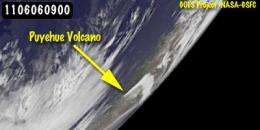
GOES-11 satellite image, taken on June 6 at 0900 UTC (5 a.m. EDT) from the farthest vantage point of any of the satellites, still showed the triangular-shaped plume, even from its position over the western US, despite the large distance. Credit: NASA/NOAA GOES Project, Dennis Chesters

NASA's Terra Satellite, the GOES-13 and GOES-11 satellites all captured images of the ash plume from southern Chile's Puyehue-Cordón Volcano this week. The volcano is located in Puyehue National Park in the Andes of Ranco Province of Chile.

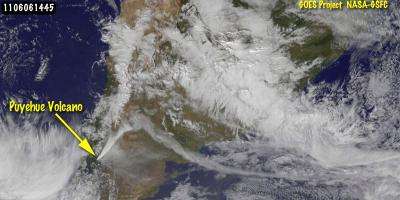
The flew over the volcano on June 6 at 14:25 UTC (10:25 a.m. EDT). The Moderate Resolution Imaging Spectroradiometer (MODIS) instrument captured a visible image of the eruption that showed the large ash plume blowing northeast, then to the southeast and over the Atlantic Ocean. The went at least as high as six miles on June 4 when it erupted, according to CNN International. Some 3,500 people were evacuated.
3 satellites see eruption of Puyehue-Cordón volcano from space
This image of the eruption of the Puyehue-Cordón Caulle volcano (left center), Chile was captured by the GOES-13 Satellite on June 6 at 14:45 UTC (10:45 a.m. EDT). The plume is blowing northeast, then turns toward the southeast and over the Atlantic Ocean. Credit: NASA/NOAA GOES Project, Dennis Chesters

The Geostationary Operational Environmental Satellites called GOES-13 and GOES-11 also captured images of the volcano from a different vantage point in space that revealed the plume was visible from even farther away.

GOES-13 monitors the eastern U.S. and the Atlantic Ocean, while GOES-11 monitors the western U.S. and eastern Pacific Ocean. The GOES-11 image, taken from the farthest vantage point of any of the satellites, still showed the triangular-shaped plume, even from its position over the western U.S., despite the large distance.

Explore further: Astonishing hi-resolution satellite views of the destruction from the Moore, Oklahoma tornado

add to favorites email to friend print save as pdf

Related Stories

Recommended for you

Strong earthquake at exceptional depth

May 24, 2013

This morning at 05:45 CEST, the earth trembled beneath the Okhotsk Sea in the Pacific Northwest. The quake, with a magnitude of 8.2, took place at an exceptional depth of 605 kilometers. Because of the great ...

Marine forecasting on the horizon for Indian Ocean Rim

May 24, 2013

Nearly all of the member countries of the Indian Ocean Rim Association for Regional Cooperation (IOR-ARC) will attend the week-long workshop to further cooperation and understanding on international ocean ...

Russia evacuates drifting Arctic research station

May 23, 2013

Russia has ordered the urgent evacuation of the 16-strong crew of a drifting Arctic research station after ice floe that hosts the floating laboratory began to disintegrate, officials said Thursday.

User comments : 0

More news stories

Galaxies fed by funnels of fuel

(Phys.org) —Computer simulations of galaxies growing over billions of years have revealed a likely scenario for how they feed: a cosmic version of swirly straws.

Century-old science helps confirm global warming

(Phys.org) —Ocean measurements taken more than 135 years ago during the scientific expedition of HMS Challenger have provided further confirmation of human-produced global warming over the past century.