GOES satellites see ash still spewing from Chilean volcano
June 29, 2011

GOES satellites see ash still spewing from Chilean volcano

Enlarge

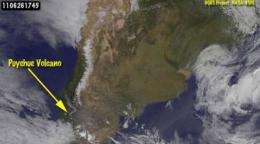
This GOES-13 image from June 26 at 23:45 UTC (7:35 p.m. EDT) shows the light brown ash plume from the Puyehue-Cordón volcano blowing north. Credit: (Credit: NASA/NOAA GOES Project, Dennis Chesters)

The Puyehue-Cordón volcano in Chile continues to spew ash that is still disrupting travel as far as Australia and New Zealand this week. A new animation of satellite imagery just released from the NASA/NOAA GOES Project shows the ash spewing from the volcano.

Satellite data from the Geostationary Operational Environmental Satellites called GOES-13 and GOES-11, both managed by NOAA, have been providing images of the volcanic plume since the eruption began on June 4, 2011. Those images were created at NASA's GOES Project located at NASA's Goddard Space Flight Center, Greenbelt, Md. The images were compiled into an animation and sped up to show several days worth of eruptions in less than a minute.

The animation begins on June 24 at 0039 UTC (June 23 8:39 p.m. EDT) and runs 22 seconds. In the animation, the ash plume originally appears very thin as it blows northward. As the time series continues, the plume thickens and blows to the northwest into the Pacific Ocean. The animation ends on June 26 at 23:45 UTC (7:35 p.m. EDT).

This video is not supported by your browser at this time.

This GOES-13 satellite imagery shows the Chilean caldera still emitting a steady stream of ash, three weeks after the initial eruption on June 4, 2011. The cold winter wind from the south carries it up the coast out over the Pacific, instead of over the Andes into Argentina. The video runs from June 24 through June 26, 2011. Credit: (Credit: NASA/NOAA GOES Project, Dennis Chesters)

Dennis Chesters of the NASA GOES Project noted of the animation, "The Chilean caldera still emits a steady stream of ash, three weeks after the initial eruption. Fortunately, the volume is much less, and the cold winter wind from the south carries it up the coast out over the Pacific, instead of over the Andes into Argentina."

According to CNN on June 28, the volcanic cloud was still affecting air travel in New Zealand, Australia. The eruptions of the Puyehue , located in Puyehue National Park in the Andes of Ranco Province of Chile have also caused flight delays and cancellations in Argentina, Brazil, Chile and Uruguay.

Provided by NASA's Goddard Space Flight Center search and more info website


Rank not rated yet
Tags

Relevant PhysicsForums posts

More news stories

Sophisticated simulations predict future warming

The chances of our planet being hit by a global warming of 3 degrees Celsius by 2050 is as likely as it being hit by an increase of 1.4 degrees, new research shows. Presented in the journal Nature Geoscience, the British study ...

Space & Earth / Earth Sciences

created May 22, 2012 | popularity 4.4 / 5 (9) | comments 51

Kyoto Protocol architect 'frustrated' by climate dialogue

UN climate talks are going nowhere, as politicians dither or bicker while the pace of warming dangerously speeds up, one of the architects of the Kyoto Protocol told AFP.

Space & Earth / Environment

created May 23, 2012 | popularity 3.7 / 5 (7) | comments 39

Aliens don't want to eat us, says former SETI director

Alien life probably isn’t interested in having us for dinner, enslaving us or laying eggs in our bellies, according to a recent statement by former SETI director Jill Tarter.

Space & Earth / Space Exploration

created May 25, 2012 | popularity 4.4 / 5 (13) | comments 37

Dragon arrives at space station in historic 1st (Update 2)

The privately bankrolled Dragon capsule made a historic arrival at the International Space Station on Friday, triumphantly captured by astronauts wielding a giant robot arm.

Space & Earth / Space Exploration

created May 25, 2012 | popularity 5 / 5 (10) | comments 19

What's the big deal about private space launches?

(AP) -- The first private spaceship is headed to the International Space Station. Some questions and answers about the cargo mission by Space Exploration Technologies, known as SpaceX:

Space & Earth / Space Exploration

created May 22, 2012 | popularity 5 / 5 (6) | comments 32


Nvidia trumpets Tegra 3 phone design wins for 2012

(Phys.org) -- Nvidia’s competitive war paint has a name, Tegra 3. On the heels of Nvidia announcements about lowering costs of its Tegra 3 processors and Nvidia-enabled tablets running Android Ice Cream ...

Browser wars flare in mobile space

The browser wars are heating up again, but this time the fight is for dominance of the mobile Internet.

Scientist: Evolution debate will soon be history

(AP) -- Richard Leakey predicts skepticism over evolution will soon be history. Not that the avowed atheist has any doubts himself.

Dell tablet leak: 10.1-inch display, two-battery choice

(Phys.org) -- Headline after headline talks about vendors’ tablets in the wings as likely number-one contenders for the iPad. Such claims have justifiably been taken with a grain of salt, considering ...

Keep food safety in mind this memorial day weekend

(HealthDay) -- Picnics, parades and cookouts are as much a part of Memorial Day weekend as tributes to the United States' war veterans.

Social welfare cuts ultimately come with heavy price, researchers say

(Phys.org) -- Slashing government funding for Medicaid, food stamps and other programs that serve the poor – while politically popular with some lawmakers and many conservatives – may do more harm ...