Rockin' tortoises: A 150-year-old new species
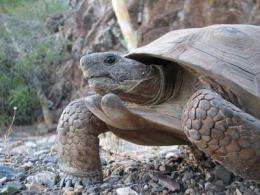
A team of researchers investigated a desert tortoise from the Southwest USA and northwestern Mexico. What was thought to be a simple problem in species identification turned out to be a very complex matter. Their investigations required forensic genetics and several other methods. In the end, they found it necessary to describe a new species. More than that, the discovery has very important implications for conservation and the development of the deserts of southern California.
Since the original description of Agassiz's Land Tortoise, scientifically called Gopherus agassizii, facts have been nothing less than Dazed and Confused. One hundred and fifty years ago in 1861, James Graham Cooper described a new species of tortoise from the deserts of California. From the get-go, factual confusion has been more common than not. The publication date has consistently been inappropriately attributed to 1863, and even the original common name, Agassiz Land Tortoise, was inexplicably changed to the Desert Tortoise, a moniker that is commonly used today. But there's more than just a new name.
For 150 years, Agassiz's Land Tortoise has been masking the existence of at least two species whose distributions are restricted to either side of the Colorado River. Prof. Bob Murphy of the Royal Ontario Museum, Toronto, Canada and the Kunming Institute of Zoology, Chinese Academy of Sciences, and colleagues from the US Geological Survey, Arizona Research Laboratories, California Academy of Sciences, and Lincoln University have now started to unravel a Gordian knot. As if coming straight out of an episode of the TV series CSI, they went into the laboratory and obtained DNA data from the original 150-year-old type specimen, as well as from a more recently described species inhabiting the tip of the Baja California peninsula. The effort in forensic genetics documented that the named species was from California, and not Arizona as sometimes claimed. The enigmatic species from Baja California was previously thought to be a transplant from Tiburon Island, Sonora, Mexico, but turns out to be from California, or at least its founding mother was from there. All of this meant that the population in Arizona and adjacent Mexico was an unnamed, new species, one whose identity had been hidden for more than a century.
The new rock-dwelling species, Gopherus morafkai, is named for the late Prof. David J. Morafka, a pioneer in tortoise research. The results of the research are published in the open access journal ZooKeys.
The recognition of Morafka's Desert Tortoise means that Agassiz's Desert Tortoise has lost a whopping 70 percent of its range! Arizona and adjacent Mexico can no longer serve as a genetic reservoir for the Western species. And given that the Western species was already listed as being threatened because of drastic decline in the number of individuals—a consequence of disease, urban expansion and habitat destruction—the description of the new species may turn up the heat on politicians and developers with respect to the massive construction of solar energy sites in prime Desert Tortoise habitat in the Mojave Desert. Perhaps this flagship centurion of the Southwest should be upgraded to Endangered status? Because Morafka's Desert Tortoise has lost 30% of its range, perhaps protection for this species should be fast-tracked? Only time will tell.
The complete story remains untold. The knot remains untied. It is possible that Morafka's Desert Tortoise may consist of two species. And so, back to the field and lab goes the team, inspired by knowing that Dave Morafka would be very pleased with the progress.
More information: dx.doi.org/10.3897/zookeys.1131353
Provided by Pensoft Publishers


