3 Questions: Richard Binzel on near-Earth asteroids
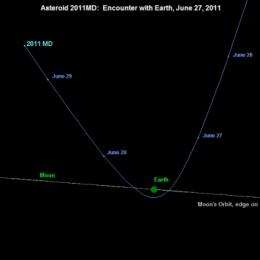
On Monday at approximately 1:14 p.m. EDT, an asteroid named 2011 MD will pass only 7,500 miles above Earth’s surface — a close call in astronomical terms. The asteroid was discovered only last week by researchers at MIT Lincoln Lab’s Near Earth Asteroid Research (LINEAR) project. Richard Binzel, a professor of planetary sciences at MIT, spoke with MIT News about such near-Earth objects and their potential to impact the planet.
Q. The asteroid 2011 MD has been reported to be about the size of a bus — or twice as large as previous asteroids that have been observed this close to Earth. What brings an asteroid of this size so close to Earth without making an impact?
A. Actually, asteroids of this size passing this close to Earth is relatively normal and the fact that they miss more often than hit is just good fortune — Earth is a relatively small target in the vastness of space. We expect that objects like this come by this close once every five to 10 years — very frequently by astronomical standards. Credit goes to the LINEAR program for their dedicated survey work that found this one. Even though Lincoln Lab astronomers and a very small number of other teams are working to scan the entire sky over the course of a month searching for incoming asteroids, the telescopes available for this work are rather modest in size and objects such as this might easily slip through the search network. Our Lincoln Lab colleagues have been surveying for more than a decade and it has been just a matter of time that an object like this one might be caught in their search pattern.
Q. What conditions would there have to be for an asteroid to actually collide with Earth, and how accurately can we predict such a future impact?
A. Once every 50 years or so, we do get hit by one of these — when the both Earth and the asteroid intersect in four dimensions: the three dimensions of space and the fourth dimension of time. Typically for a body of this size, the atmospheric entry breaks it up, resulting in a shower of meteorite samples. What’s amazing here is that this is the first time we have spotted one this size so many days in advance — and if it were on a collision course we would have been able to predict accurately the impact point (likely the South Pacific Ocean) several days in advance. In October 2008, an object roughly one-half this size was spotted on a collision course less than 24 hours in advance. The accuracy of the prediction for its impact point in the Sudan desert enabled the recovery of many kilograms of hand-sized meteorite fragments resulting from the object’s atmospheric breakup along the path of its impact trajectory.
Q. What observations might scientists make from Monday’s flyby? Is this a special opportunity that may give us new understanding of the solar system and its origins?
A. We are very interested to see just exactly how the path of this asteroid gets “bent” by Earth’s gravity as it passes by, so that we will know its trajectory on into the future for many years. One thing we might hope to find out is whether this asteroid gets “shaken up” during its close approach.
The object should pass close enough that Earth’s tidal forces will cause it to have an “asteroid quake” even though it misses Earth entirely. While we cannot detect any quakes directly, we might be able to measure whether the surface of the asteroid “shakes off” an older reddish coat of “sunburned” dust to reveal a more fresh and more bluish underlying layer. In more broad terms, we are extremely interested in what these objects are made of — if they are indeed leftover pieces from the time when Earth was formed. Sometimes these objects have measureable compositions resembling something we might have in our meteorite collections. Sometimes we are completely surprised. Each and every close-approaching asteroid gives us a new and exciting opportunity.
This story is republished courtesy of MIT News (web.mit.edu/newsoffice/), a popular site that covers news about MIT research, innovation and teaching.
Provided by Massachusetts Institute of Technology


