Recycling: A new source of indispensible 'rare earth' materials mined mainly in China
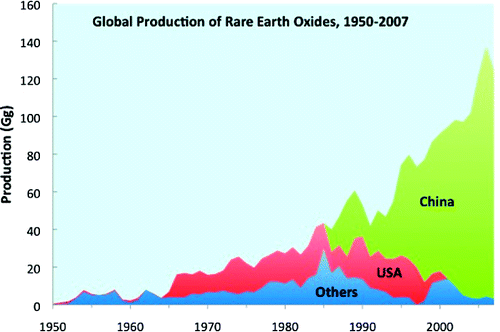
That axiom of sustainability -- "recycle and reuse" -- could help ease concerns about a reliable supply of substances, indispensible for a modern technological society, that are produced almost exclusively in the Peoples' Republic of China. That's the conclusion of a study on these so-called "rare earth" elements in the ACS journal Environmental Science & Technology.
Xiaoyue Du and Thomas E. Graedel note that the dozen-plus rare earth elements (REEs) have unique physical and chemical properties making them essential for defense applications, computers, cell phones, electric vehicles, batteries, appliances, fertilizers, liquid crystal displays, and other products. But there is growing concern about the supply, since only one country, China, is the major source. "Since 1990, China has played a dominant role in REE mining production; other countries are almost completely dependent on imports from China with respect to rare earth resources," the researchers state.
To determine how much recycling potential of the REEs from in-use products could add to the supply, they did the first analysis of the amount of REEs available in products in the United States, Japan, and China. Those countries are the major uses of REEs. The analysis concluded that nearly 99,000 tons REEs were included in products in 2007. This invisible stock, equivalent to more than 10 years of production, "suggests that REE recycling may have the potential to offset a significant part of REE virgin extraction in the future...and minimize the environmental challenges present in REE mining and processing," the report notes.
More information: Global In-Use Stocks of the Rare Earth Elements: A First Estimate, Environ. Sci. Technol., 2011, 45 (9), pp 40964101. DOI: 10.1021/es102836s
Abstract
Even though rare earth metals are indispensible in modern technology, very little quantitative information other than combined rare earth oxide extraction is available on their life cycles. We have drawn upon published and unpublished information from China, Japan, the United States, and elsewhere to estimate flows into use and in-use stocks for 15 of the metals: La, Ce, Pr, Nd, Sm, Eu, Gd, Tb, Dy, Ho, Er, Tm, Yb, Lu, and Y. Here, we show that the combined flows into use comprised about 90 Gg in 2007; the highest for individual metals were 28 Gg Ce and 22 Gg La, the lowest were 0.16 Gg Tm and 0.15 Gg Lu. In-use stocks ranged from 144 Gg Ce to 0.2 Gg Tm; these stocks, if efficiently recycled, could provide a valuable supplement to geological stocks.
Provided by
American Chemical Society
-
From lemons to lemonade: Reaction uses carbon dioxide to make carbon-based semiconductor,
32 comments
-
Thioridazine kills cancer stem cells in human while avoiding toxic side-effects of conventional cancer treatments,
3 comments
-
SpaceX private rocket blasts off for space station (Update),
42 comments
-
Climate scientists say they have solved riddle of rising sea,
31 comments
-
SpaceX capsule has 'new car' smell, astronauts say (Update),
2 comments
-
Hypothetical desert earth
12 hours ago
-
More human population = greater mass?
May 25, 2012
-
Conversion from aircraft bearing to normal degrees
May 23, 2012
-
Interpretation/Analysis of the Lab results(HEPA filter)
May 22, 2012
-
Has anyone here attended the The Urbino Summer School in Paleoclimatology?
May 22, 2012
-
Earthquakes: Mag 6 N. Italy and Mag 5.6 W. Bulgaria
May 21, 2012
- More from Physics Forums - Earth
More news stories
Sophisticated simulations predict future warming
The chances of our planet being hit by a global warming of 3 degrees Celsius by 2050 is as likely as it being hit by an increase of 1.4 degrees, new research shows. Presented in the journal Nature Geoscience, the British study ...
Space & Earth / Earth Sciences
May 22, 2012 |
4.4 / 5 (9) |
51
Kyoto Protocol architect 'frustrated' by climate dialogue
UN climate talks are going nowhere, as politicians dither or bicker while the pace of warming dangerously speeds up, one of the architects of the Kyoto Protocol told AFP.
May 23, 2012 |
3.7 / 5 (7) |
39
Aliens don't want to eat us, says former SETI director
Alien life probably isnt interested in having us for dinner, enslaving us or laying eggs in our bellies, according to a recent statement by former SETI director Jill Tarter.
Space & Earth / Space Exploration
May 25, 2012 |
4.4 / 5 (13) |
37
Dragon arrives at space station in historic 1st (Update 2)
The privately bankrolled Dragon capsule made a historic arrival at the International Space Station on Friday, triumphantly captured by astronauts wielding a giant robot arm.
Space & Earth / Space Exploration
May 25, 2012 |
5 / 5 (10) |
19
What's the big deal about private space launches?
(AP) -- The first private spaceship is headed to the International Space Station. Some questions and answers about the cargo mission by Space Exploration Technologies, known as SpaceX:
Space & Earth / Space Exploration
May 22, 2012 |
5 / 5 (6) |
32
Nvidia trumpets Tegra 3 phone design wins for 2012
(Phys.org) -- Nvidias competitive war paint has a name, Tegra 3. On the heels of Nvidia announcements about lowering costs of its Tegra 3 processors and Nvidia-enabled tablets running Android Ice Cream ...
Browser wars flare in mobile space
The browser wars are heating up again, but this time the fight is for dominance of the mobile Internet.
Scientist: Evolution debate will soon be history
(AP) -- Richard Leakey predicts skepticism over evolution will soon be history. Not that the avowed atheist has any doubts himself.
Dell tablet leak: 10.1-inch display, two-battery choice
(Phys.org) -- Headline after headline talks about vendors tablets in the wings as likely number-one contenders for the iPad. Such claims have justifiably been taken with a grain of salt, considering ...
Keep food safety in mind this memorial day weekend
(HealthDay) -- Picnics, parades and cookouts are as much a part of Memorial Day weekend as tributes to the United States' war veterans.
Social welfare cuts ultimately come with heavy price, researchers say
(Phys.org) -- Slashing government funding for Medicaid, food stamps and other programs that serve the poor while politically popular with some lawmakers and many conservatives may do more harm ...