What's in a name? Plenty, if you're a lesbian or gay parent
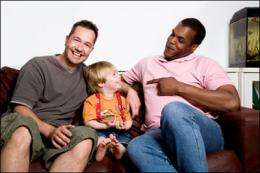
(PhysOrg.com) -- Visiting a park with their kids, it’s not uncommon for lesbian mothers to be asked by a stranger: “Which one of you is the real mom?” On a family outing, one gay dad is often taken to be the biological father, the other to be “just” a friend (or cousin, or uncle) tagging along.
How, then, do same-sex parents make it known that they are co-equal parents, ease strangers’ dis-ease, fend off excessive scrutiny or emphasize their family’s legitimacy?
Rafael Colonna, a Berkeley Ph.D. candidate interested in gender, sexuality and the sociology of the family, has been interviewing same-sex parents to answer such questions. In the process, he’s discovered that in family life, “small practices can have a lot of meaning behind them.”
The assigning of familial names and titles is one of the “small” arenas where same-sex parents attempt to navigate a “hetero-normative” world, he says. Some couples create a shared last name for themselves and for their kids. Others give their children the surname of the non-birth mother, thereby signaling that she is as “real” a parent as the biological mom, Colonna notes.
And since “Mommy” and “Daddy” don’t always fit as descriptors for both parents in a same-sex couple — in part because most prefer a unique term for each parent — lesbian and gay parents often pay close attention to how they name themselves within the family and in public.
For LGBT couples, “choosing how a child will refer to their parents — a task that for different-gendered couples may seem fairly straightforward — is fraught with important meanings to identity and recognition of family relationships,” says Colonna.
Families headed by lesbians or gay men “do not easily map” onto dominant notions of the family, he observes. So “very deliberate discussions come up around naming.” In the process, same-sex parents “end up dissecting a lot of the deep meanings that go with these names.” In U.S. society, to “father” a child, for instance, usually implies “a biological tie (siring a child),” he notes, while to “mother” carries connotations of care work and nurturance.
“Who gets to use the term ‘Mommy’ comes up a lot” in Colonna’s work. For lesbian moms, there’s often a conscious decision about who should take the “nurturing and affective” name “Mommy.”
Leaving Dodge
“Absolutely miserable” is how Colonna describes his high-school years in Lathrop, a small town in California’s San Joaquin Valley, in the late 1990s. Just weeks into his freshman year, Matthew Shepard was murdered in a highly publicized anti-gay hate crime; a year and a half later, California voters approved Prop 22, the so-called Knight Initiative, which restricted marriage to opposite-sex couples.
In the wake of those events, the atmosphere in school turned “very hostile and negative” toward gays, he recalls. “It was very scary.” Though he had come out to himself at 13, he shared that information with no one — telling himself that college, ideally somewhere far away, would be his chance to come out publicly. “That motivated me to look beyond community college. I became very studious.”
Colonna’s plan worked. He earned a scholarship to UC San Diego, a seven-hour drive south. There, he focused on biochemistry and bioinformatics — until an elective course in sociology changed his career path. “Sociology gave me a language to articulate my experiences as a gay male,” he says.
Soon he was researching LGBT family life for his senior thesis, looking at the division of labor in two-mom households. (Birth mothers were more likely to take primary responsibility for family financial matters and outdoor work, while their non-biological partners tended to take charge of childcare and housework, he found.)
Nurturing instinct
Colonna also became active in the San Diego queer community — for example helping to organize a safe prom for LGBT youth. As a grad student at Berkeley he’s remained committed to service, volunteering for the past three years on the Chancellor’s Advisory Committee on the LGBT Community at Cal, as well as the sociology department’s senior-honors program, where he mentors undergrad researchers, many of them working on LGBT-related projects. It was in recognition of these efforts that Colonna recently received a Markowski-Leach scholarship, given annually to gay and lesbian university students who are making important contributions to the LGBT community.
Now 26 and part of what he calls the “hot” field of LGBT sociological research, Colonna is crisscrossing the state this summer to speak with lesbian and gay parents — with the town of Lathrop among his destinations. “A fair amount of time has passed since I lived in the San Joaquin Valley,” he notes. “From talking to folks still living there, it sounds like the climate for LGBT people has slowly changed for the better. I’m curious what this means for queer parents living there.”
As for his own parenting plans, “I go really back and forth,” he says. Both Colonna and his partner are oldest children; these days his nurturing instincts are focused on his 10-year-old brother.
In good time, though, “I think we do want kids,” says Colonna. “Talking to gay parents who had kids at different ages has given me a much bigger appreciation about when children can come, in terms of one’s own life course.”
Provided by University of California - Berkeley


