New planets feature young star and twin Neptunes
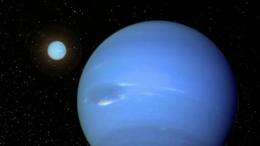
(PhysOrg.com) -- An international team, including Oxford University scientists, has discovered ten new planets. Amongst them is one orbiting a star perhaps only a few tens of million years old, twin Neptune-sized planets, and a rare Saturn-like world.
The planets were detected using the CoRoT (Convection, Rotation and Transits) space telescope, operated by the French space agency CNES. It discovers planets outside our solar system – exoplanets – when they ‘transit’, that is pass in front of their stars.
The new finds were announced on 14 June at the Second CoRoT Symposium, held in Marseille.
Out of the ten new exoplanets (CoRoT-16b through to 24b and c) seven are hot Jupiters some of which are unusually dense and/or on unusually elongated orbits, and one is in orbit around an unusually young star. The announcement also includes a planet slightly smaller than Saturn, and two Neptune-sized planets orbiting the same star.
Dr Suzanne Aigrain of Oxford University’s Department of Physics, lead UK scientist for CoRoT, said: ‘CoRoT-18b is special because its star might be quite young. Finding planets around young stars is particularly interesting because planets evolve very fast initially, before settling into a much steadier pattern of evolution.
‘If we want to understand the conditions in which planets form, we need to catch them within the first few hundred million years. After that, the memory of the initial conditions is essentially lost. In the case of CoRoT-18, different ways of determining the age give different results, but it's possible that the star might be only a few tens of millions of years old. If this is confirmed, then we could learn a lot about the formation and early evolution of hot gas giant planets by comparing the size of CoRoT-18b to the predictions of theoretical models.’
Another system of particular interest is CoRoT-24, which is around 4,400 light years from us and consists of a star just a little smaller than our Sun, orbited by two transiting planets.
‘The first of these planets is three times larger than the Earth, and takes 5.1 days to orbit the star, whilst the second is 4.8 times larger than the Earth and takes 11.8 days to complete an orbit. So these planets are similar to Neptune in size, but much hotter,’ said Dr Aigrain.
‘However, we don't know yet whether they are also similar to Neptune in composition, because even with the best instruments in the world, we could only obtain upper limits on their masses. It's the first system with two transiting planets found by CoRoT, and it ties in well with similar transiting planet systems found by the Kepler mission.’
Elsewhere CoRoT-22b is a rare example of a planet similar in size to Saturn. Located around 2,000 light years from us it takes about 10 days to orbit its star, which is slightly hotter than our Sun. Dr Aigrain said: ‘we have only an upper limit on its mass, but this is enough to determine that is density is not much more than that of Jupiter, which means it has a predominantly gaseous composition, although it could also contain significant quantities of rock and ice.’
Once CoRoT detects a transit, additional observations are made from the ground, using a number of telescopes all over the world. Although astronomers cannot see the planets directly, they use the space- and ground-based data to measure the sizes, masses, and orbits of these new planets precisely. This is why, among all known exoplanets, those with transits yield the most complete information about planet formation and evolution.
The new planets will also be presented at a seminar on June 15th at the Institute of Physics in London.
The 10 new planets are:
CoRoT-16b: A puffed-up short-period giant planet, with half the Jupiter mass and its full radius. It orbits in 5.3 days around a mature Sun-like star with an age of 6 billion years. The orbit of this planet is highly elongated which is rare for such an old, close-in planet.
CoRoT-17b: A massive giant planet around a star with an age of 10 billion years, or twice as old as our Sun. It orbits in 3.7 days, has 2.4 Jupiter masses and a density twice that of Jupiter. Observing such an old planetary system is important for understanding the long term evolution of giant planets.
CoRoT-18b: Unlike the previous CoRoT planets this “Hot Jupiter” orbits a young star that is a mere 600 million years old. This planet has a size 1.4 times that of Jupiter, but 3.5 times its mass. This planet is very dense, with almost twice the density of Jupiter.
CoRoT-19b: A planet with the same mass as Jupiter but 1.5 times the size. It has a density much less than that of Saturn, the least dense planet in our solar system.
CoRoT-20b: A “Hot Jupiter” in an eccentric orbit with a period of 9.2 days. CoRoT-20b is special because it has a very elongated orbit which may be related to its extremely high density. It has a density twice that of Mars, even though it is a gaseous giant planet.
CoRoT-21b: A giant gas planet with a size 1.3 times that of Jupiter and 2.5 times the mass. This is one of the faintest CoRoT stars for which the planet mass has been determined. These mass measurements required observations with the Keck 10m telescope in Hawaii, USA, the largest telescope in the world.
CoRoT-22b: This planet has a size of 0.74 radii that of Saturn. The mass of this exoplanet has yet to be determined precisely, but it is certainly less than half that of Saturn.
CoRoT-23b: A “Hot Jupiter” in a 3.6 day orbit.
CoRoT-24b and 24c: A system with two transiting planets of Neptune size in orbits of 5.1 and 11.8 days. The planets have sizes of 1 and 1.4 times that of Neptune, respectively.
More information: *Despite their best efforts, the team were not able to detect the radial velocity signatures of CoRoT-22b, 24b and 24c unambiguously. However, they were able to rule out almost every configuration of stars that could mimic a planet in the CoRoT data at high confidence.
Provided by Oxford University


