Phobos slips past Jupiter (w/ video)
Jun 17, 2011
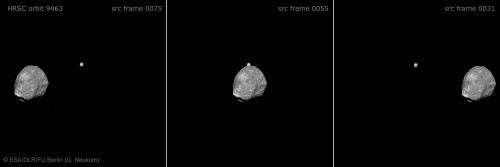
Three frames from the series of 104 taken by Mars Express during the Phobos-Jupiter conjunction on 1 June 2011. Credits: ESA/DLR/FU Berlin (G. Neukum)

(PhysOrg.com) -- Earlier this month, ESA's Mars Express performed a special manoeuvre to observe an unusual alignment of Jupiter and the martian moon Phobos. The impressive images have now been processed into a movie of this rare event.

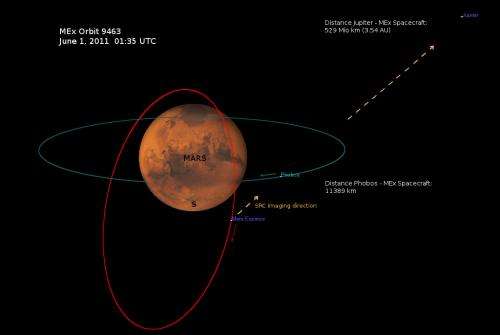
At the moment when Mars Express, Phobos, and Jupiter aligned on 1 June 2011, there was a distance of 11 389 km between the spacecraft and Phobos, and a further 529 million km to Jupiter.

This video is not supported by your browser at this time.
A movie of the encounter made by combining 100 images of the June 1, 2011 Phobos-Jupiter conjunction. The High Resolution Stereo Camera on Mars Express took this sequence. Credit: ESA/DLR/FU Berlin (G. Neukum)

The on Mars Express was kept fixed on Jupiter for the conjunction, ensuring that the planet remained static in the frame. The operation returned a total of 104 images over a period of 68 seconds, all of them taken using the camera's super-resolution channel.

By knowing the exact moment when Jupiter passed behind Phobos, the observation will help to verify and even improve our knowledge of the orbital position of the .

The trajectories of Phobos and Mars Express at the time of the conjunction with Jupiter on 1 June 2011. The graphic was created using Celestia software. The letter ‘S’ denotes the South Pole of Mars

The images shown here were processed at the Department of Planetary Sciences and Remote Sensing at the Institute of Geological Sciences of the Freie Universität Berlin.

Explore further: NASA head views progress on asteroid lasso mission

Related Stories

Pioneering images of both martian moons (w/ Video)

Dec 11, 2009

(PhysOrg.com) -- For the very first time, the martian moons Phobos and Deimos have been caught on camera together. ESA's Mars Express orbiter took these pioneering images last month. Apart from their ‘wow’ ...

Phobos flyby images (w/ Video)

Mar 15, 2010

Images from the recent flyby of Phobos, on 7 March 2010, are released today. The images show Mars' rocky moon in exquisite detail, with a resolution of just 4.4 metres per pixel. They show the proposed landing ...

Mars Express to rendezvous with Martian moon

Jul 16, 2008

(PhysOrg.com) -- Scientists and engineers are preparing ESA’s Mars Express for a pair of close fly-bys of the Martian moon Phobos. Passing within 100 km of the surface, Mars Express will conduct some of ...

Phobos flyby season starts again

Feb 16, 2010

(PhysOrg.com) -- Today Mars Express began a series of flybys of Phobos, the largest moon of Mars. The campaign will reach its crescendo on 3 March, when the spacecraft will set a new record for the closest ...

Scientists close in on the origin of Mars' larger moon

Oct 16, 2008

(PhysOrg.com) -- European space scientists are getting closer to unravelling the origin of Mars’ larger moon, Phobos. Thanks to a series of close encounters by ESA’s Mars Express spacecraft, the moon looks ...

Recommended for you

NASA head views progress on asteroid lasso mission

6 hours ago

Surrounded by engineers, NASA chief Charles Bolden inspected a prototype spacecraft engine that could power an audacious mission to lasso an asteroid and tow it closer to Earth for astronauts to explore.

Ecuador satellite collides with Russian space junk

6 hours ago

A small Ecuadoran satellite collided in orbit with the remains of a Russian rocket, but it is too soon to know how much damage it might have sustained, Quito's space agency said Thursday.

Forecast for Titan: Wild weather could be ahead

May 22, 2013

(Phys.org) —Saturn's moon Titan might be in for some wild weather as it heads into its spring and summer, if two new models are correct. Scientists think that as the seasons change in Titan's northern hemisphere, ...

SDO observes mid-level solar flare

May 22, 2013

UPDATE 16:30 p.m. EDT: The M7-class flare was also associated with a coronal mass ejection or CME, another solar phenomenon that can send billions of tons of particles into space. While this CME was not Ea ...

User comments : 4

Adjust slider to filter visible comments by rank

Display comments: newest first

panorama
not rated yet Jun 17, 2011
Isn't Mars supposed to lose one of its moons at some point in the future? Is it this one or both? Also, I wonder if at that point if humans are still around would we have the technology to fix the orbit? "Change the gravitational constant of the universe..."
Pyle
5 / 5 (5) Jun 17, 2011
unusual alignment
Funny to call something unusual when you purposefully line it up that way with "a special manoeuvre".
Pretty cool all the same.

Let's drink a round for one less belt miner meeting his demise due to poor oribital mechanics models.
Ramael
5 / 5 (1) Jun 17, 2011
Big woop, Phobos isn't even a real moon.

@panorama, yeah, one or both of mars's moons have unstable orbits, because they're both captured debris. Supposedly mars had dozens of these moons at one point. Probably from when the fifth rocky body broke up and formed the asteroid belt.
Going
not rated yet Jun 17, 2011
I seem to recall that Earth's Moon will eventually move out of orbit as it is picking up energy by slowing the rotation of the Earth through tidal friction.

More news stories

A hidden population of exotic neutron stars

(Phys.org) —Magnetars – the dense remains of dead stars that erupt sporadically with bursts of high-energy radiation - are some of the most extreme objects known in the Universe. A major campaign using ...

Hubble reveals the ring nebula's true shape

(Phys.org) —The Ring Nebula's distinctive shape makes it a popular illustration for astronomy books. But new observations by NASA's Hubble Space Telescope of the glowing gas shroud around an old, dying, ...

NASA head views progress on asteroid lasso mission

Surrounded by engineers, NASA chief Charles Bolden inspected a prototype spacecraft engine that could power an audacious mission to lasso an asteroid and tow it closer to Earth for astronauts to explore.

Controlling mood through the motions of mitochondria

(Medical Xpress)—Regulating the distribution of power in neurons is done by a system that makes the national electric grid look simple by comparison. Each neuron has several thousand mitochondria confined ...

A quantum simulator for magnetic materials

Physicists understand perfectly well why a fridge magnet sticks to certain metallic surfaces. But there are more exotic forms of magnetism whose properties remain unclear, despite decades of intense research. ...