ORNL neutrons, simulations reveal details of bioenergy barrier
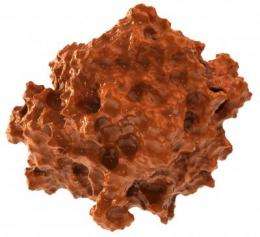
A first of its kind combination of experiment and simulation at the Department of Energy's Oak Ridge National Laboratory is providing a close-up look at the molecule that complicates next-generation biofuels.
Lignin, a major component of plant cell walls, aggregates to form clumps, which cause problems during the production of cellulosic ethanol. The exact shape and structure of the aggregates, however, have remained largely unknown.
A team led by ORNL's Jeremy Smith revealed the surface structure of lignin aggregates down to 1 angstrom—the equivalent of a 10 billionth of a meter or smaller than the width of a carbon atom. The team's findings were published in Physical Review E.
"We've combined neutron scattering experiments with large-scale simulations on ORNL's main supercomputer to reveal that pretreated softwood lignin aggregates are characterized by a highly folded surface," said Smith, who directs ORNL's Center for Molecular Biophysics and holds a Governor's Chair at University of Tennessee.
Lignin clumps can inhibit the conversion of biofuel feedstocks—for example, switchgrass—into ethanol, a renewable substitute for gasoline. When enzymes are used to release plant sugars necessary for ethanol production, the lignin aggregates bind to the enzymes and reduce the efficiency of the conversion.
Lignin's highly folded surface creates more opportunities to capture the passing enzymes than a smooth surface would. An improved understanding of the lignin aggregates will aid scientists in efforts to design a more effective pretreatment process, which in turn could lower the cost of biofuels.
"Nature has evolved a very sophisticated mechanism to protect plants against enzymatic attack," said ORNL team member Loukas Petridis. "We're trying to understand the physical basis of biomass recalcitrance—resistance of the plants to enzymatic degradation."
The complementary techniques of simulation on ORNL's Jaguar supercomputer and neutron scattering at the lab's High Flux Isotope Reactor enabled Smith's team to resolve lignin's structure at scales ranging from 1 to 1,000 angstroms. Smith's project is the first to combine the two methods in biofuel research. "This work illustrates how state-of-the-art neutron scattering and high-performance supercomputing can be integrated to reveal structures of importance to the energy biosciences," Smith said.
Provided by Oak Ridge National Laboratory


