'Odd couple' binary makes dual gamma-ray flares
June 29, 2011

'Odd couple' binary makes dual gamma-ray flares

Enlarge

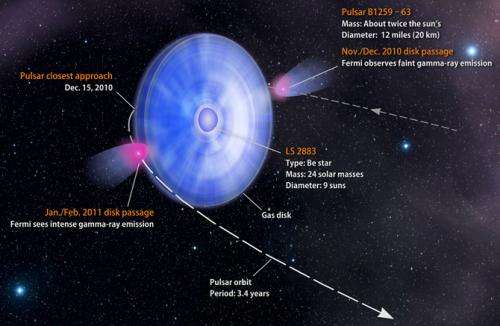
This diagram, which illustrates the view from Earth, shows the binary's anatomy as well as key events in the pulsar's recent close approach. Credit: NASA's Goddard Space Flight Center/Francis Reddy

(PhysOrg.com) -- In December 2010, a pair of mismatched stars in the southern constellation Crux whisked past each other at a distance closer than Venus orbits the sun. The system possesses a so-far unique blend of a hot and massive star with a compact fast-spinning pulsar. The pair's closest encounters occur every 3.4 years and each is marked by a sharp increase in gamma rays, the most extreme form of light.

The unique combination of stars, the long wait between close approaches, and periods of intense gamma-ray emission make this system irresistible to astrophysicists. Now, a team using NASA's Fermi Gamma-ray to observe the 2010 encounter reports that the system displayed fascinating and unanticipated activity.

"Even though we were waiting for this event, it still surprised us," said Aous Abdo, a Research Assistant Professor at George Mason University in Fairfax, Va., and a leader of the research team.

Few pairings in astronomy are as peculiar as high-mass binaries, where a hot blue-white star many times the sun's mass and temperature is joined by a compact companion no bigger than Earth -- and likely much smaller. Depending on the system, this companion may be a burned-out star known as a white dwarf, a city-sized remnant called a neutron star (also known as a ) or, most exotically, a black hole.

This video is not supported by your browser at this time.

Every 3.4 years, pulsar B1259-63 dives twice through the gas disk surrounding the massive blue star it orbits. With each pass, it produces gamma rays. During the most recent event, NASA's Fermi observed that the pulsar's gamma-ray flare was much more intense the second time it plunged through the disk. Astronomers don't yet know why. (Credit: NASA's Goddard Space Flight Center, Conceptual Image Lab)

Just four of these "odd couple" binaries were known to produce , but in only one of them did astronomers know the nature of the compact object. That binary consists of a pulsar designated PSR B1259-63 and a 10th-magnitude Be-type star known as LS 2883. The pair lies 8,000 light-years away.

The pulsar is a fast-spinning neutron star with a strong magnetic field. This combination powers a lighthouse-like beam of energy, which astronomers can easily locate if the beam happens to sweep toward Earth. The beam from PSR B1259-63 was discovered in 1989 by the Parkes radio telescope in Australia. The neutron star is about the size of Washington, D.C., weighs about twice the sun's mass, and spins almost 21 times a second.

The pulsar follows an eccentric and steeply inclined orbit around LS 2883, which weighs roughly 24 solar masses and spans about nine times its size. This hot blue star sits embedded in a disk of gas that flows out from its equatorial region.

At closest approach, the pulsar passes less than 63 million miles from its star -- so close that it skirts the gas disk around the star's middle. The pulsar punches through the disk on the inbound leg of its orbit. Then it swings around the star at closest approach and plunges through the disk again on the way out.

"During these disk passages, energetic particles emitted by the pulsar can interact with the disk, and this can lead to processes that accelerate particles and produce radiation at different energies," said study co-author Simon Johnston of the Australia Telescope National Facility in Epping, New South Wales. "The frustrating thing for astronomers is that the pulsar follows such an eccentric that these events only happen every 3.4 years."

In anticipation of the Dec. 15, 2010, closest approach, astronomers around the world mounted a multiwavelength campaign to observe the system over a broad energy range, from radio wavelengths to the most energetic gamma rays detectable. The observatories included Fermi and NASA's Swift spacecraft; the European space telescopes XMM-Newton and INTEGRAL; the Japan-U.S. Suzaku satellite; the Australia Telescope Compact Array; optical and infrared telescopes in Chile and South Africa; and the High Energy Stereoscopic System (H.E.S.S.), a ground-based observatory in Namibia that can detect gamma rays with energies of trillions of electron volts, beyond Fermi's range. (For comparison, the energy of visible light is between two and three electron volts.)

"When you know you have a chance of observing this system only once every few years, you try to arrange for as much coverage as you can," said Abdo, the principal investigator of the NASA-funded international campaign. "Understanding this system, where we know the nature of the compact object, may help us understand the nature of the compact objects in other, similar systems."

Despite monitoring of the system with the EGRET telescope aboard NASA's Compton Gamma-Ray Observatory in the 1990s, gamma-ray emission in the billion-electron-volt (GeV) energy range had never been seen from the binary.

Late last year, as the pulsar headed toward its massive companion, the Large Area Telescope (LAT) aboard Fermi discovered faint .

"During the first disk passage, which lasted from mid-November to mid-December, the LAT recorded faint yet detectable emission from the binary. We assumed that the second passage would be similar, but in mid-January 2011, as the pulsar began its second passage through the disk, we started seeing surprising flares that were many times stronger than those we saw before," Abdo said.

Stranger still, the system's output at radio and X-ray energies showed nothing unusual as the gamma-ray flares raged.

"The most intense days of the flare were Jan. 20 and 21 and Feb. 2, 2011," said Abdo. "What really surprised us is that on any of these days, the source was more than 15 times brighter than it was during the entire month-and-a-half-long first passage."

The study will appear in the July 20 issue of The Astrophysical Journal Letters and is available online.

"One great advantage of the Fermi LAT observations is the continuous monitoring of the source, which gives us the most complete gamma-ray observations of this system," said Julie McEnery, the project scientist at NASA's Goddard Space Flight Center in Greenbelt, Md.

Astronomers are continuing to analyze their bounty of data and working to understand the surprising flares. And in May 2014, when the pulsar once again approaches its giant companion, they'll be watching.

Provided by NASA's Goddard Space Flight Center search and more info website

Filter


Move the slider to adjust rank threshold, so that you can hide some of the comments.


Display comments: newest first

omatumr
Jun 29, 2011

Rank: 1 / 5 (8)
Thanks for continued news reports about gamma-ray flares and bipolar discharges.

If the universe is in fact powered by dynamic competition between neutron repulsion and gravitational forces of attraction, as now suspected [1], it seems reasonable to expect that these two opposing forces will produce maximum activity in the most densely compacted regions of space.

1. "Is the Universe Expanding?" [The Journal of Cosmology 13, 4187-4190 (2011)]

http://journalofc...102.html

With kind regards,
Oliver K. Manuel
AAhhzz01
Jul 08, 2011

Rank: 5 / 5 (1)
True enough Oliver.

However if the pulsar was gobbling down gas at the initial pass and solids (comets asteroids gravel whatever ) during the second portion of its pass, would not the increased density of the material lead to an increase in the gamma rays emitted? More matter captured, compressed and crashing on the surface of the pulsar = More gamma rays emitted?.

Just a thought...
omatumr
Jul 08, 2011

Rank: 1 / 5 (2)
True enough Oliver.

However if the pulsar was gobbling down gas at the initial pass and solids (comets asteroids gravel whatever ) during the second portion of its pass, would not the increased density of the material lead to an increase in the gamma rays emitted? More matter captured, compressed and crashing on the surface of the pulsar = More gamma rays emitted?.

Just a thought...


Thanks for the comment.

The fable of pulsars gobbling down gas was apparently invented because observations violated mainstream models of neutron stars as the "dead nuclear embers" of stars.

H. Heiselberg, Neutron Star Masses, Radii and Equation of State, in Proceedings of the
Conference on Compact Stars in the QCD Phase Diagram, eConf C010815, edited by R.
Ouyed and F. Sannion, Copenhagen, Denmark, Nordic Institute for Theoretical Physics
(2002) pp. 3-16, www.arxiv.org/abs...?0201465

Neutron repulsion energizes nuclei of atoms, stars and galaxies.

Oliver K. Manuel

Rank 4 /5 (4 votes)
Relevant PhysicsForums posts
  • revamping general concept and cosmological principle
    createdMay 25, 2012
  • Transiting Exoplanet Light Curve
    createdMay 25, 2012
  • Math behind Theoretical Physics
    createdMay 24, 2012
  • Do we know whats at the center of galaxies yet?
    createdMay 23, 2012
  • Structure of the Milky Way?
    createdMay 20, 2012
  • What would it take to terraform Pluto and Charon?
    createdMay 19, 2012
  • More from Physics Forums - General Astronomy

More news stories

Sophisticated simulations predict future warming

The chances of our planet being hit by a global warming of 3 degrees Celsius by 2050 is as likely as it being hit by an increase of 1.4 degrees, new research shows. Presented in the journal Nature Geoscience, the British study ...

Space & Earth / Earth Sciences

created May 22, 2012 | popularity 4.4 / 5 (9) | comments 51

Dragon arrives at space station in historic 1st (Update 2)

The privately bankrolled Dragon capsule made a historic arrival at the International Space Station on Friday, triumphantly captured by astronauts wielding a giant robot arm.

Space & Earth / Space Exploration

created May 25, 2012 | popularity 5 / 5 (10) | comments 19

Kyoto Protocol architect 'frustrated' by climate dialogue

UN climate talks are going nowhere, as politicians dither or bicker while the pace of warming dangerously speeds up, one of the architects of the Kyoto Protocol told AFP.

Space & Earth / Environment

created May 23, 2012 | popularity 3.7 / 5 (7) | comments 39

Aliens don't want to eat us, says former SETI director

Alien life probably isn’t interested in having us for dinner, enslaving us or laying eggs in our bellies, according to a recent statement by former SETI director Jill Tarter.

Space & Earth / Space Exploration

created May 25, 2012 | popularity 4.4 / 5 (13) | comments 37

What's the big deal about private space launches?

(AP) -- The first private spaceship is headed to the International Space Station. Some questions and answers about the cargo mission by Space Exploration Technologies, known as SpaceX:

Space & Earth / Space Exploration

created May 22, 2012 | popularity 5 / 5 (6) | comments 32


Nvidia trumpets Tegra 3 phone design wins for 2012

(Phys.org) -- Nvidia’s competitive war paint has a name, Tegra 3. On the heels of Nvidia announcements about lowering costs of its Tegra 3 processors and Nvidia-enabled tablets running Android Ice Cream ...

Browser wars flare in mobile space

The browser wars are heating up again, but this time the fight is for dominance of the mobile Internet.

Scientist: Evolution debate will soon be history

(AP) -- Richard Leakey predicts skepticism over evolution will soon be history. Not that the avowed atheist has any doubts himself.

Dell tablet leak: 10.1-inch display, two-battery choice

(Phys.org) -- Headline after headline talks about vendors’ tablets in the wings as likely number-one contenders for the iPad. Such claims have justifiably been taken with a grain of salt, considering ...

Keep food safety in mind this memorial day weekend

(HealthDay) -- Picnics, parades and cookouts are as much a part of Memorial Day weekend as tributes to the United States' war veterans.

Family history of Alzheimer's affects functional connectivity

(HealthDay) -- Cognitively normal individuals with a family history of late-onset Alzheimer's disease (AD) may display lower resting state functional connectivity in the default mode network (DMN) of the brain, ...