Nanowire-based sensors offer improved detection of volatile organic compounds
June 22, 2011

Nanowire-based sensors offer improved detection of volatile organic compounds

Enlarge

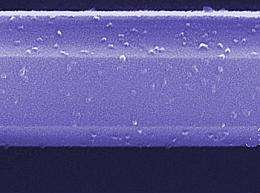
Scanning electron microscope image of a gas sensor segment fabricated of a semiconducting nanowire of gallium nitride. The nanowire of less than 500 nanometers across is coated with nanoclusters of titanium dioxide, which alters the current in the nanowire in the presence of a volatile organic compound and ultraviolet light. Credit: NIST

(PhysOrg.com) -- A team of researchers from the National Institute of Standards and Technology (NIST), George Mason University and the University of Maryland has made nano-sized sensors that detect volatile organic compounds -- harmful pollutants released from paints, cleaners, pesticides and other products -- that offer several advantages over today's commercial gas sensors, including low-power room-temperature operation and the ability to detect one or several compounds over a wide range of concentrations.

The recently published work is proof of concept for a made of a single nanowire and metal oxide nanoclusters chosen to react to a specific organic compound. This work is the most recent of several efforts at NIST that take advantage of the unique properties of nanowires and metal oxide elements for sensing dangerous substances.

Modern commercial are made of thin, conductive films of . When a volatile organic compound like benzene interacts with , for example, a reaction alters the current running through the film, triggering an alarm. While thin-film are effective, many must operate at temperatures of 200° C (392° F) or higher. Frequent heating can degrade the materials that make up the films and contacts, causing reliability problems. In addition, most thin-film sensors work within a narrow range: one might catch a small amount of toluene in the air, but fail to sniff out a massive release of the gas. The range of the new nanowire sensors runs from just 50 parts per billion up to 1 part per 100, or 1 percent of the air in a room.

These new sensors, built using the same fabrication processes that are commonly used for silicon computer chips, operate using the same basic principle, but on a much smaller scale: the gallium nitride wires are less than 500 nanometers across and less than 10 micrometers in length. Despite their microscopic size, the and titanium dioxide nanoclusters they're coated with have a high surface-to-volume ratio that makes them exquisitely sensitive.

"The electrical current flowing through our nanosensors is in the microamps range, while traditional sensors require milliamps," explains NIST's Abhishek Motayed. "So we're sensing with a lot less power and energy. The nanosensors also offer greater reliability and smaller size. They're so small that you can put them anywhere." Ultraviolet light, rather than heat, promotes the titanium dioxide to react in the presence of a volatile organic compound.

Further, each nanowire is a defect-free single crystal, rather than the conglomeration of crystal grains in thin-film sensors, so they're less prone to degradation. In reliability tests over the last year, the nano-sized sensors have not experienced failures. While the team's current experimental sensors are tuned to detect benzene as well as the similar toluene, ethylbenzene and xylene, their goal is to build a device that includes an array of and various metal oxide nanoclusters for analyzing mixtures of compounds. They plan to collaborate with other NIST teams to combine their ultraviolet light approach with heat-induced nanowire sensing technologies.

More information: G.S. Aluri, A. Motayed, A.V. Davydov, V.P. Oleshko, K.A. Bertness, N.A. Sanford and M.V. Rao. Highly selective GaN-nanowire/TiO2-nanocluster hybrid sensors for detection of benzene and related environment pollutants. Nanotechnology. 22 295503 doi: 10.1088/0957-4484/22/29/295503

Provided by National Institute of Standards and Technology search and more info website


Rank not rated yet
Relevant PhysicsForums posts
  • distribution of molecules throughout the atmosphere
    created2 hours ago
  • The Global Positioning System !
    created3 hours ago
  • A Question relating Power
    created4 hours ago
  • Writing a book so im learning about things, i have some general questions please read
    created6 hours ago
  • Question about induced E field.
    created7 hours ago
  • Charging a capacitor in a tesla coil
    created7 hours ago
  • More from Physics Forums - General Physics

More news stories

In nanorod crystal growth, nanoparticles seen as artificial atoms

In the growth of crystals, do nanoparticles act as "artificial atoms" forming molecular-type building blocks that can assemble into complex structures? This is the contention of a major but controversial theory ...

Nanotechnology / Nanophysics

created May 24, 2012 | popularity 4.8 / 5 (6) | comments 0 | with audio podcast

First direct observation of oriented attachment in nanocrystal growth

Berkeley Lab researchers have reported the first direct observation of nanoparticles undergoing oriented attachment, the critical step in biomineralization and the growth of nanocrystals. A better understanding ...

Nanotechnology / Nanophysics

created May 24, 2012 | popularity 4.7 / 5 (3) | comments 0 | with audio podcast

Dopant gives graphene solar cells highest efficiency yet

(Phys.org) -- By taking advantage of graphene’s favorable electrical and optical properties, and then adding an organic dopant, researchers have achieved the highest power conversion efficiency yet for ...

Nanotechnology / Nanophysics

created May 21, 2012 | popularity 5 / 5 (10) | comments 14 | with audio podcast feature

Synthetic nano-waste does not disappear

(Phys.org) -- Tiny particles of cerium oxide do not burn or change in the heat of a waste incineration plant. They remain intact on combustion residues or in the incineration system, as a new study by Swiss ...

Nanotechnology / Bio & Medicine

created May 25, 2012 | popularity 5 / 5 (2) | comments 1 | with audio podcast

'Metamaterials,' quantum dots show promise for new technologies

(Phys.org) -- Researchers are edging toward the creation of new optical technologies using "nanostructured metamaterials" capable of ultra-efficient transmission of light, with potential applications including ...

Nanotechnology / Nanophysics

created May 24, 2012 | popularity 5 / 5 (7) | comments 1 | with audio podcast


Nvidia trumpets Tegra 3 phone design wins for 2012

(Phys.org) -- Nvidia’s competitive war paint has a name, Tegra 3. On the heels of Nvidia announcements about lowering costs of its Tegra 3 processors and Nvidia-enabled tablets running Android Ice Cream ...

Browser wars flare in mobile space

The browser wars are heating up again, but this time the fight is for dominance of the mobile Internet.

Scientist: Evolution debate will soon be history

(AP) -- Richard Leakey predicts skepticism over evolution will soon be history. Not that the avowed atheist has any doubts himself.

Dell tablet leak: 10.1-inch display, two-battery choice

(Phys.org) -- Headline after headline talks about vendors’ tablets in the wings as likely number-one contenders for the iPad. Such claims have justifiably been taken with a grain of salt, considering ...

SpotterRF debuts Radar Backpack Kit (w/ Video)

(Phys.org) -- SpotterRF has announced a special radar backpack kit designed to enhance situational awareness for soldiers on the ground. The company says its special radar is designed for warfighters as part ...

SpaceX capsule has 'new car' smell, astronauts say (Update)

SpaceX's Dragon cargo vessel smells like a new car, said astronauts at the International Space Station after opening the hatches Saturday following the spacecraft's landmark mission to the orbiting lab.