Researchers develop integrated nanomechanical sensor for atomic force microscopy
Jun 02, 2011
Researchers develop integrated nanomechanical sensor for atomic force microscopy
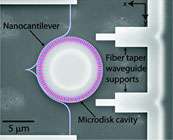
Scanning electron micrograph of the cantilever-microdisksystem. The image has a calculated z-component of the magnetic field overlaid on the structure. 

(PhysOrg.com) -- The atomic force microscope (AFM) is an important tool for nanoscale surface metrology. Typical AFMs map local tip-surface interactions by scanning a flexible cantilever probe over a surface. They rely on bulky optical sensing instrumentation to measure the motion of the probe, which limits the sensitivity, stability, and accuracy of the microscope, and precludes the use of probes much smaller than the wavelength of light.

As reported in , CNST researchers have fabricated a novel integrated sensor combining a nanomechanical cantilever probe with a nanophotonic on a single . Replacing the bulky laser detection system allowed them to build cantilevers orders of magnitude smaller than those used in conventional AFMs.

Because each of these smaller structures has an effective mass less than a picogram, the detection bandwidth is dramatically increased, reducing the system response time to a few hundred nanoseconds.

While probe was kept comparable to conventional microcantilevers in order to maintain high mechanical gain (how much the tip moves when it senses a force change), the probe size was reduced to a mere 25 µm in length, 260 nm in thickness, and only 65 nm in width.

Readout is based on “cavity optomechanics”, with the probe fabricated adjacent to a microdisk optical cavity at a gap of less than 100 nm. Due to this close separation, light circulating within the cavity is strongly influenced by the motion of the probe tip.

The cavity has a high optical quality factor (Q), meaning that the light makes tens of thousands of round-trips inside the cavity before leaking out of it, all the time accumulating information about the probe’s position.

The combination of small probe-cavity separation and high Q gives the device sensitivity to probe motion at less than 1 fm/√Hz, while the cavity is able to sense changes in probe position with high bandwidth.

The entire device is nanofabricated as a single, monolithic unit on a silicon wafer. It is therefore compact (chip-scale), self-aligned, and stable.

Fiber optic waveguides couple light into and out of the sensor, so that it can be easily interfaced with standard optical sources and detectors.

Finally, through simple changes to the probe geometry, the mechanics of the probe tip can be greatly varied, allowing for the different combinations of mechanical gain and bandwidth needed for a variety of AFM applications.

Explore further: Team builds first integrated graphene digital circuit to function at gigahertz frequencies

More information: Optomechanical transduction of an integrated silicon cantilever probe using a microdisk resonator, K. Srinivasan, et al., Nano Letters 11, 791-797 (2011).

Related Stories

Researchers Holding Steady in an Atomic-Scale Tug-of-War

Mar 31, 2010

(PhysOrg.com) -- How hard do you have to pull on a single atom of -- let's say -- gold to detach it from the end of a chain of like atoms?* It's a measure of the astonishing progress in nanotechnology that ...

IBM Scientists Effectively Eliminate Wear at the Nanoscale

Sep 07, 2009

(PhysOrg.com) -- IBM scientists have demonstrated a promising and practical method that effectively eliminates the mechanical wear in the nanometer-sharp tips used in scanning probe-based techniques. This discovery can potentially ...

Outsmarting light

Oct 13, 2005

A team of scientists headed by Dr. Christoph Lienau of the Max Born Institute for Nonlinear Optics and Short Pulse Spectroscopy (MBI) in Berlin develops and utilizes novel nanoptical techniques for imaging structures that ...

Recommended for you

3D printing tiny batteries

15 hours ago

(Phys.org) —3D printing can now be used to print lithium-ion microbatteries the size of a grain of sand. The printed microbatteries could supply electricity to tiny devices in fields from medicine to communications, ...

World's most powerful microscope ready for research

21 hours ago

(Phys.org) —The world's most powerful microscope, which resides in a specially constructed room at the University of Victoria, has now been fully assembled and tested, and has a lineup of scientists and businesses eager ...

Future looks bright for carbon nanotube solar cells

21 hours ago

(Phys.org) —In an approach that could challenge silicon as the predominant photovoltaic cell material, University of Wisconsin-Madison materials engineers have developed an inexpensive solar cell that exploits ...

A breakthrough in plasmonics

Jun 17, 2013

EPFL scientists have discovered how optical signal transmission can be controlled, paving the way for the integration of plasmonics with conventional electronic circuits.

User comments : 0

More news stories

3D printing tiny batteries

(Phys.org) —3D printing can now be used to print lithium-ion microbatteries the size of a grain of sand. The printed microbatteries could supply electricity to tiny devices in fields from medicine to communications, ...

Future looks bright for carbon nanotube solar cells

(Phys.org) —In an approach that could challenge silicon as the predominant photovoltaic cell material, University of Wisconsin-Madison materials engineers have developed an inexpensive solar cell that exploits ...

Hybrid material as gold-leaf substitute

(Phys.org) —A team of researchers headed by Professor Raffaele Mezzenga has created a hybrid material out of gold and milk proteins that looks like a wafer-thin gold leaf. Thanks to its properties, it could ...

World's most powerful microscope ready for research

(Phys.org) —The world's most powerful microscope, which resides in a specially constructed room at the University of Victoria, has now been fully assembled and tested, and has a lineup of scientists and businesses eager ...

Dish won't submit revised bid for Sprint

Satellite TV operator Dish Network Corp. said Tuesday it would not submit a revised bid for Sprint, leaving the path open for the wireless carrier to accept what it already considers a superior offer from Japan's Softbank.

Cape Wind gets $200M investment from Danish fund

The Cape Wind offshore wind project has secured a $200 million investment from a Danish pension fund in what the wind farm's president said Tuesday is a milestone for the long-delayed project.