Cleaning up masterpieces with ... bacteria?
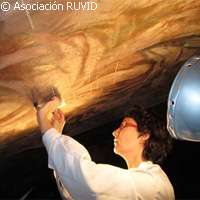
(PhysOrg.com) -- For most people the word bacteria will conjure up either images of nasty microorganisms that we fight against daily by cleaning the spaces around us, or the type of 'good' bacteria doctors advise us to consume to keep our digestive system's ticking over.
But who would have guessed that bacteria could be of use in the world of art restoration?
Well now, a team of art restoration experts from Spain and Italy have successfully shown that it is possible to clean up masterpieces with bacteria in a fast, targeted and careful manner. To boot, they have also shown that as well as being respectful to the paintings, these handy microorganisms are also kind to the restorers themselves and the surrounding environment. Until now the options were either restoration by aggressive, non-selective and toxic chemicals or erosion of the crust by often damaging mechanical means.
Through collaboration between the Institute of Heritage Restoration (IRP) at the University of Valencia, Spain, and experts working on the restoration of wall paintings at the Campo Santo di Pisa, Italy, these new methods have been tried and tested.
The collaboration came about while restorers from the IRP were working on the murals in the Church of Santos Juanes, Valencia, Spain. These murals were nearly completely destroyed after a fire in 1936 before becoming victim to a bad 1960s restoration job. The team from the IRP began experimenting with new techniques for 'filling' with transferred printed digital images in spaces without painting. However, salt efflorescence, the white scabs present on the paintings caused by a build-up of crystallized salts and gelatin glue, proved to be a major stumbling block.
"By the action of gravity and evaporation, the salts of organic matter in decomposition migrate to the paintings and produce a white crust hiding the work of art and sometimes can also cause the loosening of the painting layer," comments Dr. Pilar Bosch, one of the restorers from the IRP.
To investigate other options, the researchers from the IRP then travelled to Italy to learn about the pioneering work being carried out there in the Campo Santo di Pisa.
Under the guidance of microbiologist Gainluiggi Colalucci, restorers there were using bacteria to remove the hardened glue that conventional methods found so difficult to shift.
The bacteria used are a strain of Pseudomanas bacteria which literally eat the saline efflorescence that gathers in the arches where the paintings sit, normally where Pigeons like to reside.
Thanks to the collaboration between the two countries, the restorers were able to share best practices and find out what works best on different types of painting.
"In Italy they use cotton wool to apply the micro-organisms," comments Dr. Bosch. "We, however, have developed a gel that acts on the surface, which prevents moisture from penetrating deep into the material and causing new problems."
As bacteria only thrive in wet environments, Dr. Bosch explains how important the drying process is: "After an hour and a half, we remove the gel with the bacteria. The surface is then cleaned and dried."
Europe's greatest masterpieces have always been fragile; the ropes and museum cabinets separating us from our favourite pieces are evidence of this delicate nature. But now thanks to this research, ancient masterpieces could be kept 'young' for many years to come.
"After the good results of the tests we will continue the studies and improve the technique with the aim of transferring it to other surfaces," comments Dr. Bosch. "As in nature we find different species of bacteria that feed on almost anything, we are convinced that we can eliminate other substances from different types of materials."
Provided by CORDIS


