This is what the margins of the Ebro looked like 6 million years ago
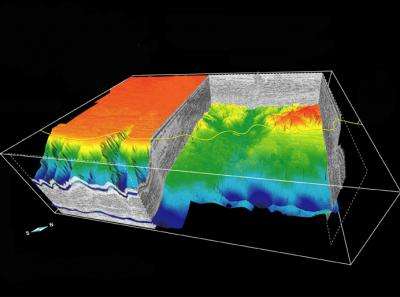
A Spanish research team, using 3D reflection seismology, has for the first time mapped the geomorphological features of the Ebro river basin between five and six million years ago. The images obtained show that the surface analysed is today 2.5 or 3 kilometres below the sea bed.
"The results shed light on the way in which the sea level fell during the Messinian (between 5.33 and 6 million years ago), and imply that the subsequent inundation of the river margins happened extremely quickly", Roger Urgeles, lead author of the study and a researcher at the Department of Marine Geology of the Institute of Sea Sciences (CSIC), tells SINC.
The study, which has been published in Basin Research, was based on 3D reflection seismology carried out on a 2,700 km² block of the continental margin of the Ebro. This technique enabled the researchers to see the morphology of the continental margin as it was six million years ago in great detail, and to map its drainage network, coastline and river valleys, channels, meanders and terraces.
According to Urgeles, the images obtained show that the Ebro river of six million years ago eroded and penetrated up to 1,300 metres into the continental margin. "The numerical simulations of fluvial transport and drainage evolution show that the Ebro in the Messinian period was similar in size and drainage basin to the Ebro of today", the expert points out.
The researchers say the period studied was "highly unique" in the Mediterranean, because when the Straits of Gibraltar closed, the sea level in the basin fell "dramatically", exposing the continental margins to atmospheric agents.
Quantitative analysis enabled the team of scientists to determine the real depth of this part of the continental margin during the Messinian. To do this, they restored the position of the Messinian coastline identified in the 3D seismic data, using techniques that make it possible to remove the effects of thermal subsidence, flexure of the Earth's crust and the compacting of sediments.
"The sea level during this period and in this part of the Mediterranean basin fell by around 1,300 metres", says Urgeles. The results also make it possible to determine the extent of the clastic structures associated with this drop in the sea level. "These structures are of interest to the oil industry, since they can act as a reservoir for hydrocarbons".
Exclusive 3D technology
The acquisition of data using this geophysical technique – 3D reflection seismology – "is accessible to very few research groups in the world", due to the high costs it entails. It is used almost exclusively in oil exploration. The data it provides provide a relief map of the ancient land surface, with the data of a similar quality to data taken from the planet's surface.
Using this technique, the research team managed to characterise the morphology of the strata and discontinuities. The scientists describe this tool as "much more rigorous and detailed" in its analysis of ancient sedimentary processes than the 2D reflection seismology traditionally used in academia.
This study was based on a 3D reflection seismology block made available by the oil company British Gas, along with the diagraphs (physical properties of the sediments extracted in a survey drill) of a three kilometre-deep well also made available by the company.
More information: Urgeles, Roger; Camerlenghi, Angelo; García-Castellanos, Daniel; De Mol, Ben; Garces, Miquel; Verges, Jaume; Haslam, Ian; Hardman, Martin. "New constraints on the Messinian sealevel drawdown from 3D seismic data of the Ebro Margin, western Mediterranean" Basin Research 23(2): 123-145, April 2011.
Provided by FECYT - Spanish Foundation for Science and Technology


