LLNL partners with SWAY to launch deep sea offshore wind demonstration
The amount of wind blowing off the California coast is teeming with potential.
Lawrence Livermore National Laboratory atmospheric scientists are working with a Norwegian company to possibly leverage that wind as a valuable energy source.
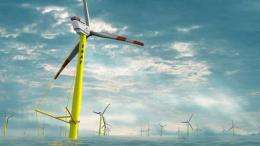
LLNL has signed a memorandum of understanding with SWAY, a renewable energy company, that has developed floating towers for wind turbines located in deep water. Though California has not yet approved offshore wind turbines, SWAY will launch a 1/5 scale prototype of the technology off the coast of Norway on June 10 to demonstrate how the system could work in the Pacific Ocean.
Towers for offshore wind turbines typically sit 0-30 meters deep in the water and are anchored to the ocean floor. Based on technology that was originally used for deep-sea oil drilling, SWAY has developed a system to generate more offshore power by locating turbine towers deeper in the ocean – at depths from 60-400 meters. The turbines would sit on top of the floating, tethered tower.
"California has an abundance of deep water wind resources, so this is an opportunity for the state," said Nalu Kaahaaina, LLNL's Low-Carbon Energy Program leader. "This technology is clean, reliable and even more consistent than traditional onshore wind turbines."
Power generation from offshore wind turbines is significantly higher than onshore wind turbines.
"We have offshore wind resources in California and the wind is blowing all the time," said Roger Aines, LLNL's Carbon Fuel Cycle Program leader. "If SWAY has success in Norway, the technology could be useful in California."
Lawrence Livermore has a long history in atmospheric sciences and scientists will provide their expertise in wind energy technology to help launch the project internationally, nationally and regionally.
The Laboratory works on numerical weather prediction models to predict power generated by the wind, so that wind farms can operate more efficiently while providing more power to hungry grids. Predictive time frames range from an hour ahead to days ahead of time. LLNL scientists plan to include ocean circulation and wake turbulent studies to determine the most suitable sites for offshore deep ocean wind farms.
Using this data, Aines said wind operators can optimize the best locations for wind farms, on or offshore. In California, the only option for offshore wind turbines would be in the deep ocean, far away from coastlines.
"We're looking at how we might use the SWAY technology off the coast of California," Aines said. "With our California offshore resource, we can't do it with the current technology that's available today."
In the United States, offshore wind projects must strike a balance between technological and economic challenges and adhere to more demanding environmental requirements to be successful. The latest generation of offshore turbines is equipped to meet the challenges of the ocean environment and tough weather conditions, which can limit access for routine maintenance.
According to the American Wind Energy Association, wind energy made up 2.3 percent of U.S. electricity by the end of 2010, up from 1.8 percent a year ago.
Provided by Lawrence Livermore National Laboratory


