Intelligent construction practices developed for roads also apply to river levees
June 27, 2011

Intelligent construction practices developed for roads also apply to river levees

Enlarge

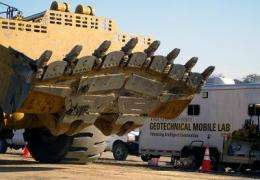
Iowa State University's Geotechnical Mobile Lab shows up on construction sites to help researchers develop technologies that measure the performance of the earth materials used for roadbeds and foundations. Photo courtesy of David White. Credit: Photo courtesy of David White/Iowa State University

The same technologies that Iowa State University's David J. White is developing to build better roads and foundations could also be used to build better river levees.

White, the Waldo W. Wegner Associate Professor in Civil Engineering, leads the crew working with Iowa State's Geotechnical Mobile Lab. In six years of operation, the lab has visited construction sites in 22 states to test new ideas for making sure solid, long-lasting earthen foundations are built under roads and buildings.

"The work we're doing is extremely important," White said.

First, "Earth materials are the world's most abundant construction materials - and the most variable ."

And second, "The improper use of earth materials contributes to billions of dollars in taxpayer expense for roadbeds, levees, foundations for buildings and slopes that fail."

White, for example, said up to $100 billion a year is spent because of bad roads. That includes the cost of road repairs, the wear on cars and time lost to traffic delays. If better, smarter construction practices can save just 1 percent of that, that's $1 billion that can be spent on other needs.
Intelligent construction practices developed for roads also apply to river levees
Enlarge

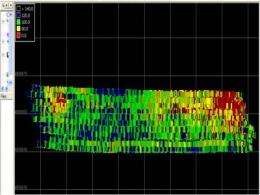
High-tech instruments and sensors show engineers where the earthworks under roads and buildings are strong and weak. Credit: David J. White/Iowa State University

So what can contractors do to build better roads and foundations?

White - plus mobile lab researchers Heath Gieselman and Pavana Vennapusa - are testing and developing technologies that equip those big, heavy rollers that smooth roadways with sensors that can detect the hard and soft spots in a road or roadbed. The technology's color-coded data instantly tells the operator exactly where the roadbed is good and where it needs more work. The technology, in fact, collects a million times more data than typical roadbed sampling and testing.

The Iowa State engineers are also working with new instruments, including a $75,000 resilient modulus triaxial device. White said Iowa State's device is the only one in the world that's part of a mobile lab. It quickly subjects earthwork samples to thousands of load tests to determine the long-term performance of a roadbed or foundation.

And the Iowa State engineers are starting to work with nondestructive evaluation techniques. White said microwaves and near infrared waves can tell researchers about the water or mineral content in soil.

White said the mobile lab's work has been supported by grants from the Federal Highway Administration and state departments of transportation. He said the construction industry and its manufacturers are also following and supporting the research.

And, in these days of prolonged flooding causing Missouri River levees to fail, White said the same techniques and instruments that lead to better roadbeds and foundations could also be applied to the construction and monitoring of earthen levees.

"These new technologies could be used to test river levees for stability," White said. "Normally, you have some lead time before floods come down the Missouri River. You could see this technology rapidly deployed to do an assessment. Then you can identify that badger hole and plug it."

And, he said, whenever Iowa State's mobile lab pulls into a construction site, it's starting to change some minds about the best .

"This is not just a research project," White said. "We now have a network of people around the country who are becoming more interested and motivated to research and implement these emerging technologies."

Provided by Iowa State University search and more info website

4.5 /5 (2 votes)  

Rank 4.5 /5 (2 votes)
Relevant PhysicsForums posts

More news stories

Browser wars flare in mobile space

The browser wars are heating up again, but this time the fight is for dominance of the mobile Internet.

Technology / Software

created 5 hours ago | popularity 5 / 5 (1) | comments 2

Probability of contamination from severe nuclear reactor accidents is higher than expected: study

Catastrophic nuclear accidents such as the core meltdowns in Chernobyl and Fukushima are more likely to happen than previously assumed. Based on the operating hours of all civil nuclear reactors and the number ...

Technology / Energy & Green Tech

created May 22, 2012 | popularity 3.6 / 5 (22) | comments 56 | with audio podcast

SpotterRF debuts Radar Backpack Kit (w/ Video)

(Phys.org) -- SpotterRF has announced a special radar backpack kit designed to enhance situational awareness for soldiers on the ground. The company says its special radar is designed for warfighters as part ...

Technology / Hi Tech & Innovation

created May 26, 2012 | popularity 5 / 5 (5) | comments 12 | with audio podcast report

HyperSolar shows dirty water no barrier to power world

(Phys.org) -- The Santa Barbara, California, company, HyperSolar, is set to transparently share the ups and downs of its research experiences toward the company’s ultimate vision, successfully producing ...

Technology / Energy & Green Tech

created May 24, 2012 | popularity 4.8 / 5 (16) | comments 17 | with audio podcast report

Tesla to launch electric sedan in US on June 22

Tesla Motors said Tuesday it would begin deliveries of "the world's first premium electric sedan" on June 22, slightly ahead of schedule.

Technology / Energy & Green Tech

created May 22, 2012 | popularity 4.5 / 5 (11) | comments 18


Nvidia trumpets Tegra 3 phone design wins for 2012

(Phys.org) -- Nvidia’s competitive war paint has a name, Tegra 3. On the heels of Nvidia announcements about lowering costs of its Tegra 3 processors and Nvidia-enabled tablets running Android Ice Cream ...

Scientist: Evolution debate will soon be history

(AP) -- Richard Leakey predicts skepticism over evolution will soon be history. Not that the avowed atheist has any doubts himself.

Dell tablet leak: 10.1-inch display, two-battery choice

(Phys.org) -- Headline after headline talks about vendors’ tablets in the wings as likely number-one contenders for the iPad. Such claims have justifiably been taken with a grain of salt, considering ...

Keep food safety in mind this memorial day weekend

(HealthDay) -- Picnics, parades and cookouts are as much a part of Memorial Day weekend as tributes to the United States' war veterans.

Social welfare cuts ultimately come with heavy price, researchers say

(Phys.org) -- Slashing government funding for Medicaid, food stamps and other programs that serve the poor – while politically popular with some lawmakers and many conservatives – may do more harm ...

Is a classical electrodynamics law incompatible with special relativity?

(Phys.org) -- The laws of classical electromagnetism that were developed in the 19th century are the same laws that scientists use today. They include Maxwell’s four equations along with the Lorentz la ...