'Laughing' insects among new Philippine species
June 8, 2011 by Mynardo Macaraig

These starfish showcase the vast biodiversity of the Philippines archipelago that is under severe threat

Enlarge

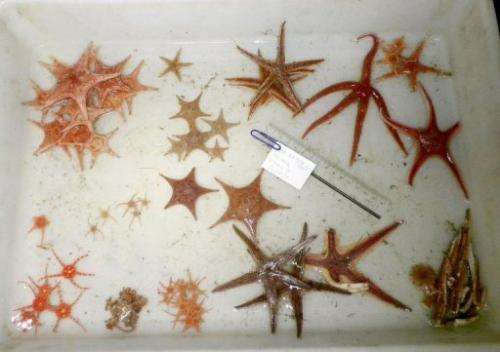
This picture provided by California Academy of Sciences shows species of starfish found by a team of US and Filipino researchers in waters and islands of the Philippines. Laughing cicadas and small "cat sharks" are among scores of species believed new to science discovered by US and Filipino researchers in waters and islands of the Philippines.

Laughing cicadas and small "cat sharks" are among scores of species believed new to science discovered by US and Filipino researchers in waters and islands of the Philippines, the team said Wednesday.

The finds showcased the vast biodiversity of the Southeast Asian archipelago that is now under severe threat, said the experts from the California Academy of Sciences and local institutions.

The team found a rich harvest of starfish, sea urchins, eels and barnacles, many of which had not been previously documented by scientists, said Richard Mooi, one of the California .

"We found at least 75 new species, perhaps more. A lot more analysis is needed," he told a forum to announce the discoveries.

"Unquestionably, we found 20 new species of starfish and sea urchins alone," Mooi added.

Fellow academy scientist John McCosker said they discovered several small "cat sharks" with brown backs and having dark stripes and white bellies, colours which he had never seen on any other shark before.

Picked up by a trawler net 2,000 metres (6,600 feet) below the waves, the sharks are about 60 centimetres (two feet) long and feed on shrimp, said McCosker, head of the aquatic biology department.

Detailing other finds, California Academy dean Terry Gosliner said: "We found one new species of eel, possibly a new species of pipe fish, new species of barnacles, new species of nudibranch (shell-less) mollusks."

Among the other unusual discoveries, Filipino entomologist Ireneo Lit said his team believed they had found several new species, including a cicada that made a sound like high-pitched laughter.

"The local residents were afraid of them. They thought the laughter was from dwarves, laughing dwarves," he told AFP of the insect found on 2,158-metre Mount Banahaw, a volcano on the main island of Luzon.

Lit, director of a national history museum at the University of the Philippines, said he would contact a colleague in France's Paris to confirm if it was a new species.

These starfish showcase the vast biodiversity of the Philippines archipelago that is under severe threat
Enlarge

This picture provided by California Academy of Sciences shows species of starfish found by a team of US and Filipino researchers in waters and islands of the Philippines. Laughing cicadas and small "cat sharks" are among scores of species believed new to science discovered by US and Filipino researchers in waters and islands of the Philippines.

The expedition had trawled the depths of the waters off Batangas province and Taal Lake south of Manila.

It also took samples of fauna from Banahaw and other mountains on Luzon, where the scientists found three possible new species of spiders, said American spider expert Charles Griswold.

It would take several months of laboratory work to confirm if the finds were all truly new species but the large number of experts involved could easily tell if they had really found something new, Mooi said.

Edgardo Gomez, a professor of the University of the Philippines' Marine Science Institute, said some of the marine finds would have been under threat of extinction.

"Philippine marine biodiversity is under siege," Gomez told the forum.

He cited damage caused both by pollution and overfishing and climate change.

Theresa Mundita Lim, head of the environment ministry's Protected Areas and Wildlife Bureau, warned some could become extinct before they are even documented.

"The research on biodiversity is not at pace with the threats. The threats are more numerous," she added.

(c) 2011 AFP

Filter


Move the slider to adjust rank threshold, so that you can hide some of the comments.


Display comments: newest first

Sinister1811
Jun 09, 2011

Rank: 3 / 5 (2)
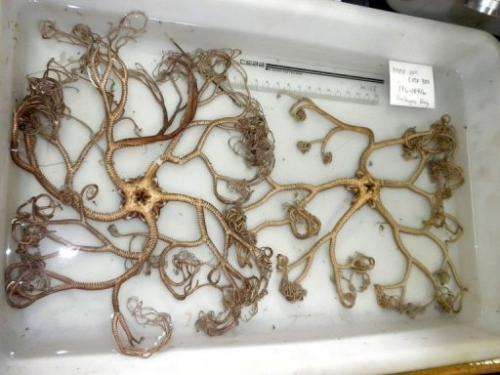
Amazing. But it's disappointing that they've only released two photos of what they've found. I would have loved to have seen more of this marine biodiversity. Especially more about this intriguing "cat shark". I've googled for about 10 minutes and can't find a photo of it anywhere.
Rank 5 /5 (1 vote)
Relevant PhysicsForums posts

More news stories

Scientist: Evolution debate will soon be history

(AP) -- Richard Leakey predicts skepticism over evolution will soon be history. Not that the avowed atheist has any doubts himself.

Biology / Evolution

created 16 hours ago | popularity 3.3 / 5 (17) | comments 51

More plant species responding to global warming than previously thought

(Phys.org) -- Far more wild plant species may be responding to global warming than previous large-scale estimates have suggested.

Biology / Ecology

created May 22, 2012 | popularity 4.6 / 5 (14) | comments 18 | with audio podcast

Thousands of shellfish found dead in Peru

Thousands of crustaceans were found dead off the coast of Lima following the mystery mass death of dolphins and pelicans, the Peruvian Navy said Friday.

Biology / Ecology

created May 26, 2012 | popularity 4.8 / 5 (4) | comments 7

For monogamous sparrows, it doesn't pay to stray (but they do it anyway)

It's quite common for a female song sparrow to stray from her breeding partner and mate with the male next door, but a new study shows that sleeping around can be costly.

Biology / Plants & Animals

created May 22, 2012 | popularity 5 / 5 (2) | comments 7 | with audio podcast

Study uncovers secret to speedy burrowing by razor clams

(Phys.org) -- If you look at a razor burrowing clam sitting in a bucket, you’d never guess that it could burrow itself down into the soil, much less do it with any speed. Razor clams look like fat straws, ...

Biology / Plants & Animals

created May 25, 2012 | popularity 1 / 5 (1) | comments 3 | with audio podcast report


Nvidia trumpets Tegra 3 phone design wins for 2012

(Phys.org) -- Nvidia’s competitive war paint has a name, Tegra 3. On the heels of Nvidia announcements about lowering costs of its Tegra 3 processors and Nvidia-enabled tablets running Android Ice Cream ...

Browser wars flare in mobile space

The browser wars are heating up again, but this time the fight is for dominance of the mobile Internet.

Dell tablet leak: 10.1-inch display, two-battery choice

(Phys.org) -- Headline after headline talks about vendors’ tablets in the wings as likely number-one contenders for the iPad. Such claims have justifiably been taken with a grain of salt, considering ...

Keep food safety in mind this memorial day weekend

(HealthDay) -- Picnics, parades and cookouts are as much a part of Memorial Day weekend as tributes to the United States' war veterans.

Social welfare cuts ultimately come with heavy price, researchers say

(Phys.org) -- Slashing government funding for Medicaid, food stamps and other programs that serve the poor – while politically popular with some lawmakers and many conservatives – may do more harm ...

Is a classical electrodynamics law incompatible with special relativity?

(Phys.org) -- The laws of classical electromagnetism that were developed in the 19th century are the same laws that scientists use today. They include Maxwell’s four equations along with the Lorentz la ...