Ill penguin stranded in NZ is offered a lift home
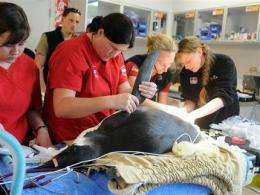
(AP) -- A young emperor penguin stranded in New Zealand has survived two medical procedures and now has an offer of a lift home.
Yet the aquatic bird that many are calling Happy Feet - after the lighthearted 2006 movie - is not out of danger yet. The penguin remained on an intravenous drip Saturday and faces another procedure Monday to remove more sand from its digestive system.
If it does pull through, a businessman wants to take it by boat to Antarctica next February.
Happy Feet arrived on Peka Peka Beach, about 40 miles (65 kilometers) northwest of Wellington, last Monday, the first time in 44 years that an emperor penguin has been spotted in the wild in New Zealand. Typically, emperors spend their entire lives in and around Antarctica.
At first Happy Feet seemed fine, but as the week progressed, the bird became more lethargic. It ate a lot of sand, apparently mistaking it for snow, which emperor penguins eat in Antarctica to hydrate themselves during the frozen winters.
By Friday, conservation officials decided its condition had worsened to the point that it would likely die without intervention. So they transported the penguin in a tub of ice to the Wellington Zoo.
Zoo spokeswoman Kate Baker said the bird was put on anesthesia for 2 1/2 hours Friday while veterinarians flushed its throat and stomach with water to remove sand. A second procedure on Saturday was more of the same, yet the penguin's digestive system still remained clogged.
Baker said staff want to give the bird a break Sunday but plan a third flushing procedure Monday. The bird remained on an intravenous drip Saturday to help it rehydrate.
New Zealand investment adviser Gareth Morgan, who is leading an expedition to Antarctica next February, on Saturday offered Happy Feet a trip home aboard a Russian icebreaker. But it would not be for another eight months.
"Of course until that time Happy Feet will have to be cared for here in Wellington, where we're lucky enough to have a great community of wildlife experts, capable not just of pumping sand but also ensuring this wayfaring fellow is hosted appropriately until it's time to set sail," Morgan wrote on his website.
"A sea passage is far more akin to the animal's natural rite of passage across the Southern Ocean than any trip in a Globelifter jet might be, with no risk of deep vein thrombosis," Morgan added jokingly.
Whether officials choose to take Morgan up on his offer may depend on Happy Feet's health.
Peter Simpson, a program manager for New Zealand's Department of Conservation, said earlier in the week that there was a chance the bird might have picked up a disease in warmer climes which staff wouldn't want to introduce back into the Antarctic colony.
If a trip back to the Antarctic doesn't pan out, there's always the offer of a more sheltered life.
Lauren DuBois, assistant curator of birds at SeaWorld in San Diego, which has the only colony of emperor penguins in North America, said SeaWorld would be willing to step in and help. Thirty birds live there in a 25-degree Fahrenheit (minus 4 Celsius) habitat that simulates Antarctica, with up to 5,000 pounds (2,270 kilograms) of snow blown in every day.
Estimated to be about 10 months old, Happy Feet probably was born during the last Antarctic winter and may have been searching for squid and krill when it got lost. Experts haven't yet determined whether it is male or female.
The rare venture north captured the public's imagination, with school groups, sightseers and news crews coming to the beach to see the penguin and photograph it from a distance.
The amazing journey of emperors, the tallest and largest species of penguin, to breeding grounds deep in the Antarctic was chronicled in the 2005 documentary "March of the Penguins," which highlighted their ability to survive - and breed - despite the region's brutal winters.
©2011 The Associated Press. All rights reserved. This material may not be published, broadcast, rewritten or redistributed.


