June 7, 2011 report
Hibernation keeps rabies going in bats
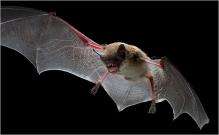
(PhysOrg.com) -- In a new study published in the Proceedings of the National Academy of Sciences, infectious disease biologist Dylan George from Colorado State University reports that a bat’s hibernation is what keeps the rabies virus alive and does not wipe out the bat before the virus can spread.
George conducted a five year field study looking at big brown bats from Colorado. Using data from the study and a mathematical model, the team looked at the incubation period of the virus and the bats hibernation period and determined that three main factors play a role in the survival of the bats. The three factors are a long viral incubation period, the bat’s hibernation, and a large supply of newborn bats in the spring and summer.
According to the study, an infected bat will enter into hibernation. This hibernation period slows the body’s metabolism and thus slows the progression of the rabies. This insures that the bat and the virus do not die during this period of time. When spring arrives and hibernation is over, the bats then roost and give birth to their young. This takes place in large colonies, creating a breeding ground for the virus. With numerous bats in one area grooming and nipping at each other, it creates a perfect environment for the virus to spread.
When compared to data provided from the Colorado Department of Public Health and Environment and the U.S. Centers for Disease Control and Prevention on rabies peaks and juvenile deaths in the summer, the teams model seems to hold true.
The model also shows that if hibernation were to be taken out of the picture, the virus and the bats would go extinct.
More information: Host and viral ecology determine bat rabies seasonality and maintenance, PNAS, Published online before print June 6, 2011, doi: 10.1073/pnas.1010875108
Abstract
Rabies is an acute viral infection that is typically fatal. Most rabies modeling has focused on disease dynamics and control within terrestrial mammals (e.g., raccoons and foxes). As such, rabies in bats has been largely neglected until recently. Because bats have been implicated as natural reservoirs for several emerging zoonotic viruses, including SARS-like corona viruses, henipaviruses, and lyssaviruses, understanding how pathogens are maintained within a population becomes vital. Unfortunately, little is known about maintenance mechanisms for any pathogen in bat populations. We present a mathematical model parameterized with unique data from an extensive study of rabies in a Colorado population of big brown bats (Eptesicus fuscus) to elucidate general maintenance mechanisms. We propose that life history patterns of many species of temperate-zone bats, coupled with sufficiently long incubation periods, allows for rabies virus maintenance. Seasonal variability in bat mortality rates, specifically low mortality during hibernation, allows long-term bat population viability. Within viable bat populations, sufficiently long incubation periods allow enough infected individuals to enter hibernation and survive until the following year, and hence avoid an epizootic fadeout of rabies virus. We hypothesize that the slowing effects of hibernation on metabolic and viral activity maintains infected individuals and their pathogens until susceptibles from the annual birth pulse become infected and continue the cycle. This research provides a context to explore similar host ecology and viral dynamics that may explain seasonal patterns and maintenance of other bat-borne diseases.
© 2010 PhysOrg.com


