Smoking gun elusive in deadly E. coli outbreak
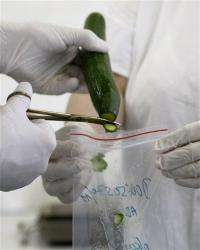
(AP) -- European health officials tracking one of the worst E. coli outbreaks on record might never know where it came from. It's a sad fact of life in food poisoning cases: There often is no smoking gun.
The germ has sickened more than 1,500 people, mostly in Germany. Most patients who have been interviewed said they ate lettuce, tomatoes or cucumbers, but officials testing produce across the continent have yet to find any vegetables with the particular strain involved.
Illnesses can occur days after tainted food is eaten and leftovers thrown out, so "the trail gets cold pretty quick," said Bill Marler, a Seattle attorney who specializes in food poisoning cases.
"They might never find the cause of the outbreak," said Paul Hunter, professor of health protection at England's University of East Anglia. "In most foodborne outbreaks, we don't know definitively where the contaminated food came from."
Germany's national health agency said Wednesday that more than 1,530 people there had been sickened by a dangerous E. coli germ, including 17 dead and 470 suffering from a kidney failure complication that was previously considered rare.
The outbreak has hit at least nine European countries, but virtually all the sick people either live in Germany or recently traveled there. Two people who were sickened are now in the U.S., and both had recently traveled to Hamburg, Germany, where many of the infections occurred.
The outbreak is already considered the third-largest involving E. coli in recent world history, and it may be the deadliest. Twelve people died in a 1996 Japanese outbreak that reportedly sickened more than 12,000, and seven died in a 2000 Canadian outbreak that also made thousands ill.
Nearly all cases are linked to northern Germany, "so it seems to be a common exposure there. But we don't yet know what was this exposure," said Dr. Hilde Kruse, the World Health Organization's food safety program manager for Europe.
"It's like a puzzle. But unfortunately the puzzle is not complete."
Where the dangerous germ came from is just one of the questions health officials have. Another is why patients are suffering from life-threatening kidney complications in an unusually high percentage of cases. It might mean the strain is particularly virulent, but it's also possible that thousands of less serious cases of food poisoning have gone unreported.
People with less severe symptoms may contact health authorities later, or not at all, Kruse said.
Kruse also said the outbreak is "different in that it mainly affects adults and predominantly women." Some experts say that likely has to do with diet - women tend to eat more fresh produce.
Experts are cautious about trying to explain what's happening at the moment. "An epidemic is like a battle - it's not clear where everything is coming from and what is going on," said Dr. Phillip Tarr, an E. coli expert at the Washington University School of Medicine.
The bacteria being investigated is one of the few dangerous types among the hundreds of different E. coli bugs. People and animals carry various E. coli in their intestines. But only a very small percentage are deadly. One of the most notorious was a strain that killed four U.S. children in 1993 and was linked to contaminated hamburgers at a fast-food chain.
Some experts said the sheer scope of the German outbreak may help eventually solve it. With more cases, there are better odds that the source can be found. That helped in the Japanese outbreak in 1996, which was blamed on radish sprouts, and the 2000 Canadian outbreak, which was traced to drinking water.
"Public health investigations are not always successful. But a big one with a lot of investigation around it is usually successful," said Dr. Robert Tauxe, a foodborne disease expert at the U.S. Centers for Disease Control and Prevention.
To nail down the source, scientists will have to match the strain found in patients to one in vegetables or other sources by using DNA sequencing, said Brendan Wren, professor of pathogen molecular biology at the London School of Hygiene and Tropical Medicine.
But it can be difficult to find the strain in vegetables, and Wren doubts cucumbers are responsible. "As in many foodborne disease outbreaks, the culprit may never be identified and the epidemic just fades away," he said.
Meanwhile, investigators will increase efforts to find the food distributors and producers where the vegetables originated.
That can take weeks or even months, and can be complicated by the fact that different vegetables are often eaten together, as in salads, Tauxe said.
In the U.S., the government said it would step up testing of any imports of cucumbers or other possibly implicated produce from affected countries - but the nation gets very little fresh produce from Europe, especially this time of year. There was just one shipment of cucumbers from Spain in May, for instance, and no cucumbers, tomatoes or lettuce from Germany since January.
Another challenge for health officials: Catching and preventing future outbreaks of this strain.
According to an expert panel of the European Food Safety Authority, there is limited data on the presence of dangerous E. coli strains across Europe.
Current surveillance systems aren't well coordinated across Europe, the group said. It recommends monitoring a number of dangerous E. coli strains - but not the one that is responsible for the current outbreak.
In Germany, there are no spot checks of imported food coming from the 25 countries that are part of a zone that lacks internal border controls.
In the United States, labs regularly test for a dangerous E. coli type in stool samples from people with food-poisoning symptoms, but only a small percentage of the labs test for other forms of E. coli that make people sick. In recent years, investigators have found that a wider variety of E. coli bugs are also causing illness.
©2011 The Associated Press. All rights reserved. This material may not be published, broadcast, rewritten or redistributed.


