Gamma-ray emission from Terzan 5
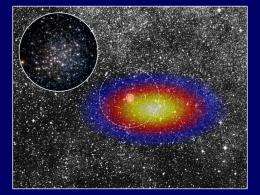
(PhysOrg.com) -- The H.E.S.S. telescope system in Namibia discovered a new source of very-high-energy gamma-rays from the direction of the globular cluster Terzan 5. Being very likely located in the outer parts of Terzan 5 this source is the first example for of gamma-ray emission from a globular cluster. The off-centre position of the source and the specific origin of the gamma-rays pose a puzzle for scientists.
The globular cluster Terzan 5 situated in the Sagittarius constellation is a remarkable object in several aspects. Obscured behind galactic dust clouds the faint cluster was discovered in 1968 by Agop Terzan on photographic plates of the Haute-Provence Observatory in France. About 150 known globular clusters, concentrated spherical collection of very old stars, orbit the centre of our galaxy in form of a spherical swarm as part of the galactic halo.
Terzan 5 is located in the inner parts of our galaxy closely above the galactic plain in about 20,000 light-years distance to the earth. It has the highest density of stars of all globular clusters and contains the largest number of millisecond pulsars. The latter are rapidly rotating neutron stars which are thought to be part of close binary systems.
Terzan 5 gained particular attention in 2009 when it turned out that is has two star populations of different age (12 and 6 billion years, respectively). Due to these unique properties Terzan 5 is assumed to be the remnant of a dwarf galaxy which has been captured by our galaxy.
Researchers of the Max Planck Institute for Nuclear Physics in Heidelberg and 33 other institutions within the H.E.S.S. collaboration report the discovery of a new source (HESS J1747 – 248) of very-high-energy gamma-rays from the direction of Terzan 5. The location in the close vicinity to the cluster suggests that the source is a so far unknown part of Terzan 5. The probability of a chance coincidence with an unrelated gamma emission (derived from the abundance of known sources) is less than 1/10,000.
The photon energy of very-high-energy gamma-rays exceeds that of visible light by a factor of several trillions. The gamma-rays are detected by the H.E.S.S. (High Energy Stereoscopic System) Cherenkov telescope system in Namibia. It consists of four large telescopes equipped with ultrafast cameras which image extremely faint light (Cherenkov radiation) of atmospheric particle showers created by gamma photons absorbed about 10 km above the ground. Coincident observation from the up to four viewpoints allows to reconstruct the original direction of the gamma-ray source in the sky. Terzan 5 is the first case of a globular cluster being identified as a gamma-ray emitting object.
Like many discoveries, the new source raises a bunch of questions which are not finally settled up to now. One striking feature is the elongated form of the source and its significant offset from the cluster’s centre. There exist several explanations for the origin of the gamma-rays which have been discussed within studies of other known sources. Based on theoretical models it is assumed that first charged particles (electrons, protons) gain the according energy in a cosmic accelerator. The particle’s energy is then subsequently transformed into gamma photons in collision processes.
While millisecond pulsars may act as gamma-ray sources themselves, electron acceleration may be driven as well by pulsar winds or colliding shock fronts therein – plausible processes considering the high stellar density in a globular cluster. Indeed, diffuse X-ray emission from Terzan 5 has already been observed. However, this does not explain the offset of the gamma source from the centre of the cluster where one expects both the highest density of pulsars and the highest rate of electron interaction with stellar light.
Protons are known to be accelerated in supernova remnants and these spectacular explosions induced by stellar collisions are expected to occur in globular clusters as well. But again, there is the question why the source is found off-centre. The source object may have been ejected into the outer zone by a close stellar encounter. But it remains puzzling why HESS J1747 – 248 is a “dark source” which is not detectable so far in other regions of the electromagnetic spectrum. “In summary, the nature of the source is uncertain since no counterpart or model fully explains the observed morphology” says Wilfried Domainko from the Max Planck Institute of Nuclear Physics.
Future studies will concentrate on the region of less energetic gamma-rays which is still unexplored so far both by satellite-based measurements and observations by telescope systems like H.E.S.S. Currently, the construction of a fifth large telescope (H.E.S.S. II) is under way. By means of a fivefold larger mirror area of about 600 square metres it will be sensitive enough to detect the even more faint particle showers produced by less energetic photons.
More information: A. Abramowski et al. Very-high-energy gamma-ray emission from the direction of the Galactic globular cluster Terzan 5 Astronomy & Astrophysics 2011 (accepted for publication) arxiv.org/abs/1106.4069
Provided by Max-Planck-Gesellschaft


