Farmer networks hold key to agricultural innovation in developing countries, study finds
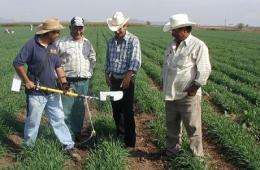
Farmers in Mexico's Yaqui Valley use a nitrogen sensor to optimize fertilizer application, thus reducing costs and agricultural runoff. Credit: Ivan Ortiz-Monasterio, Stanford University
New technologies can improve agricultural sustainability in developing countries, but only with the engagement of local farmers and the social and economic networks they depend on, say Stanford University researchers. Their findings are published in the May 23 online edition of the Proceedings of the National Academy of Sciences (PNAS).
"Most people tend to think that technology information flows to farmers through a direct pipeline from scientists, but that isn't true," said lead author Ellen McCullough, a former research fellow at Stanford's Program on Food Security and the Environment, now at the Bill and Melinda Gates Foundation.
The study was co-authored by Pamela Matson, dean of the School of Earth Sciences and senior fellow at the Woods Institute for the Environment at Stanford.
To better understand how farmers decide to adopt new technologies, the researchers interviewed growers, farm credit unions and agricultural experts in the Yaqui Valley in Sonora, Mexico the birthplace of the "green revolution" in wheat and one of Mexico's most productive breadbaskets.
Matson and other Stanford researchers have been working in the Yaqui Valley for nearly 20 years. Among their objectives is demonstrating how science can inform agricultural policy in an area grappling with the kinds of environmental challenges that plague other intensive farming regions.
While Yaqui Valley supplies most of Mexico's wheat, the environmental costs are high, according to the Stanford researchers. Valley farms pollute local drinking water, wreck coastal ecosystems and foul the air with particulates that cause a variety of diseases.
"If scientists want to offer solutions to manage these environmental impacts, they need to understand what influences farmers' decisions about technology and production strategies," McCullough said.
Credit union clout
In Yaqui Valley, credit unions hold sway among the majority of farmers, McCullough said. In addition to providing loans, crop insurance, fertilizer and seed, credit unions have taken over the government's role in providing technical expertise and management advice.
Valley growers also have a long history of working with the Mexico-based International Maize and Wheat Improvement Center, a world-renowned agricultural research center known by its Spanish acronym, CIMMYT.
But interviews conducted for the PNAS study revealed that most farmers take their cues from local credit unions and not from experts at CIMMYT. As an example, McCullough pointed to a collaborative effort between CIMMYT scientists and farmers to develop a nitrogen diagnostic tool that reduces fertilizer use without sacrificing crop yields.
The device, which gives real-time readings of nitrogen levels in the soil, proved early on that it could save farmers 12 to 17 percent of their profits. Yet most farmers rejected the new technology until CIMMYT researchers finally convinced credit union officials that it was a worthwhile investment.
"The most successful innovations that have been adopted by farmers in the Yaqui Valley have come from collaborations among researchers, farmers and local establishments, like the credit unions," McCullough said. Because of their considerable influence among farmers, credit unions should be included in any effort to effect environmental change in the region, she added.
"The Yaqui case negates the simplistic view of the one-way flow of scientific information from the agricultural research community to the user community," Matson said. "If researchers seek to produce relevant knowledge that ultimately influences decision making, they must recognize the dynamics of the local knowledge system and participate purposefully and strategically in it."
Provided by
Stanford University
-
From lemons to lemonade: Reaction uses carbon dioxide to make carbon-based semiconductor,
32 comments
-
Thioridazine kills cancer stem cells in human while avoiding toxic side-effects of conventional cancer treatments,
3 comments
-
SpaceX private rocket blasts off for space station (Update),
42 comments
-
Climate scientists say they have solved riddle of rising sea,
31 comments
-
SpaceX capsule has 'new car' smell, astronauts say (Update),
2 comments
-
Hypothetical desert earth
11 hours ago
-
More human population = greater mass?
May 25, 2012
-
Conversion from aircraft bearing to normal degrees
May 23, 2012
-
Interpretation/Analysis of the Lab results(HEPA filter)
May 22, 2012
-
Has anyone here attended the The Urbino Summer School in Paleoclimatology?
May 22, 2012
-
Earthquakes: Mag 6 N. Italy and Mag 5.6 W. Bulgaria
May 21, 2012
- More from Physics Forums - Earth
More news stories
Sophisticated simulations predict future warming
The chances of our planet being hit by a global warming of 3 degrees Celsius by 2050 is as likely as it being hit by an increase of 1.4 degrees, new research shows. Presented in the journal Nature Geoscience, the British study ...
Space & Earth / Earth Sciences
May 22, 2012 |
4.4 / 5 (9) |
51
Dragon arrives at space station in historic 1st (Update 2)
The privately bankrolled Dragon capsule made a historic arrival at the International Space Station on Friday, triumphantly captured by astronauts wielding a giant robot arm.
Space & Earth / Space Exploration
May 25, 2012 |
5 / 5 (10) |
19
Kyoto Protocol architect 'frustrated' by climate dialogue
UN climate talks are going nowhere, as politicians dither or bicker while the pace of warming dangerously speeds up, one of the architects of the Kyoto Protocol told AFP.
May 23, 2012 |
3.7 / 5 (7) |
39
Aliens don't want to eat us, says former SETI director
Alien life probably isnt interested in having us for dinner, enslaving us or laying eggs in our bellies, according to a recent statement by former SETI director Jill Tarter.
Space & Earth / Space Exploration
May 25, 2012 |
4.4 / 5 (13) |
37
What's the big deal about private space launches?
(AP) -- The first private spaceship is headed to the International Space Station. Some questions and answers about the cargo mission by Space Exploration Technologies, known as SpaceX:
Space & Earth / Space Exploration
May 22, 2012 |
5 / 5 (6) |
32
Nvidia trumpets Tegra 3 phone design wins for 2012
(Phys.org) -- Nvidias competitive war paint has a name, Tegra 3. On the heels of Nvidia announcements about lowering costs of its Tegra 3 processors and Nvidia-enabled tablets running Android Ice Cream ...
Browser wars flare in mobile space
The browser wars are heating up again, but this time the fight is for dominance of the mobile Internet.
Scientist: Evolution debate will soon be history
(AP) -- Richard Leakey predicts skepticism over evolution will soon be history. Not that the avowed atheist has any doubts himself.
Dell tablet leak: 10.1-inch display, two-battery choice
(Phys.org) -- Headline after headline talks about vendors tablets in the wings as likely number-one contenders for the iPad. Such claims have justifiably been taken with a grain of salt, considering ...
Keep food safety in mind this memorial day weekend
(HealthDay) -- Picnics, parades and cookouts are as much a part of Memorial Day weekend as tributes to the United States' war veterans.
Family history of Alzheimer's affects functional connectivity
(HealthDay) -- Cognitively normal individuals with a family history of late-onset Alzheimer's disease (AD) may display lower resting state functional connectivity in the default mode network (DMN) of the brain, ...