Efficiency record for flexible CdTe solar cell due to novel polyimide film
June 9, 2011

New superstrate material enables flexible, lightweight and efficient thin film solar modules

Enlarge

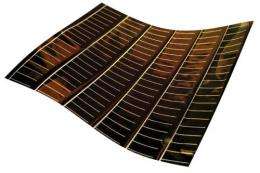
CdTe-solar module (Empa)

DuPont Kapton colorless polyimide film, a new material currently in development for use as a flexible superstrate for cadmium telluride (CdTe) thin film photovoltaic (PV) modules, has enabled a new world record for energy conversion efficiency. A team at Empa, the Swiss Federal Laboratories for Materials Science and Technology, has demonstrated a conversion efficiency of 13.8 percent using the new colorless film, leapfrogging their previous record of 12.6 percent and nearing that of glass.

Because Kapton film is over 100 times thinner and 200 times lighter than glass typically used for PV, there are inherent advantages in transitioning to flexible, film-based vs. rigid glass CdTe systems. High-speed and low-cost roll-to-roll deposition technologies can be applied for high-throughput manufacturing of flexible solar cells on polymer film as . The new polyimide film potentially enables significantly thinner and lighter-weight flexible modules that are easier to handle and less expensive to install, making them ideal for applications including building-integrated photovoltaics.

“Rather than transporting heavy, fragile glass modules on large trucks and lifting them by crane onto rooftop PV installations, one could imagine lightweight, flexible film-based modules that could simply be rolled up for transport, and easily carried up stairs,” said Robert G. Schmidt, new business development manager, Photovoltaics - DuPont Circuit & Packaging Materials. “With record-setting established through Empa, we’re confident this flexible, lightweight and durable material has the potential to revolutionize the industry by enabling flexible design and lowering balance of system costs.”

Increase in efficiency – toward achieving grid parity
New superstrate material enables flexible, lightweight and efficient thin film solar modules
Enlarge

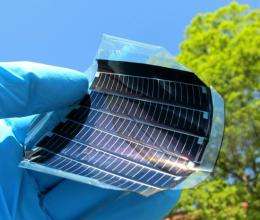
Fully monolithically integrated flexible solar module (consisting of 6 cells) based on cadmium telluride (CdTe): Empa researchers recently achieved a new world record in energy conversion efficiency of 13.8 percent with this type of solar cell.

Empa’s Laboratory for Thin Films and Photovoltaics is developing high-efficiency thin film solar cells with emphasis on novel concepts for enhancing their performance, simplifying the fabrication processes, and advancing device structures for next generation of more efficient and low-cost devices. They have been doing groundbreaking work in developing and optimizing a low temperature process (below 450 degrees Celsius) for high-efficiency CdTe solar cells on glass (reaching 15.6 percent efficiency) and (reaching 12.6 percent efficiency, the highest value before the recent improvement to 13.8 percent). Only a few weeks ago Tiwari's team also set a new world record in energy efficiency (of 18.7 percent) for another type of flexible based on copper indium gallium (di)selenide (also known as CIGS).

“Finding a film that could both be transparent and withstand high processing temperatures was a challenge initially, but the new Kapton colorless polyimide film had both the tolerance for high temperatures needed, and higher light transmittance due to its transparency that allowed it to exceed our previous world record in conversion efficiency of flexible CdTe solar cell,” said Ayodhya N. Tiwari, head of the laboratory. “As we continue to raise the standards for PV efficiency, materials make a distinct difference in the progress we make toward achieving grid parity. Of course, further development is needed for addressing cost and stability issues.” Tiwari plans to present a technical paper on the full findings at the 26th European Photovoltaic Solar Energy Conference and Exhibition in Hamburg, Germany, being held Sept. 5–9, 2011.

DuPont Kapton polyimide film has made innovative design solutions possible in a range of industries over the last 45 years including aerospace, automotive and industrial applications. With a unique combination of electrical, thermal, chemical and mechanical properties that withstand extreme temperature and other demanding environments, Kapton films have set the standards in high performance, long-term reliability and durability, and are ideally suited for applications in the PV industry. Three new Kapton PV9100 series films were introduced for the thin film PV market in 2010, including offerings for amorphous Silicon (a-Si) modules and Copper Indium Gallium Selenide (CIGS) photovoltaic applications.

Provided by Empa

Filter


Move the slider to adjust rank threshold, so that you can hide some of the comments.


Display comments: newest first

SteveL
Jun 09, 2011

Rank: 5 / 5 (1)
I wonder if they could bond this to Polycarbonate sheating for direct roof placement, with a suitable border and open zones for nails and bonding of course. With enough cheap PV on a roof angled for lattitude you wouldn't need to track the sun. This would be far more resistant to hail and other damage than glass. Yeah, we still need better energy storage, but this is a good step.
Vendicar_Decarian
Jun 10, 2011

Rank: 0 / 5 (23)
Haven't the grey aliens taken most of our Tellurium and stockpiled at their space port that is located in the center of our hollow earth?

I'm sure I remember reading a report on this in the British Daily Mail.
SteveL
Jun 10, 2011

Rank: not rated yet
Naw, that was all the Unobtainium that was produced by the neurton core of our sun via repulsion.
JamesThomas
Jun 10, 2011

Rank: not rated yet
As mentioned in the article...the transportation and handling costs of glass cells is far lower for film (making film "greener" from the start). I really think film is the way to go and will soon be the dominate solar cell material installed.
Vendicar_Decarian
Jun 10, 2011

Rank: 0 / 5 (23)
I thought that Neutron/Neutron repulsion was responsible for producing Unobtanium by pushing it into the sun's Iron Neutron core?

I am sure I had a bottle of Unobtanium in my chemistry kit when I was younger, and now it's gone. At first I blamed Da Evils Gubdermant for taking it by sneaking into my house when I was having a bath, but later I was told that it was those pesky Neutron/Neutron repulsors from the sun that has Magnetically Fluxtomoposed all of my Unobtanium into the sun's unstable Iron core.

Where is the Iron Sun QuackTard to explain all of this and how it is essential for his tin foil hat vision of freedom?
Rank 5 /5 (4 votes)
Relevant PhysicsForums posts
  • Gibbs Free Energy Change/Entropy
    created3 hours ago
  • What's the rule to covalent character
    created4 hours ago
  • Schwartz reagent-- NMR/MS/IR
    created22 hours ago
  • High school chemistry EEI
    createdMay 25, 2012
  • oxidation of I- by KMnO4
    createdMay 25, 2012
  • Inversion temp
    createdMay 25, 2012
  • More from Physics Forums - Chemistry

More news stories

New CO2-removing catalyst can take the heat

(Phys.org) -- The current method of removing the greenhouse gas carbon dioxide (CO2) from the flues of coal-fired power plants uses so much energy that no one bothers to use it. So says Roger Aines, principal ...

Chemistry / Materials Science

created May 24, 2012 | popularity 5 / 5 (7) | comments 7 | with audio podcast

High-speed method to aid search for solar energy storage catalysts

Eons ago, nature solved the problem of converting solar energy to fuels by inventing the process of photosynthesis.

Chemistry / Materials Science

created May 25, 2012 | popularity 5 / 5 (3) | comments 4 | with audio podcast

Researchers demonstrate possible primitive mechanism of chemical info self-replication

(Phys.org) -- When scientists think about the replication of information in chemistry, they usually have in mind something akin to what happens in living organisms when DNA gets copied: a double-stranded molecule ...

Chemistry / Materials Science

created May 25, 2012 | popularity 5 / 5 (4) | comments 2 | with audio podcast

Building a better solar panel -- one molecule at a time

(Phys.org) -- One of the fundamental building blocks in modern chemistry, an organometallic chemical compound called ferrocene, has never been structurally defined - until now.

Chemistry / Materials Science

created May 25, 2012 | popularity 5 / 5 (3) | comments 0 | with audio podcast

Discarded data may hold the key to a sharper view of molecules

(Phys.org) -- There's nothing like a new pair of eyeglasses to bring fine details into sharp relief. For scientists who study the large molecules of life from proteins to DNA, the equivalent of new lenses have come in the ...

Chemistry / Biochemistry

created May 24, 2012 | popularity 4.7 / 5 (3) | comments 0 | with audio podcast


Nvidia trumpets Tegra 3 phone design wins for 2012

(Phys.org) -- Nvidia’s competitive war paint has a name, Tegra 3. On the heels of Nvidia announcements about lowering costs of its Tegra 3 processors and Nvidia-enabled tablets running Android Ice Cream ...

Browser wars flare in mobile space

The browser wars are heating up again, but this time the fight is for dominance of the mobile Internet.

Scientist: Evolution debate will soon be history

(AP) -- Richard Leakey predicts skepticism over evolution will soon be history. Not that the avowed atheist has any doubts himself.

Dell tablet leak: 10.1-inch display, two-battery choice

(Phys.org) -- Headline after headline talks about vendors’ tablets in the wings as likely number-one contenders for the iPad. Such claims have justifiably been taken with a grain of salt, considering ...

Keep food safety in mind this memorial day weekend

(HealthDay) -- Picnics, parades and cookouts are as much a part of Memorial Day weekend as tributes to the United States' war veterans.

Family history of Alzheimer's affects functional connectivity

(HealthDay) -- Cognitively normal individuals with a family history of late-onset Alzheimer's disease (AD) may display lower resting state functional connectivity in the default mode network (DMN) of the brain, ...