Small asteroid swings harmlessly past Earth (Update)
Jun 27, 2011
Small asteroid swings harmlessly past Earth (AP)
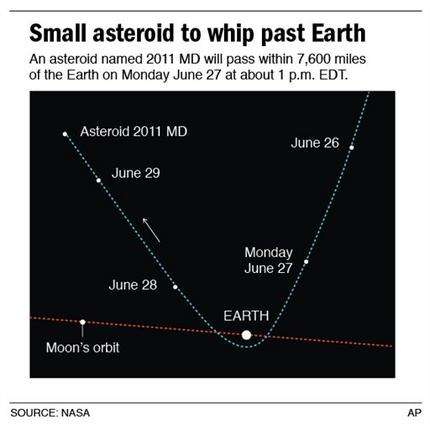
Illustration shows path of asteroid 2011 MD.

An asteroid the size of a tour bus has zipped harmlessly past Earth.

The space rock flew 7,600 miles above the Earth's surface. It sailed high above the southern Atlantic Ocean at closest approach.

The asteroid was discovered last week by telescopes in New Mexico. It is between 15 feet and 60 feet wide. Scientists say asteroids this size sail past Earth every six years.

Earlier this year, a smaller came within 3,400 miles of Earth.

Explore further: Dark, massive asteroid to fly by Earth on May 31

More information: NASA's near Earth object program: http://neo.jpl.nasa.gov/index.html

5 /5 (2 votes)
add to favorites email to friend print save as pdf

Related Stories

Mystery object to whizz by Earth Wednesday

Jan 12, 2010

(AP) -- A mystery object from space is about to whizz close by Earth on Wednesday. It won't hit our planet, but scientists are stumped by what exactly it is.

Huge asteroid hurtles toward Earth

Jun 29, 2006

An asteroid that's about one-half-mile wide is hurtling toward Earth, expected to narrowly miss the planet early Monday.

Small asteroid to pass within Earth-Moon system Tuesday

Oct 11, 2010

(PhysOrg.com) -- A small asteroid will fly past Earth early Tuesday within the Earth-moon system. The asteroid, 2010 TD54, will have its closest approach to Earth's surface at an altitude of about 45,000 kilometers ...

Space rock gives Earth a close shave

Mar 03, 2009

An asteroid of a similar size to a rock that exploded above Siberia in 1908 with the force of a thousand atomic bombs whizzed close past Earth on Monday, astronomers said on Tuesday.

Recommended for you

Dark, massive asteroid to fly by Earth on May 31

16 hours ago

It's 1.7 miles long. Its surface is covered in a sticky black substance similar to the gunk at the bottom of a barbecue. If it impacted Earth it would probably result in global extinction. Good thing it is ...

Research team explains 'Lazarus' comets

19 hours ago

Astronomers from the University of Antioquia have discovered a graveyard of comets. These once-dormant comets, dubbed by astronomers as "The Lazarus comets," are now rejuvenated.

NASA ships sensors for seafaring satellite to France

20 hours ago

(Phys.org) —Three NASA-built instruments that are integral components of the next in a series of U.S./European ocean altimetry satellites have arrived in France for integration with their spacecraft in ...

Trip into space with DiCaprio costs $1.55m

20 hours ago

Leonardo DiCaprio is going to get closer to stars of a different kind as he heads into space aboard the Virgin Galactic, and a well-heeled bidder at the Cannes Film Festival has paid 1.2 million euros (1.5 million) to be ...

User comments : 5

Adjust slider to filter visible comments by rank

Display comments: newest first

Cave_Man
not rated yet Jun 27, 2011
If the other asteroid they are talking about is 99942 Apophis then someone needs a brain scan cuz that rock is much larger than this one at ~1k ft diameter.
JonnyMcA
5 / 5 (1) Jun 27, 2011
If the other asteroid they are talking about is 99942 Apophis then someone needs a brain scan cuz that rock is much larger than this one at ~1k ft diameter.


They are referring to asteroid 2011 CQ1 which was bout 1-2 metres in size, and swung past the earth on the 4th February 2011.
Shootist
1 / 5 (1) Jun 27, 2011
They refer to neither.
SteWe
1 / 5 (1) Jun 28, 2011
From the link given:

June 23, 2011
Small Asteroid to Whip Past Earth on June 27, 2011

Near-Earth asteroid 2011 MD will pass ...
JonnyMcA
5 / 5 (2) Jun 28, 2011
@ shootist and @SteWe

To clarify, Cave_Man was asking which asteroid they were referring to in the article when they stated "Earlier this year, a smaller space rock came within 3,400 miles of Earth."

Asteroid 2011 CQ1 passed by the earth at 3,400 miles of the earth on the 4th February 2011. This was about 1 or 2 metres in size.

More news stories

Galaxies fed by funnels of fuel

(Phys.org) —Computer simulations of galaxies growing over billions of years have revealed a likely scenario for how they feed: a cosmic version of swirly straws.

Source of life running out: water scientists

The majority of people on Earth people will face severe water shortages within a generation or two if pollution and waste continues unabated, scientists warned at a conference in Bonn Friday.

Dark, massive asteroid to fly by Earth on May 31

It's 1.7 miles long. Its surface is covered in a sticky black substance similar to the gunk at the bottom of a barbecue. If it impacted Earth it would probably result in global extinction. Good thing it is ...