Donors promise $4 billion to global vaccines body
Jun 13, 2011 By MARIA CHENG , Associated Press
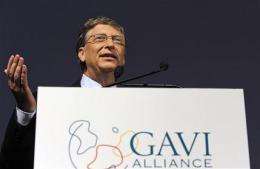
Microsoft founder and philanthropist Bill Gates speaks at the Global Alliance for Vaccines and Immunisation, GAVI, conference in London June 13, 2011. Australia and Britain have given the Global Alliance for Vaccines and Immunization a head start at its London pledging conference by committing more funds to support the campaign to prevent childhood disease. British Prime Minister David Cameron announced Monday that the British government will provide 814 million pounds ($1.3 billion) of new funding up to 2015. On Sunday, Australian Foreign Affairs Minister Kevin Rudd announced a commitment of 200 million Australian dollars ($211 million) in matching funds. (AP Photo/Paul Hackett, Pool)

(AP) -- Donors promised to give a global vaccines body more than $4 billion to help it protect millions of children from diseases like measles, pneumonia and yellow fever.

At a one-day pledging conference in London on Monday, British Prime Minister David Cameron announced the U.K. would provide 814 million pounds ($1.3 billion) of new funding up to 2015.

Australia announced on Sunday it would commit $211 million to the Global Alliance for Vaccines and Immunization, and the Bill & Melinda Gates Foundation declared it would donate more than $1 billion to the cause.

GAVI is an alliance of organizations including the Gates Foundation, the World Health Organization, UNICEF, major makers and others. The group buys injections for the world's poorest countries. They estimate about 2 million die every year from diseases that could have been prevented with a shot.

"Today is an important moment in our collective commitment to protecting children in developing countries from ," said Ellen Johnson Sirleaf, president of Liberia, in a statement.

Daniel Berman, a vaccines expert at Doctors Without Borders, said it was exciting so much money had been pledged and that many lives would be saved. But he questioned whether the millions of taxpayer dollars would be spent properly.

Executives from major vaccine companies also sit on GAVI advisory boards and influence their purchasing policies. GlaxoSmithKline Plc and Pfizer Inc. each get a subsidy of $225 million to produce pneumonia vaccines - which are then purchased by GAVI for about $3.50 a dose.

The subsidies are intended to convince vaccine makers to produce injections that aren't normally profitable. But in 2008, Pfizer reported making nearly $3 billion in sales from the shot. "Why are we lining the pockets of big pharma like this?" Berman asked. "That just screams conflict of interest and corporate welfare to us."

Health officials hope to vaccinate more than 250 million children, saving about 4 million lives in the next few years.

"For the first time in history, children in developing countries will receive the same vaccines against diarrhea and pneumonia as children in rich countries," said Bill Gates, co-chair of the Gates Foundation, in a statement. "Together we must do more to ensure that all children - no matter where they live- have equal access to life-saving vaccines."

Previous research has been raised about whether vaccines bought by GAVI are actually making it to the children who need them.

Several years ago, a study published in the journal Lancet showed dozens of exaggerated figures on how many children were vaccinated against deadly diseases, allowing them to get more money from GAVI. Researchers said only half as many children were immunized than was claimed by countries.

Other experts warned more money wouldn't solve the problem and that donating vaccines to countries with broken health systems might mean they just end up sitting in warehouses.

"We need to be mindful of the fact that investment in vaccines is not the magic answer to global health issues such as and diarrhea," said Sophie Harman, a public health expert at City University in London. "Without proper funding commitments to health infrastructure...any investment in vaccines will be redundant."

Explore further: Breakup of physician, drug company relationship could improve health care, cut cost

More information: http://www.gavialliance.org

not rated yet
add to favorites email to friend print save as pdf

Related Stories

Gates makes $10 billion vaccines pledge

Jan 29, 2010

(AP) -- The Bill and Melinda Gates Foundation will donate $10 billion over the next decade to research new vaccines and bring them to the world's poorest countries, the Microsoft co-founder and his wife said ...

Cost of child vaccines fall, more kids saved

Nov 20, 2009

(AP) -- Babies squirmed and wailed as needles plunged into their chubby thighs at a public health clinic on the outskirts of Hanoi on Friday. Like little ones everywhere, the reaction to the sting was never pretty.

Vaccine against world's top child killer launched

Feb 14, 2011

A vaccine against pneumonia, the leading cause of child deaths around the world, was rolled out in Kenya Monday and is expected to save hundreds of thousands of lives in coming years.

WHO approves cervical cancer vaccine Cervarix

Jul 09, 2009

(AP) -- The World Health Organization has approved a second cervical cancer vaccine, this one made by GlaxoSmithKline, meaning U.N. agencies and partners can now officially buy millions of doses of the vaccine for poor countries ...

Recommended for you

New sleeping pill poised to hit US markets

8 hours ago

An experimental sleeping pill from US drug company Merck is effective at helping people fall and stay asleep, according to reviewers at the US Food and Drug Administration, which could soon approve the new drug.

Global recommendations on child medicine

9 hours ago

Transparent information on the evidence supporting global recommendations on paediatric medicines should be easily accessible in order to help policy makers decides on what drugs to include in their national drug lists, according ...

FDA has safety concerns on Merck insomnia drug

May 20, 2013

Federal health regulators say an experimental insomnia drug from Merck can help patients fall asleep, but it also carries worrisome side effects, including daytime drowsiness and suicidal thinking.

US adviser on board of firm that sold anthrax drug

May 20, 2013

(AP)—Former Navy Secretary Richard J. Danzig, who has served as a bio-warfare adviser to the president, the Pentagon, and the Department of Homeland Security, urged the government to stockpile an anti-anthrax drug while ...

User comments : 0

More news stories

If you can remember it, you can remember it wrong

(Medical Xpress)—Native peoples in regions where cameras are uncommon sometimes react with caution when their picture is taken. The fear that something must have been stolen from them to create the photo ...

B vitamins could delay dementia

(Medical Xpress)—Despite spending billions of dollars on research and development, drug companies have been unable to come up with effective treatments for dementia and Alzheimer's Disease (AD). Now, A. ...

Reducing caloric intake delays nerve cell loss

Activating an enzyme known to play a role in the anti-aging benefits of calorie restriction delays the loss of brain cells and preserves cognitive function in mice, according to a study published in the May ...

Encouraging signs for bee biodiversity

Declines in the biodiversity of pollinating insects and wild plants have slowed in recent years, according to a new study. Researchers led by the University of Leeds and the Naturalis Biodiversity Centre in the Netherlands ...

New method for producing clean hydrogen

Duke University engineers have developed a novel method for producing clean hydrogen, which could prove essential to weaning society off of fossil fuels and their environmental implications.