Comet Hartley 2

Jun 15, 2011
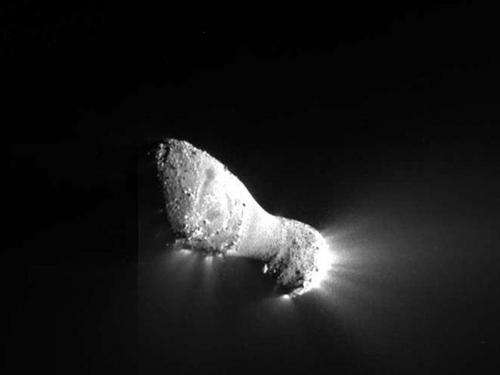
An optical image of Comet Hartley 2, taken by the the NASA EPOXI (Deep Impact) mission between Nov. 3 and 4, 2010, during the spacecraft's flyby of comet Hartley 2. Credit: NASA/JPL-Caltech/UMd

(PhysOrg.com) -- The comet Hartley 2 is a relatively small and elongated comet - only about 0.6 x 0.4 kilometers in size. It orbits the sun every 6.46 years, getting as close to it as 1.05 astronomical units (the Earth is at a distance of 1 AU) and as far away as 5.88 AU; Hartley 2 was discovered in 1986. In 2007, NASA decided to direct its Deep Impact satellite to visit Hartley 2, having completed its primary mission to study the comet Tempel 1. Hartley 2 was chosen because of its small size — about 100 times smaller in volume than Tempel 1 — and its odd propensity to shoot out relatively large amounts of gas and dust, a feature that makes it quite different from other known comets.

The mission reached Hartley 2 on November 4, 2010, and the results of its measurements, together with those from a multi-wavelength, multi-observatory campaign, appeared this month in the Astrophysical Journal Letters. CfA astronomer Scott Wolk was part of a large international team studying the comet during this period. He worked in particular with X-ray observations of Hartley 2 using the Chandra X-ray Observatory.

Hartley 2 had been flagged as a very active emitter of gas and material, but the astronomers found that most of this activity was actually coming from a large halo of fluffy, icy grains rather than from the nucleus of the comet itself, making the comet itself somewhat less strange.

Chandra detected X-ray emission due to the impact of atoms in the solar wind with molecular gas surrounding the comet. Models of the comet's overall behavior show that carbon dioxide gas evaporating from the comet is the dominant driver of its activity, at least once the comet gets near to its closest approach to the sun; this is the first time that carbon dioxide gas has been identified as being the dominant driving source of activity in a comet. The results shed new light on comets - the objects that are suspected of having brought water to the Earth in the early days of the solar system - and on the nature of the young solar system itself.

Explore further: Galaxy's Ring of Fire

add to favorites email to friend print save as pdf

Related Stories

Image: Comet Hartley 2 approaches Earth

Sep 30, 2010

A pale green interloper among the stars of Cassiopeia, Comet Hartley 2 shines in this four-minute exposure taken on the night of Sept. 28, 2010, by NASA astronomer Bill Cooke.

NASA spacecraft on final approach toward comet

Nov 02, 2010

(PhysOrg.com) -- The EPOXI mission spacecraft has refined its path toward a Nov. 4 flyby of comet Hartley 2, successfully performing its final maneuver today at 8 a.m. PDT (11 a.m. EDT). The spacecraft burned ...

Primordial dry ice fuels comet jets

Nov 10, 2010

One of the biggest comet findings coming out of the amazing images and data taken by the University of Maryland-led EPOXI mission as it zipped past comet Hartley 2 last week is that dry ice is the 'jet' fuel ...

Recommended for you

Galaxy's Ring of Fire

7 hours ago

Johnny Cash may have preferred this galaxy's burning ring of fire to the one he sang about falling into in his popular song. The "starburst ring" seen at center in red and yellow hues is not the product of ...

4C+29.30: Black hole powered jets plow into galaxy

May 15, 2013

(Phys.org) —This composite image of a galaxy illustrates how the intense gravity of a supermassive black hole can be tapped to generate immense power. The image contains X-ray data from NASA's Chandra X-ray ...

A space-time magnifying glass

May 15, 2013

(Phys.org) —Bright arcs are smeared around the heart of galaxy cluster Abell S1077 in this image taken by the NASA/ESA Hubble space telescope. The arcs are stretched images of distant galaxies distorted ...

User comments : 0

More news stories

Galaxy's Ring of Fire

Johnny Cash may have preferred this galaxy's burning ring of fire to the one he sang about falling into in his popular song. The "starburst ring" seen at center in red and yellow hues is not the product of ...

Alaska volcano shoots ash 15,000 feet into the air

(AP)—One of Alaska's most restless volcanoes has shot an ash cloud 15,000 feet into the air in an ongoing eruption that has drawn attention from a nearby community but isn't expected to threaten air traffic.

Chinese, Indian airlines face EU pollution fines

Eight Chinese and two Indian airlines face fines of up to several million euros for not paying for their greenhouse gas emissions during flights within the bloc, the European Commission said on Friday.

Morocco to harness the wind in energy hunt

Morocco is ploughing ahead with a programme to boost wind energy production, particularly in the southern Tarfaya region, where Africa's largest wind farm is set to open in 2014.

US seizes Bitcoin operator accounts

US authorities seized the accounts of a Bitcoin digital currency exchange operator, claiming it was functioning as an "unlicensed money service business," court documents showed Friday.