Comet-chasing probe goes into hibernation in 10-year trek
June 8, 2011

Comet-chasing probe goes into hibernation in 10-year trek

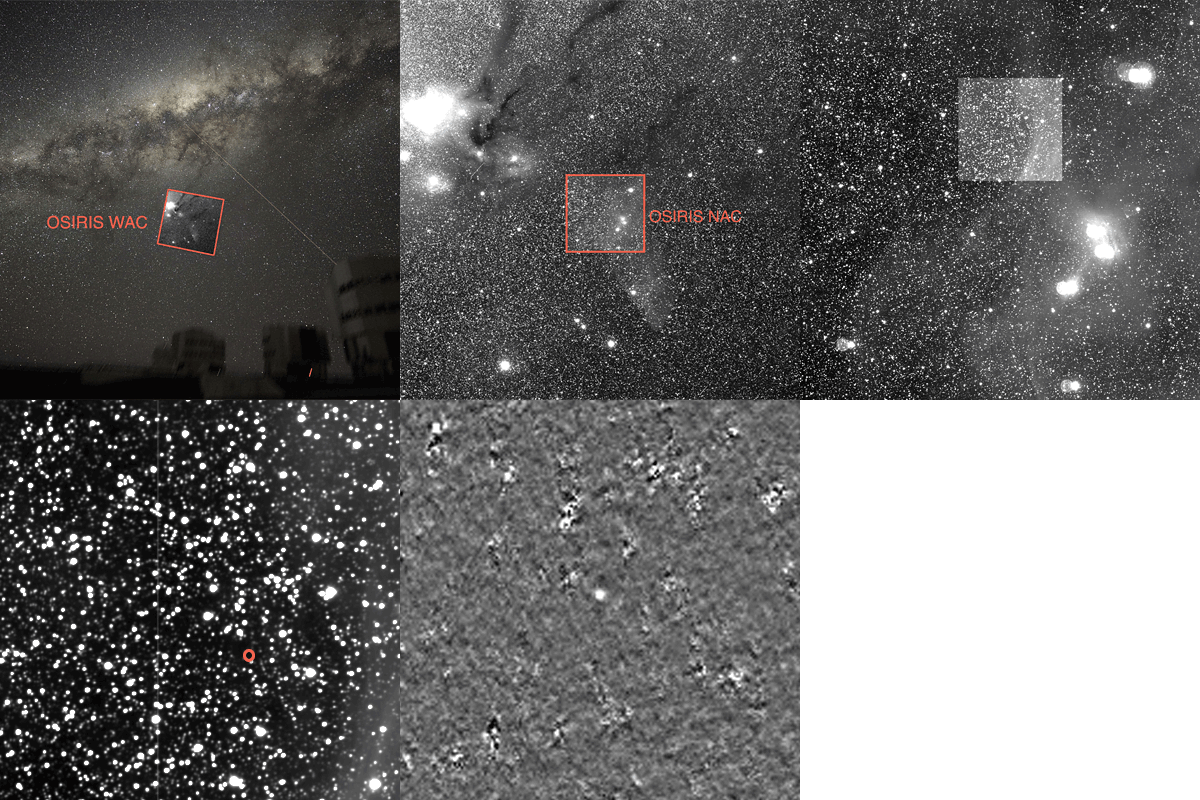
This animation comprises a series of images that include Comet 67-P/Churyumov-Gerasimenko acquired by the European Southern Observatory (ESO; first image only) and by Rosetta's OSIRIS imaging system (all subsequent images) on 25/26 March 2011 at a distance of 163 mn km. The images show a progressively narrower field of view, 'zooming in' on the comet, which initially is invisible against the background star field.

A billion-euro (1.47-billion-dollar) space probe was placed in hibernation on Wednesday until 2014, when it will be woken for a deep-space rendezvous with a comet, the European Space Agency (ESA) said.

The unmanned scoutcraft, Rosetta, is on a 10-year mission in which it will cover 7.1 billion kilometers (4.4 billion miles).

In May 2014, it is due to meet up with 67/P Churyumov-Gerasimenko 675 million kilometres (422 million miles) from home and then send down a refrigerator-sized lab called Philae to probe its surface.

At 1258 GMT Wednesday, ESA's Space Operations Centre in Darmstadt, Germany, sent a final command to close down almost all the onboard systems, including radio contact with Earth, thus sending Rosetta into a long sleep.

The three-tonne craft's solar panels will provide power for an onboard timer, which will count down the seconds to a wakeup call at exactly 1000 GMT on January 20 2014, ESA said in a press release.

The will also provide the electricity for several heaters to ensure the spacecraft does not freeze up.

"We sent the command via NASA's 70-metre (227-feet) station in Canberra, Australia, ensuring the signal was transmitted with enough power to reach Rosetta," Spacecraft Operations Manager Andrea Accomazzo said.

"We'll monitor via ESA's 35m (114-feet) station at New Norcia in Australia for a few days to see if any problems occur, but we expect to receive no until 2014. Rosetta's on her own now."

Rosetta's mission manager, Gerhard Schwehm, admitted to a frisson as the spacecraft -- approved as a project in 1993 and launched in 2004 -- was put into .

"We were all sitting there, watching. It was a special moment," he told AFP by phone.

Comets are a passionate subject of interest for solar scientists.

The theory is that they are "dirty snowballs" of ice and primordial dust that can provide insights into the building of the Solar System.

is the loneliest part of Rosetta's trip, a mission that is one of the biggest gambles in the history of space exploration.

To get to its distant meeting point, Rosetta had to play planetary billiards for five years, using four "gravitational assists" from Earth and Mars as slingshots to build up speed.

The craft also flew close by two asteroids, providing it with an excellent opportunity to calibrate its instruments.

Rosetta has already set a distance record for a spacecraft that is powered by solar energy alone. Deep-space probes usually have an atomic source to supplement their power when sunlight is very weak.

Schwehm said that the spacecraft's systems were in excellent health, although use of fuel to make course corrections had been slightly less efficient than hoped. But this should not affect the mission's goals or timetable in any way, he said.

After tracking the comet, Rosetta will escort it during its loop around the Sun, with the mission scheduled to end in December 2015.

(c) 2011 AFP


Rank 5 /5 (1 vote)
Relevant PhysicsForums posts
  • revamping general concept and cosmological principle
    createdMay 25, 2012
  • Transiting Exoplanet Light Curve
    createdMay 25, 2012
  • Math behind Theoretical Physics
    createdMay 24, 2012
  • Do we know whats at the center of galaxies yet?
    createdMay 23, 2012
  • Structure of the Milky Way?
    createdMay 20, 2012
  • What would it take to terraform Pluto and Charon?
    createdMay 19, 2012
  • More from Physics Forums - General Astronomy

More news stories

Sophisticated simulations predict future warming

The chances of our planet being hit by a global warming of 3 degrees Celsius by 2050 is as likely as it being hit by an increase of 1.4 degrees, new research shows. Presented in the journal Nature Geoscience, the British study ...

Space & Earth / Earth Sciences

created May 22, 2012 | popularity 4.4 / 5 (9) | comments 51

Kyoto Protocol architect 'frustrated' by climate dialogue

UN climate talks are going nowhere, as politicians dither or bicker while the pace of warming dangerously speeds up, one of the architects of the Kyoto Protocol told AFP.

Space & Earth / Environment

created May 23, 2012 | popularity 3.7 / 5 (7) | comments 39

Aliens don't want to eat us, says former SETI director

Alien life probably isn’t interested in having us for dinner, enslaving us or laying eggs in our bellies, according to a recent statement by former SETI director Jill Tarter.

Space & Earth / Space Exploration

created May 25, 2012 | popularity 4.4 / 5 (13) | comments 37

Dragon arrives at space station in historic 1st (Update 2)

The privately bankrolled Dragon capsule made a historic arrival at the International Space Station on Friday, triumphantly captured by astronauts wielding a giant robot arm.

Space & Earth / Space Exploration

created May 25, 2012 | popularity 5 / 5 (10) | comments 19

What's the big deal about private space launches?

(AP) -- The first private spaceship is headed to the International Space Station. Some questions and answers about the cargo mission by Space Exploration Technologies, known as SpaceX:

Space & Earth / Space Exploration

created May 22, 2012 | popularity 5 / 5 (6) | comments 32


Nvidia trumpets Tegra 3 phone design wins for 2012

(Phys.org) -- Nvidia’s competitive war paint has a name, Tegra 3. On the heels of Nvidia announcements about lowering costs of its Tegra 3 processors and Nvidia-enabled tablets running Android Ice Cream ...

Browser wars flare in mobile space

The browser wars are heating up again, but this time the fight is for dominance of the mobile Internet.

Scientist: Evolution debate will soon be history

(AP) -- Richard Leakey predicts skepticism over evolution will soon be history. Not that the avowed atheist has any doubts himself.

Dell tablet leak: 10.1-inch display, two-battery choice

(Phys.org) -- Headline after headline talks about vendors’ tablets in the wings as likely number-one contenders for the iPad. Such claims have justifiably been taken with a grain of salt, considering ...

Keep food safety in mind this memorial day weekend

(HealthDay) -- Picnics, parades and cookouts are as much a part of Memorial Day weekend as tributes to the United States' war veterans.

Social welfare cuts ultimately come with heavy price, researchers say

(Phys.org) -- Slashing government funding for Medicaid, food stamps and other programs that serve the poor – while politically popular with some lawmakers and many conservatives – may do more harm ...