Chemist solves riddle of killer diseases
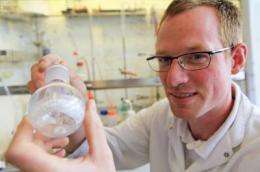
Using the tools of synthetic chemistry, Copenhagen chemist Christian Marcus Pedersen has copied the endotoxin of bacteria causing diseases such as anthrax. This paves the way for new and efficient antibiotics. Credit: Photo: Jes Andersen/University of Copenhagen
Anthrax, septicemia and meningitis are some of the planet's most deadly infections. In part because doctors lack basic insights to prevent and cure diseases caused by so called Gram-positive bacteria. Now, a chemist from the University of Copenhagen has revealed the mechanism behind these deadly infections.
By creating a synthetic version of a Gram-positive bacterial endotoxin, Danish synthetic chemist Christian Marcus Pedersen has made a contribution that'll compel immune biologists to revise their textbooks. More importantly, he has paved the first steps of the way towards new and effective types of antibiotics.
Chemist in international collaboration with biologists and physicians
The research results were attained in collaboration with Prof. Richard R. Schmidt of the University of Konstanz and biologists at the Leibniz-Zentrum für Medizin und Biowissenschaften in Borstel, Germany. Ulrich Zähringer, leader of the Center in Borstel, is thrilled with Pedersen's achievement.
"No one knew what substance Gram-positive bacteria released to make us sick. But because Pedersen can supply us with substances that are entirely pure, and have a known structure and composition, we are able to get a more precise answer as to why we show symptoms when these bacteria enter our body," explains Professor Zähringer.
Synthesis succeeds where biologists gave up
Lipoteichoic acid, is a substance created and present in the cell wall of Gram positive bacteria. It appears to be the culprit of stimulating immune response symptoms such as fever, inflammation and organ failure. Indeed, when exploring illness, it is critical to investigate the substances that bind themselves to healthy human cells and thus, the cell wall becomes an important place to look. But if the substance breaks down as soon as it comes under the microscope, the chances of studying its binding abilities are not very great. Therefore, it was a major breakthrough when Pedersen was able to fabricate the molecule from scratch.
"Biologists have been trying to isolate this poison from living organisms for years. But the substance has a number of active groups. That is to say, the spiked parts of the molecule which enable the entire molecule to bind to cells. This makes it extremely difficult to purify. And dirty molecules are not conducive to viable research. Therefore, it's a great advantage to fabricate the substance synthetically, because we can "build" a molecule in which everything is included... Or where we ourselves decide which part of the structure to leave out," says Christian Marcus Pedersen.
Tiresome task but outstanding results
Lipoteichoic acid consists of 335 atoms combined in tangle, the complexity of which has made it difficult to collect. To create pure and intact molecules, Pedersen needed to complete 88 so-called synthesis steps. That is to say that 88 distinct "recipes", all of which needed to function, were required in order to reach the final result. These synthetic biomolecules are a fantastic tool for biologists in the investigation of Gram-positive bacteria's attack mechanisms.
"When it comes to these bacteria, there is still no one who knows precisely what on the bacteria activates the immune system. But we can build the precise parts of the structure that we want to. And biologists can examine how what we have built reacts with the immune system," says Pedersen.
Provided by University of Copenhagen
-
From lemons to lemonade: Reaction uses carbon dioxide to make carbon-based semiconductor,
32 comments
-
Thioridazine kills cancer stem cells in human while avoiding toxic side-effects of conventional cancer treatments,
3 comments
-
SpaceX private rocket blasts off for space station (Update),
42 comments
-
Climate scientists say they have solved riddle of rising sea,
31 comments
-
SpaceX capsule has 'new car' smell, astronauts say (Update),
2 comments
-
Gibbs Free Energy Change/Entropy
4 hours ago
-
What's the rule to covalent character
5 hours ago
-
Schwartz reagent-- NMR/MS/IR
May 26, 2012
-
High school chemistry EEI
May 25, 2012
-
oxidation of I- by KMnO4
May 25, 2012
-
Inversion temp
May 25, 2012
- More from Physics Forums - Chemistry
More news stories
New CO2-removing catalyst can take the heat
(Phys.org) -- The current method of removing the greenhouse gas carbon dioxide (CO2) from the flues of coal-fired power plants uses so much energy that no one bothers to use it. So says Roger Aines, principal ...
May 24, 2012 |
5 / 5 (7) |
7
|
High-speed method to aid search for solar energy storage catalysts
Eons ago, nature solved the problem of converting solar energy to fuels by inventing the process of photosynthesis.
May 25, 2012 |
5 / 5 (3) |
4
|
Researchers demonstrate possible primitive mechanism of chemical info self-replication
(Phys.org) -- When scientists think about the replication of information in chemistry, they usually have in mind something akin to what happens in living organisms when DNA gets copied: a double-stranded molecule ...
May 25, 2012 |
5 / 5 (4) |
2
|
Building a better solar panel -- one molecule at a time
(Phys.org) -- One of the fundamental building blocks in modern chemistry, an organometallic chemical compound called ferrocene, has never been structurally defined - until now.
May 25, 2012 |
5 / 5 (3) |
0
|
Discarded data may hold the key to a sharper view of molecules
(Phys.org) -- There's nothing like a new pair of eyeglasses to bring fine details into sharp relief. For scientists who study the large molecules of life from proteins to DNA, the equivalent of new lenses have come in the ...
May 24, 2012 |
4.7 / 5 (3) |
0
|
Nvidia trumpets Tegra 3 phone design wins for 2012
(Phys.org) -- Nvidias competitive war paint has a name, Tegra 3. On the heels of Nvidia announcements about lowering costs of its Tegra 3 processors and Nvidia-enabled tablets running Android Ice Cream ...
Browser wars flare in mobile space
The browser wars are heating up again, but this time the fight is for dominance of the mobile Internet.
Scientist: Evolution debate will soon be history
(AP) -- Richard Leakey predicts skepticism over evolution will soon be history. Not that the avowed atheist has any doubts himself.
Dell tablet leak: 10.1-inch display, two-battery choice
(Phys.org) -- Headline after headline talks about vendors tablets in the wings as likely number-one contenders for the iPad. Such claims have justifiably been taken with a grain of salt, considering ...
Keep food safety in mind this memorial day weekend
(HealthDay) -- Picnics, parades and cookouts are as much a part of Memorial Day weekend as tributes to the United States' war veterans.
Social welfare cuts ultimately come with heavy price, researchers say
(Phys.org) -- Slashing government funding for Medicaid, food stamps and other programs that serve the poor while politically popular with some lawmakers and many conservatives may do more harm ...