First Australian spinosaur dinosaur had global distribution
Could the first Australian spinosaur dinosaur be a Baryonyx? New research has uncovered a fossil cervical vertebra that is nearly identical to a Baryonyx specimen at the Museum. This research suggests spinosaurs lived all over the world.
(PhysOrg.com) -- Could the first Australian spinosaur dinosaur be a Baryonyx? New research has uncovered a fossil cervical vertebra that is nearly identical to a Baryonyx specimen at the Museum. This research suggests spinosaurs lived all over the world.
The first spinosaur dinosaur from the Early Cretaceous (125-100 million years ago) of Australia has been uncovered and suggests these meat-eating dinosaurs lived all over the planet, scientists report in the journal Biology Letters today.
Scientists from the Natural History Museum and University of Cambridge in the UK and the Museum Victoria and Monash University in Australia, identified a fossil cervical vertebra from a site in Victoria, Australia.
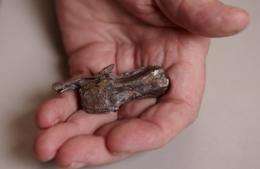
Spinosaur fossil. Credit: Jon Augier and Museum Victoria
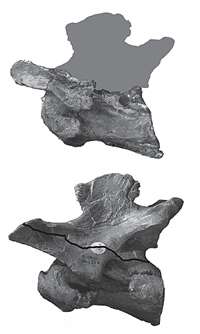
They found that the fossil belonged to a young dinosaur in the meat-eating (theropod) group called spinosaurids."The new fossil is the first example of a spinosaurid dinosaur from Australia," says Paul Barrett Natural History Museum dinosaur expert who led this study. "It is almost identical to the Natural History Museums own Baryonyx specimen from England."

Cervical vertebra of the new spinosaur find, on top, compared to one from the Museum Baryonyx, at bottom. Credit: Adapted from Biology Letters
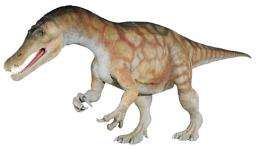
Baryonyx was the 10-meter-long dinosaur that had a crocodile-shaped mouth and claws like a bear. It lived 125 million years ago in the Early Cretaceous.North-south divide?
A patchy fossil record has led to the general idea that certain dinosaur species occurred only in the northern continents and others only in the southern continents.
For example, tyrannosaurs, dromaeosaurids (Velociraptor-like dinosaurs) and their relatives in the north, and abelisauroids such as Carnotaurus in the south.
This new find, along with an Australian tyrannosaur discovery published by the same team in March last year, suggests that most meat-eating dinosaurs lived all over the globe and had much broader distributions than generally thought.
Barrett explains, "New finds from Australia and elsewhere are starting to demolish this north-south pattern.
"They are showing that many of the dinosaurs that we used to think of as distinctively northern or southern in character were much more widespread during this particular period of Earth history.
"Were starting to find more similarities than differences as we look at these recent finds in more detail."
Supercontinental break up
When dinosaurs roamed the planet during the Cretaceous Period, the Earths surface looked very different to how it does today.
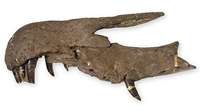
Fossil specimen of a Baryonyx snout looked after at the Museum.
The single supercontinent called Pangaea that had been present for many millions of years was just starting to break up. The new spinosaur find is dated to this time, suggesting they lived all over the globe before Pangaea's break up.Pangaea gradually broke apart, first into a southern continent called Gondwana and a northern continent called Laurasia. Later these landmasses split into the continents we recognise today, which then gradually moved towards their present-day arrangement.
Just like a Baryonyx
The Natural History Museum looks after a world-class palaeontological collection of 9 million specimens.
The new dinosaur fossil find is from a site called Eric the Red West.
It is almost identical to the cervical vertebrae of the Museums Baryonyx walkeri specimen, uncovered in England in 1983.
"Although the new Australian find is almost identical to Baryonyx, we decided not to name it," says Barrett.
"The single vertebra does not preserve enough detail to establish if all parts of the skeleton were like those of Baryonyx and new more complete finds will be necessary to settle this question."
Provided by
American Museum of Natural History
-
From lemons to lemonade: Reaction uses carbon dioxide to make carbon-based semiconductor,
32 comments
-
Thioridazine kills cancer stem cells in human while avoiding toxic side-effects of conventional cancer treatments,
3 comments
-
SpaceX private rocket blasts off for space station (Update),
42 comments
-
Climate scientists say they have solved riddle of rising sea,
31 comments
-
SpaceX capsule has 'new car' smell, astronauts say (Update),
2 comments
-
What would stain as translucent on light-coloured fabric?
17 hours ago
-
How do I identify different bacteria on culture plates?
May 26, 2012
-
Why Do Dogs do Strange things...
May 25, 2012
-
What does exophillic and endophillic mean in terms of mosquito and their control?
May 24, 2012
-
Semen stains glows under black lights (uv light)?
May 23, 2012
-
Question on Human Chromosome 2
May 23, 2012
- More from Physics Forums - Biology
More news stories
Social welfare cuts ultimately come with heavy price, researchers say
(Phys.org) -- Slashing government funding for Medicaid, food stamps and other programs that serve the poor while politically popular with some lawmakers and many conservatives may do more harm ...
Other Sciences / Social Sciences
May 24, 2012 |
4.3 / 5 (16) |
133
Ancient Bethlehem seal unearthed in Jerusalem
Israeli archaeologists have discovered a 2,700-year-old seal that bears the inscription "Bethlehem," the Israel Antiquities Authority announced Wednesday, in what experts believe to be the oldest artifact ...
Other Sciences / Archaeology & Fossils
May 23, 2012 |
3.5 / 5 (14) |
23
Oldest Jewish archaeological evidence on the Iberian Peninsula
German archaeologists of the Friedrich Schiller University Jena found one of the oldest archaeological evidence so far of Jewish Culture on the Iberian Peninsula at an excavation site in the south of Portugal, ...
Other Sciences / Archaeology & Fossils
May 25, 2012 |
4.3 / 5 (4) |
12
Dollars and sense: Why are some people morally against tax?
As the U.S. presidential election campaigns heat up, the economic debate is dominated by bailouts, austerity and, inevitably, taxation. Now a new study published in Symbolic Interaction asks why tax is such an important issue ...
Other Sciences / Social Sciences
May 23, 2012 |
3 / 5 (2) |
12
Oldest art even older
New dates from Geißenklösterle Cave in Southwest Germany document the early arrival of modern humans and early appearance of art and music.
Other Sciences / Archaeology & Fossils
May 24, 2012 |
4.3 / 5 (3) |
6
Nvidia trumpets Tegra 3 phone design wins for 2012
(Phys.org) -- Nvidias competitive war paint has a name, Tegra 3. On the heels of Nvidia announcements about lowering costs of its Tegra 3 processors and Nvidia-enabled tablets running Android Ice Cream ...
Browser wars flare in mobile space
The browser wars are heating up again, but this time the fight is for dominance of the mobile Internet.
Scientist: Evolution debate will soon be history
(AP) -- Richard Leakey predicts skepticism over evolution will soon be history. Not that the avowed atheist has any doubts himself.
Dell tablet leak: 10.1-inch display, two-battery choice
(Phys.org) -- Headline after headline talks about vendors tablets in the wings as likely number-one contenders for the iPad. Such claims have justifiably been taken with a grain of salt, considering ...
Keep food safety in mind this memorial day weekend
(HealthDay) -- Picnics, parades and cookouts are as much a part of Memorial Day weekend as tributes to the United States' war veterans.
Is a classical electrodynamics law incompatible with special relativity?
(Phys.org) -- The laws of classical electromagnetism that were developed in the 19th century are the same laws that scientists use today. They include Maxwell’s four equations along with the Lorentz la ...