Airplane deployed to monitor air over NM fire
June 29, 2011 By P. SOLOMON BANDA and SUSAN MONTOYA BRYAN , Associated Press
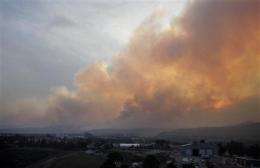
Smoke from the Las Conchas fire fills the sky near the Los Alamos Laboratory in Los Alamos, N.M., Tuesday, June 28, 2011. A vicious wildfire spread through the mountains above a northern New Mexico town on Tuesday, driving thousands of people from their homes as officials at the government nuclear laboratory tried to dispel concerns about the safety of sensitive materials. (AP Photo/Jae C. Hong)
(AP) -- The government sent a plane equipped with radiation monitors over the Los Alamos nuclear laboratory Wednesday as a 110-square-mile wildfire burned at its doorstep, putting thousands of scientific experiments on hold for days.
Lab authorities described the monitoring as a precaution, and they, along with outside experts on nuclear engineering, expressed confidence that the blaze would not scatter radioactive material, as some residents feared.
"Our facilities, our nuclear materials are all safe, they're accounted for and they're protected," said lab director Charles McMillan.
The twin-engine plane, which can take digital photographs and video as well as thermal and night images, was sent to New York City to take air samples after the Sept. 11 terrorist attacks. It has flown over wildfires and areas damaged by Hurricane Katrina. It monitored the 2002 Winter Olympics in Salt Lake City. It also helped locate debris from the disintegrated space shuttle Columbia shuttle.
"It can look for a wide variety of chemical constituents in a plume and the plumes can originate from fires, from explosions, from a wide variety of sources," said lab spokesman Kevin Roark.
And in a testament to the sophisticated research done at Los Alamos, the plane was developed with technology from the lab, the desert installation that built the atomic bomb during World War II.
The pillars of smoke that can be seen as far as Albuquerque, 60 miles away, have people on edge. The fire has also cast a haze as far away as Kansas. But officials said they analyzed samples taken Tuesday night from some of the lab's monitors and the results showed nothing abnormal in the smoke.
Anti-nuclear groups have sounded the alarm about thousands of 55-gallon drums containing low-grade nuclear waste - gloves, tools and other contaminated items - about two miles from the fire. Lab officials said it was highly unlikely the blaze would reach the drums, and that the steel containers can in any case withstand flames and will be sprayed with fire-resistant foam if necessary.
Kevin Smith, site manager for the National Nuclear Security Administration, said the lab's precautions have been scrutinized by dozens of experts.
The lab has been shut down since Monday, when all of the city of Los Alamos and some of its surrounding areas - 12,000 people in all - was evacuated. The fire has held up research on such topics as renewable energy, AIDS and particle physics.
"We have 10,000 experiments running at the same time," said Terry Wallace, science chief at the lab. "We'll have to do an analysis to see what's been affected and how it's been affected."
The plane is just one part of an elaborate air monitoring network surrounding the lab. The lab and the New Mexico Environment Department have dozens of monitors on the ground throughout the region. McMillan said four high-volume air samplers were deployed Tuesday and more were on their way Wednesday.
Some experts familiar with the Los Alamos lab said there is no reason to fear that flames will scatter radiation.
"The nuclear materials are secure," said Penn State University nuclear engineering professor Barry Scheetz, who has served on National Academy of Sciences nuclear review boards and has been to Los Alamos several times. "There's multiple redundancy in the protection of this material. It's not just laying out. It's not there so that a fire is going to disrupt it there and disperse it. The procedures that are in place to protect this material are tremendous."
He added: "The U.S. government, the Department of Energy, has spent literally hundreds of millions of dollars for scenarios that are so unlikely to occur that it is even ridiculous to think about."
©2011 The Associated Press. All rights reserved. This material may not be published, broadcast, rewritten or redistributed.
-
From lemons to lemonade: Reaction uses carbon dioxide to make carbon-based semiconductor,
32 comments
-
Thioridazine kills cancer stem cells in human while avoiding toxic side-effects of conventional cancer treatments,
3 comments
-
SpaceX private rocket blasts off for space station (Update),
42 comments
-
Climate scientists say they have solved riddle of rising sea,
31 comments
-
SpaceX capsule has 'new car' smell, astronauts say (Update),
2 comments
-
Hypothetical desert earth
12 hours ago
-
More human population = greater mass?
May 25, 2012
-
Conversion from aircraft bearing to normal degrees
May 23, 2012
-
Interpretation/Analysis of the Lab results(HEPA filter)
May 22, 2012
-
Has anyone here attended the The Urbino Summer School in Paleoclimatology?
May 22, 2012
-
Earthquakes: Mag 6 N. Italy and Mag 5.6 W. Bulgaria
May 21, 2012
- More from Physics Forums - Earth
More news stories
Sophisticated simulations predict future warming
The chances of our planet being hit by a global warming of 3 degrees Celsius by 2050 is as likely as it being hit by an increase of 1.4 degrees, new research shows. Presented in the journal Nature Geoscience, the British study ...
Space & Earth / Earth Sciences
May 22, 2012 |
4.4 / 5 (9) |
51
Kyoto Protocol architect 'frustrated' by climate dialogue
UN climate talks are going nowhere, as politicians dither or bicker while the pace of warming dangerously speeds up, one of the architects of the Kyoto Protocol told AFP.
May 23, 2012 |
3.7 / 5 (7) |
39
Aliens don't want to eat us, says former SETI director
Alien life probably isnt interested in having us for dinner, enslaving us or laying eggs in our bellies, according to a recent statement by former SETI director Jill Tarter.
Space & Earth / Space Exploration
May 25, 2012 |
4.4 / 5 (13) |
37
Dragon arrives at space station in historic 1st (Update 2)
The privately bankrolled Dragon capsule made a historic arrival at the International Space Station on Friday, triumphantly captured by astronauts wielding a giant robot arm.
Space & Earth / Space Exploration
May 25, 2012 |
5 / 5 (10) |
19
What's the big deal about private space launches?
(AP) -- The first private spaceship is headed to the International Space Station. Some questions and answers about the cargo mission by Space Exploration Technologies, known as SpaceX:
Space & Earth / Space Exploration
May 22, 2012 |
5 / 5 (6) |
32
Nvidia trumpets Tegra 3 phone design wins for 2012
(Phys.org) -- Nvidias competitive war paint has a name, Tegra 3. On the heels of Nvidia announcements about lowering costs of its Tegra 3 processors and Nvidia-enabled tablets running Android Ice Cream ...
Browser wars flare in mobile space
The browser wars are heating up again, but this time the fight is for dominance of the mobile Internet.
Scientist: Evolution debate will soon be history
(AP) -- Richard Leakey predicts skepticism over evolution will soon be history. Not that the avowed atheist has any doubts himself.
Dell tablet leak: 10.1-inch display, two-battery choice
(Phys.org) -- Headline after headline talks about vendors tablets in the wings as likely number-one contenders for the iPad. Such claims have justifiably been taken with a grain of salt, considering ...
Keep food safety in mind this memorial day weekend
(HealthDay) -- Picnics, parades and cookouts are as much a part of Memorial Day weekend as tributes to the United States' war veterans.
Social welfare cuts ultimately come with heavy price, researchers say
(Phys.org) -- Slashing government funding for Medicaid, food stamps and other programs that serve the poor while politically popular with some lawmakers and many conservatives may do more harm ...