Zapping deadly bacteria using space technology
May 27, 2011

Zapping deadly bacteria using space technology

Enlarge

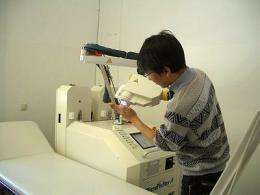
MicroPlaSter beta version of the atmospheric plasma device for chronic wound treatment. Credits: Max-Planck Institute for Extraterrestrial Physics

Technology developed with ESA funding and drawing on long-running research aboard the International Space Station is opening up a new way to keep hospital patients safe from infections.

Using plasma – superheated, electrically charged gas – Max Planck Institute for Extraterrestrial Physics director Gregor Morfill is developing ways to kill bacteria and viruses that can cause infections in hospitals.

“What we have with plasma is the possibility to supplement our own immune system,” says Dr. Morfill.  
 
The research began on the (ISS), where his ESA-funded physics experiments have been running since 2001.

The first was ‘Plasmakristall Experiment Nefedov’ in cooperation with Russian partners. Later, the PK-3 Plus and PK-4 experiments flew in 2006 as part of ESA’s Astrolab mission.

“It’s the longest-running space experiment in the history of human spaceflight,” notes Dr. Morfill. More than two dozen astronauts and cosmonauts have operated the equipment aboard the ISS.
Zapping deadly bacteria using space technology
Enlarge

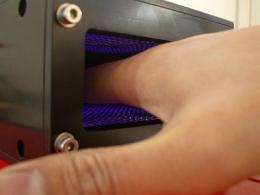
Laboratory prototype plasma device for sanitising hands. Credits: Max-Planck Institute for Extraterrestrial Physics

The work in space led to the realisation that plasma might have very practical terrestrial applications – and Dr. Morfill turned to ESA's Technology Transfer Program to make it a reality.

Plasma dispensers can tackle a serious problem: in recent years, health experts have seen a dramatic rise in super-strains of bacteria that can survive the strongest antibiotics in medicine’s arsenal.

One, the multiple drug-resistant Staphylococcus aureus – perhaps better known as MRSA – kills 37 000 people each year in the EU alone. It affects more than 150 000 patients, resulting in extra in-hospital costs of €380 million for EU healthcare systems.

With help from ESA, Dr. Morfill’s team is now focusing on developing a system for hospitals, but cold plasma technology might one day also make it into our homes. Plasma could be used to disinfect toothbrushes and razors instead of UV light, which only sanitizes the surfaces it shines on. Plasma-charged gas would clean in hidden cracks and crevices, too.

At the other end of the spectrum, he says that plasma could be used as a ‘planetary protection system’ to clean satellites and planetary probes so they don’t carry terrestrial bacteria to distant planets.

The technology looks likely to do a lot of good. Bacteria are constantly evolving, developing resistance to the most commonly used antibiotics. Today, the best way to prevent the spread of bacterial infections is sanitation: regular hand washing between patients, for example, and systematic sanitising of floors, door handles, hospital curtains and anything else that might harbor infectious material.

Instead, Dr. Morfill is designing a system that makes use of ’s innate antibacterial properties to make disinfection easy and quick.

“It has many practical applications, from hand hygiene to food hygiene, disinfection of medical instruments, personal hygiene, even dentistry – this could be used in many, many fields.”

Dr. Morfill adds that the research on the ISS and support from ESA has played an important role in turning physics experiments into life-saving technology here on Earth, both directly through ESA funding of a technology demonstrator project and through classic ‘trickle down’ of the specific technology transfer.

“ESA has been tremendously helpful – we’re 90% funded by ESA,” Dr. Morfill concludes. “Funding for doing experimental work in the laboratory and in space has made it possible to spin off and start other research.”

Provided by European Space Agency search and more info website


Rank not rated yet
Relevant PhysicsForums posts

More news stories

Browser wars flare in mobile space

The browser wars are heating up again, but this time the fight is for dominance of the mobile Internet.

Technology / Software

created 5 hours ago | popularity 5 / 5 (1) | comments 2

Probability of contamination from severe nuclear reactor accidents is higher than expected: study

Catastrophic nuclear accidents such as the core meltdowns in Chernobyl and Fukushima are more likely to happen than previously assumed. Based on the operating hours of all civil nuclear reactors and the number ...

Technology / Energy & Green Tech

created May 22, 2012 | popularity 3.6 / 5 (22) | comments 56 | with audio podcast

SpotterRF debuts Radar Backpack Kit (w/ Video)

(Phys.org) -- SpotterRF has announced a special radar backpack kit designed to enhance situational awareness for soldiers on the ground. The company says its special radar is designed for warfighters as part ...

Technology / Hi Tech & Innovation

created May 26, 2012 | popularity 5 / 5 (5) | comments 12 | with audio podcast report

HyperSolar shows dirty water no barrier to power world

(Phys.org) -- The Santa Barbara, California, company, HyperSolar, is set to transparently share the ups and downs of its research experiences toward the company’s ultimate vision, successfully producing ...

Technology / Energy & Green Tech

created May 24, 2012 | popularity 4.8 / 5 (16) | comments 17 | with audio podcast report

Tesla to launch electric sedan in US on June 22

Tesla Motors said Tuesday it would begin deliveries of "the world's first premium electric sedan" on June 22, slightly ahead of schedule.

Technology / Energy & Green Tech

created May 22, 2012 | popularity 4.5 / 5 (11) | comments 18


Nvidia trumpets Tegra 3 phone design wins for 2012

(Phys.org) -- Nvidia’s competitive war paint has a name, Tegra 3. On the heels of Nvidia announcements about lowering costs of its Tegra 3 processors and Nvidia-enabled tablets running Android Ice Cream ...

Scientist: Evolution debate will soon be history

(AP) -- Richard Leakey predicts skepticism over evolution will soon be history. Not that the avowed atheist has any doubts himself.

Dell tablet leak: 10.1-inch display, two-battery choice

(Phys.org) -- Headline after headline talks about vendors’ tablets in the wings as likely number-one contenders for the iPad. Such claims have justifiably been taken with a grain of salt, considering ...

Keep food safety in mind this memorial day weekend

(HealthDay) -- Picnics, parades and cookouts are as much a part of Memorial Day weekend as tributes to the United States' war veterans.

Social welfare cuts ultimately come with heavy price, researchers say

(Phys.org) -- Slashing government funding for Medicaid, food stamps and other programs that serve the poor – while politically popular with some lawmakers and many conservatives – may do more harm ...

Is a classical electrodynamics law incompatible with special relativity?

(Phys.org) -- The laws of classical electromagnetism that were developed in the 19th century are the same laws that scientists use today. They include Maxwell’s four equations along with the Lorentz la ...