WISE mission offers a taste of galaxies to come
May 25, 2011 by Whitney Clavin
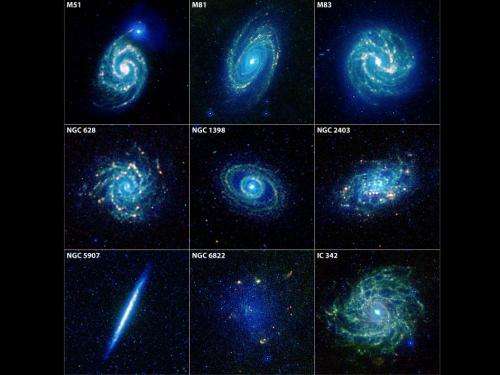
A new, colorful collection of galaxy specimens has been released by NASA's Wide-field Infrared Survey Explorer, or WISE, mission. Image credit: NASA/JPL-Caltech/UCLA
(PhysOrg.com) -- An assorted mix of colorful galaxies is being released today by NASA's Wide-field Infrared Survey Explorer mission, or WISE. The nine galaxies are a taste of what's to come. The mission plans to release similar images for the 1,000 largest galaxies that appear in our sky, and possibly more.
"Galaxies come in all sorts of delicious flavors," said Tom Jarrett, a WISE team member at the Infrared Processing and Analysis Center, California Institute of Technology, in Pasadena, who studies our Milky Way's neighboring galaxies. "Our first sample shows what WISE is capable of. We can produce spectacular high-resolution images of the largest galaxies."
The new collage showcases galaxies of varying types -- everything from "grand design spirals," with their elegant cinnamon bun-like swirling arms, to so-called "flocculent" galaxies, which have a more patchy appearance. They are close enough to us that WISE can see details of their structure, for example their sinuous arms and central bulges. Because WISE can study so many types of nearby galaxies, its observations will provide a better understanding of how these complex objects form and evolve.
WISE, which launched into space in Dec. 2009, scanned the whole sky one-and-a-half times in infrared light. It captured images of asteroids in our own solar system, distant galaxies billions of light-years away, and everything in between. The mission's first batch of data, which does not include all of the galaxies in the new collage, was released to the public in April of this year. The complete WISE catalog will follow a year later, in the spring of 2012.
"We can learn about a galaxy's stars -- where are they forming and how fast?" said Jarrett. "There's so much diversity in galaxies to explore."
The new collection of nine galaxies shows off this diversity, with members of different sizes, colors and shapes. Infrared light from the galaxies, which we can't see with our eyes, has been translated into visible-light colors that we can see. Blue colors show older populations of stars, while yellow indicates dusty areas where stars are forming.
Some of the galaxies are oriented toward us nearly face-on, such as Messier 83, and others are partly angled away from us, for example Messier 81. One galaxy, NGC 5907, is oriented completely edge-on, so that all we can see is its profile. The edge of its main galaxy disk appears pencil-thin, and its halo of surrounding stars is barely visible as a green glow above and below the disk.
The arms of the galaxies come in different shapes too. Messier 51 has arms that look like a spiral lollipop, while the arms of the flocculent galaxy NGC 2403 look choppy, perhaps more like layered frosting. Astronomers think that gravitational interactions with companion galaxies may lead to more well-defined spiral arms. One such companion can be seen near Messier 51 in blue. Some of the galaxies also have spokes, or spurs, that join the arms together, such as those in IC 342.
Provided by
JPL/NASA
-
From lemons to lemonade: Reaction uses carbon dioxide to make carbon-based semiconductor,
32 comments
-
Thioridazine kills cancer stem cells in human while avoiding toxic side-effects of conventional cancer treatments,
3 comments
-
SpaceX private rocket blasts off for space station (Update),
42 comments
-
Climate scientists say they have solved riddle of rising sea,
31 comments
-
SpaceX capsule has 'new car' smell, astronauts say (Update),
2 comments
-
revamping general concept and cosmological principle
May 25, 2012
-
Transiting Exoplanet Light Curve
May 25, 2012
-
Math behind Theoretical Physics
May 24, 2012
-
Do we know whats at the center of galaxies yet?
May 23, 2012
-
Structure of the Milky Way?
May 20, 2012
-
What would it take to terraform Pluto and Charon?
May 19, 2012
- More from Physics Forums - General Astronomy
More news stories
Sophisticated simulations predict future warming
The chances of our planet being hit by a global warming of 3 degrees Celsius by 2050 is as likely as it being hit by an increase of 1.4 degrees, new research shows. Presented in the journal Nature Geoscience, the British study ...
Space & Earth / Earth Sciences
May 22, 2012 |
4.4 / 5 (9) |
51
Kyoto Protocol architect 'frustrated' by climate dialogue
UN climate talks are going nowhere, as politicians dither or bicker while the pace of warming dangerously speeds up, one of the architects of the Kyoto Protocol told AFP.
May 23, 2012 |
3.7 / 5 (7) |
39
Aliens don't want to eat us, says former SETI director
Alien life probably isnt interested in having us for dinner, enslaving us or laying eggs in our bellies, according to a recent statement by former SETI director Jill Tarter.
Space & Earth / Space Exploration
May 25, 2012 |
4.4 / 5 (13) |
37
Dragon arrives at space station in historic 1st (Update 2)
The privately bankrolled Dragon capsule made a historic arrival at the International Space Station on Friday, triumphantly captured by astronauts wielding a giant robot arm.
Space & Earth / Space Exploration
May 25, 2012 |
5 / 5 (10) |
19
What's the big deal about private space launches?
(AP) -- The first private spaceship is headed to the International Space Station. Some questions and answers about the cargo mission by Space Exploration Technologies, known as SpaceX:
Space & Earth / Space Exploration
May 22, 2012 |
5 / 5 (6) |
32
Nvidia trumpets Tegra 3 phone design wins for 2012
(Phys.org) -- Nvidias competitive war paint has a name, Tegra 3. On the heels of Nvidia announcements about lowering costs of its Tegra 3 processors and Nvidia-enabled tablets running Android Ice Cream ...
Browser wars flare in mobile space
The browser wars are heating up again, but this time the fight is for dominance of the mobile Internet.
Scientist: Evolution debate will soon be history
(AP) -- Richard Leakey predicts skepticism over evolution will soon be history. Not that the avowed atheist has any doubts himself.
Dell tablet leak: 10.1-inch display, two-battery choice
(Phys.org) -- Headline after headline talks about vendors tablets in the wings as likely number-one contenders for the iPad. Such claims have justifiably been taken with a grain of salt, considering ...
Keep food safety in mind this memorial day weekend
(HealthDay) -- Picnics, parades and cookouts are as much a part of Memorial Day weekend as tributes to the United States' war veterans.
Social welfare cuts ultimately come with heavy price, researchers say
(Phys.org) -- Slashing government funding for Medicaid, food stamps and other programs that serve the poor while politically popular with some lawmakers and many conservatives may do more harm ...
May 25, 2011
Rank: 2.3 / 5 (6)
May 25, 2011
Rank: 1 / 5 (6)
May 26, 2011
Rank: 4 / 5 (4)
This Specpotater person is obviously completely clueless about what he is commenting on. His many comments on other articles likewise leads one to believe that he has sadly had no science education, or if he did, that he wasn't paying attention in class.
Specpotater just because you don't understand what is being talked about doesn't mean it is rubbish, so please refrain from spouting nonsense in a vain attempt to attract some attention. Your continued rants will lead the rest of us more educated people to the conclusion that either you have some serious mental condition - in which case you should seriously consider seeking medical help - or that you are just spouting nonsense to deliberately subvert these threads and annoy those of us who have a genuine scientific articles.
May 26, 2011
Rank: 3 / 5 (2)
"or that you are just spouting nonsense to deliberately subvert these threads and annoy those of us who have a genuine scientific interest in these articles."
May 26, 2011
Rank: 5 / 5 (4)
Quite an accurate send-up; at first read, I took Specpotator for the original :)