When the speed of light depends on its direction
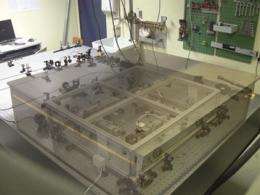
The optical cavity used in the experiment. Credit: Cécile Robilliard / CNRS
Light does not travel at the same speed in all directions under the effect of an electromagnetic field. Although predicted by theory, this counter-intuitive effect has for the first time been demonstrated experimentally in a gas by a French team from the Laboratoire 'Collisions Agregats Reactivite' at CNRS. The researchers measured with extreme precision, of around one billionth m/s, the difference between the light propagation speeds in one direction and in the opposite direction. These results open the way to more in-depth research aimed at improving the model that describes elementary particle interactions. Published on the 11 May 2011 in the journal Physical Review Letters, they point to novel applications in optics.
In an absolute vacuum, light travels at a constant velocity of 299,792,458 m/s. It seems natural that it should propagate at the same speed in all directions. However, counter-intuitively, there are situations in which this property is not valid, particularly when an electric field and a magnetic field are applied. Such cases were first predicted by theory in the late 1970s and should even be observed in a vacuum. However, these very slight variations are difficult to confirm experimentally.
Technological progress has now made it possible to detect these effects in a gas (in this instance nitrogen). To observe them, researchers from CNRS designed an optical cavity in which the light beams pass through a device comprising magnets and electrodes, which makes it possible to generate intense electric and magnetic fields (the applied magnetic field is 20,000 times greater than that of the Earth). In this way they succeeded in demonstrating experimentally, for the first time, that light does not travel at the same speed in opposing directions in a gas where an electromagnetic field reigns. The measured difference in velocity is around one billionth m/s (i.e. 10-9 m/s, which is equivalent to 10-18 times the speed of light). This infinitesimal difference, predicted by theory, is caused by the magnetic and electric fields.
These results open up several new avenues. Firstly, they could allow measurements of the anisotropy of light propagation to be pushed even further. By increasing the sensitivity of the measuring device, researchers could, one day, observe minute failures of Lorentz invariance, which is a fundamental symmetry expressed as part of the theory of relativity. This would make it possible to test certain theoretical proposals to improve the standard model (a model which today describes all of the interactions between elementary particles). Secondly, such directional anisotropy governed by an electromagnetic field could open up novel applications in optics, such as components whose behavior would differ depending on the direction, with everything being controlled by a magnetic field.
More information: Magnetoelectric directional nonreciprocity in molecular nitrogen gas. B. Pelle, H. Bitard, G. Bailly and C. Robilliard. Physical Review Letters, 11 May 2011. DOI: 10.1103/PhysRevLett.106.193003
Abstract
We report the direct observation of the nonreciprocity of the velocity of light, induced by electric and magnetic fields. This bilinear magneto-electro-optical effect appears in crossed electric and magnetic fields perpendicular to the light wave vector, as a refractive index difference between two counterpropagating directions. Using a high finesse ring cavity, we have measured this magnetoelectric nonreciprocity in molecular nitrogen at ambient temperature and atmospheric pressure; for light polarized parallel to the magnetic field it is 2η∥exp(N2)=(4.7±1)×10-23 m V-1 T-1 for λ=1064 nm, in agreement with the expected order of magnitude. Our measurement opens the way to a deeper insight into light-matter interaction beyond the electric dipole approximation. We were able to measure a nonreciprocity as small as Δn=(5±2)×10-18, which makes its observation in quantum vacuum a conceivable challenge.
Provided by
CNRS
-
From lemons to lemonade: Reaction uses carbon dioxide to make carbon-based semiconductor,
32 comments
-
Thioridazine kills cancer stem cells in human while avoiding toxic side-effects of conventional cancer treatments,
3 comments
-
SpaceX private rocket blasts off for space station (Update),
42 comments
-
Climate scientists say they have solved riddle of rising sea,
31 comments
-
SpaceX capsule has 'new car' smell, astronauts say (Update),
2 comments
-
[Drift velocity] Factors affecting velocity
2 hours ago
-
does cold gasoline have less energy
3 hours ago
-
distribution of molecules throughout the atmosphere
5 hours ago
-
The Global Positioning System !
6 hours ago
-
A Question relating Power
7 hours ago
-
Writing a book so im learning about things, i have some general questions please read
9 hours ago
- More from Physics Forums - General Physics
More news stories
Is a classical electrodynamics law incompatible with special relativity?
(Phys.org) -- The laws of classical electromagnetism that were developed in the 19th century are the same laws that scientists use today. They include Maxwell’s four equations along with the Lorentz la ...
Landmark calculation clears the way to answering how matter is formed
(Phys.org) -- An international collaboration of scientists, including Thomas Blum, associate professor of physics, is reporting in landmark detail the decay process of a subatomic particle called a kaon ...
May 25, 2012 |
4.2 / 5 (21) |
47
|
Lying in wait for WIMPs: Researchers seek to dramatically increase sensitivity of Large Underground Xenon detector
Although it's invisible, dark matter accounts for at least 80 percent of the matter in the universe. No one knows what it is, but most scientists would bet on weakly interacting massive particles, or WIMPs.
May 23, 2012 |
4 / 5 (7) |
15
|
Hawaii lab turns laser-powered bubbles into microrobots
(Phys.org) -- A team of scientists from the University of Hawaii are working on microrobots created from bubbles of air in a saline solution. The bubbles take on their title of robots as a laser ...
Sound increases the efficiency of boiling
Scientists at the Georgia Institute of Technology achieved a 17-percent increase in boiling efficiency by using an acoustic field to enhance heat transfer. The acoustic field does this by efficiently removing vapor bubbles ...
May 24, 2012 |
5 / 5 (2) |
2
Nvidia trumpets Tegra 3 phone design wins for 2012
(Phys.org) -- Nvidias competitive war paint has a name, Tegra 3. On the heels of Nvidia announcements about lowering costs of its Tegra 3 processors and Nvidia-enabled tablets running Android Ice Cream ...
Browser wars flare in mobile space
The browser wars are heating up again, but this time the fight is for dominance of the mobile Internet.
Scientist: Evolution debate will soon be history
(AP) -- Richard Leakey predicts skepticism over evolution will soon be history. Not that the avowed atheist has any doubts himself.
Dell tablet leak: 10.1-inch display, two-battery choice
(Phys.org) -- Headline after headline talks about vendors tablets in the wings as likely number-one contenders for the iPad. Such claims have justifiably been taken with a grain of salt, considering ...
Keep food safety in mind this memorial day weekend
(HealthDay) -- Picnics, parades and cookouts are as much a part of Memorial Day weekend as tributes to the United States' war veterans.
Social welfare cuts ultimately come with heavy price, researchers say
(Phys.org) -- Slashing government funding for Medicaid, food stamps and other programs that serve the poor while politically popular with some lawmakers and many conservatives may do more harm ...
May 13, 2011
Rank: 5 / 5 (3)
May 13, 2011
Rank: 4.8 / 5 (4)
May 13, 2011
Rank: not rated yet
May 13, 2011
Rank: 5 / 5 (3)
This isn't quite the same thing . . . the light in this case isn't being bent, it's being slowed, but only in one direction.
Seems to me that the importance of this experiment is in the ability to observe an effect that was too tiny to notice before, and that it verifies a theoretical prediction.
May 13, 2011
Rank: not rated yet
I think, (it's been a long time since I looked at the theory) the presence of EM fields potentially create a miniscule but non-zero gravitational field.
I could be incorrect on that proposition though.
May 13, 2011
Rank: 2 / 5 (3)
Not "wrong", exactly, but there has been some question regarding whether GR can be ontologically consistent AND completely reciprocal at the same time. This work shows the existence of asymmetrical reciprocity- which may be an opening large enough to assuage the philosophers.
Some background reading here: http://www.pitt.e...dex.html
May 13, 2011
Rank: not rated yet
I think you're referring to a discussion at the higher end of the intellectual spectrum -- not the one represented by the Conservapedia article on relativity.
If that sounds like an encouragement to read said article, I must add that I do NOT recommend it: "You'll be sorry."
May 13, 2011
Rank: 1.5 / 5 (4)
Where did you get this idea? Do you know what dark matter consists of? To date, I know of no explanation of what dark matter is, let alone an ability to bend light. I would appreciate information on the subject. Respectfully.
May 13, 2011
Rank: 1 / 5 (1)
Under that assumption, I think that any force carrier particle, such as a photon for example, would have gravity. However, if it is guided by E=MCsquared, by definition the mass and gravity equivalent of energe would be vanishingly small (Like hundreds of millions times smaller) compared to matter.
I'm curious about this affect. The universe is full of electromagnetic fields. How would a photon be affected over cosmological scales. And since the fields are so mixed, over 5 billion light years, a distortion of 5 meters could have a signifant effect on say, a 5 meter telescope.
i know that's an extreme example, but consider that when we look at a galaxy, 2 photons from opposite sides of the galaxy will encounter significantly different EM fields for part of their way to us - and it would take very little effect to impact how we see things.
May 13, 2011
Rank: 0 / 5 (23)
No they don't.
"Wouldn't that explain this?" - JudgeKing
The explanation comes of course from quantum mechanics, and the increase in vacuum energy in the space that contains the electromagnetic field in question. Higher vacuum energy = more scattering = slower light speed.
May 14, 2011
Rank: not rated yet
There are some papers going in this direction, for example David Apsel's explanation of longer muon lifetime than expected in muonic atoms - by using electromagnetic time dilation.
Such effect could be essential for pulsar star observation because of their huge magnetic fields: http://arxiv.org/.../0104025
May 14, 2011
Rank: 5 / 5 (3)
This has to be a different effect. If it was a simple warping of spacetime then the light would be affected the same going in both directions.
May 14, 2011
Rank: not rated yet
What does philosophy have to do with physics? The discipline exhibits a great deal of inertia with no relationship to substance. It experiences significant time dilation in attempting to apply obsolete 18th century fiction to 21st century reality. It is composed of strange matter which could turn the globe into a ball of gray goo if it could propagate but there is little danger of this. It is a metamaterial cloak which luckily is transparent at all higher energy wavelengths.
May 14, 2011
Rank: 5 / 5 (1)
May 14, 2011
Rank: not rated yet
No. I [i]hate[/i] to recommend that anyone read the Convservapedia article on relativity, but if you do you [i]will[/i] understand. It is [i]so[/i] bad that it has been often described as a collaboration between Loki trolls and honestly crazy people.
May 14, 2011
Rank: 5 / 5 (1)
Actually, I got around to finally looking at the article linked to by Tektrix. It's an ordinary article on special relativity and it simply explains that what seems paradoxical (tunnel paradox) isn't.
There's nothing controversial in it at all.
May 14, 2011
Rank: 1 / 5 (1)
..."Department of History and Philosophy of Science..."
-Philosophy of science. Philosophy_of_science. The article is inadequate for explaining the exact and intricate relationships among physical laws, with WORDS. It does give people the impression however that words can be used for this purpose and that perhaps scientists use words INSTEAD of math, when the truth is they use words as shorthand for the equations which do describe the phenomena they are discussing.
It also provides philosophers, who are running short on excuses for why none of their word theories can explain anything, with something of apparent relevance to do.
Words cannot explain relativity except to scientists who know the math those words represent. Period. And scientists certainly do not need number-blind philos doing their interpreting for them.
May 14, 2011
Rank: 0.1 / 5 (25)
http://pra.aps.or.../e015801
May 14, 2011
Rank: 5 / 5 (1)
May 14, 2011
Rank: 1 / 5 (1)
May 15, 2011
Rank: 0.2 / 5 (26)
No.
What has been confirmed through measurement is the existence of a flow in the zero point field. Electric fields at the same time enhance and suppress the spontaneous charge separation of the zero point field along the path of the field. A magnetic field acting at right angles then induces a net flow in the zero point field at a direction that is in the direction B x E.
Photons interacting with that flow are retarded if they move against it, or sped up if they move with it. Hence the anisotropy.
This process is also most probably the origin of spin at the quantum level.
The zero point field spins. The electrons don't.
May 15, 2011
Rank: 0.2 / 5 (26)
Since c is no longer a constant and yet is defined as a constant with length defined in terms of c.
What this experiment shows is not a change in c, but by definition a change in the span of the universe in the direction B x E.
A change that is not real of course, but one which is demanded by the definitions.
May 15, 2011
Rank: 1 / 5 (3)
As for photons interacting with a vacuum or Empty Space per se, there should be no doubt that actions are taking place constantly, albeit minimal and unknown at the present time. Each experiment brings the subject of LIGHT to a greater awareness of its dynamics. Photons are merely particles that must interact with their surroundings.
May 15, 2011
Rank: 5 / 5 (3)
Yes, that was the pre-relativistic notion. It was dropped because (subleties like the article above excepted) the concept was not supported by either observation or experiment.
May 15, 2011
Rank: 3 / 5 (1)
Firstly, "absolute vacuum" as in "absolutely empty space" does not really exist. And secondly, if "absolute vacuum" really existed somewhere, the speed of light within would be infinite.
Correct, energy content should equal gravitational potential. In the scope of this article's experiment however, this effect is mutually negated between the individual measurements (given equal field strength).
Haven't read the paper, but I think the effect might be rather related to the fact, that a mag.field = EM flux, and that light is (and propagates as) an EM wave. So, in principle, this could be about how EM flux affects the propagation/dispersion of a trespassing EM wave @var. angles
May 16, 2011
Rank: 0.1 / 5 (25)
I have already given you a related reference and a reasonably thorough explanation.
See above.
Jun 14, 2011
Rank: 1 / 5 (2)
They must be trying to get more funding from th government.