Transiting super-Earth detected around naked eye star
May 2, 2011 By Jon Voisey, Universe Today
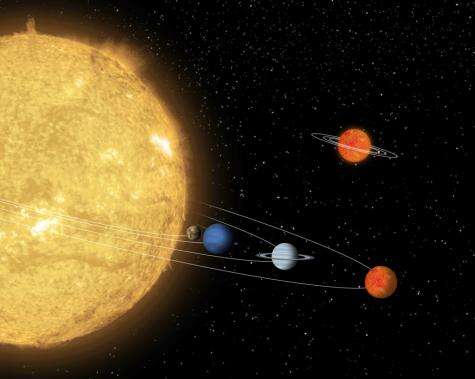
One of the first known stars to host an extrasolar planet, was that of 55 Cancri. The first planet in this system was reported in 1997 and today the system is known to host at least five planets, the inner most of which, 55 Cnc e, was recently discovered to transit the star, giving new information about this planet.
55 Cnc is an interesting system in many respects. Being a mere 41 lightyears from the Earth, the system is composed of a primary, yellow dwarf star in a wide binary orbit (1,000 AU) with a red dwarf. The planetary system lies within this orbit. The primary star is just brighter than 6th magnitude meaning it is visible to the naked eye under good viewing conditions.
One of these planets, 55 Cnc e, was discovered in this system via radial velocity measurements in 2004. At that point, the planet was reported to have a period of 2.8 days, and a minimum mass of 14.2 times the mass of the Earth. However, in 2010, Rebekah Dawson and Daniel Fabrycky from the Harvard-Smithsonian Center for Astrophysics argued that gaps in the observational period skewed the statistics and the true period the planet should be a short 0.7365 days.
One of the results of this was that the planet would have to orbit closer to the parent star. In turn, this increased the likelihood that the planet could transit the star from 13% to 33%. A team led by Joshua Winn from the Massachusetts Institute of Technology went searching for this faint transit and report its detection in a recent paper. But while the star itself is the brightest star in our sky to harbor known extrasolar planets, brighter than any other host by two full magnitudes, the eclipse is far from visible without precise observations, changing by only 0.0002%, one of the smallest changes known. The timing of the eclipses confirms that correction by Dawson and Fabrycky and adds new information about the body.
Given the radius determined as well as the mass, the team was able to estimate the structure of the planet and report that the mass is 8.57 ± 0.64 Earth masses. The reported radius is 1.63 ± 0.16 times that of Earth, and the density is 10.9 ± 3.1 g cm-3 (the average density of Earth is 5.515 g cm-3). This places the planet firmly into the categories of a rocky super-Earth.
The team also explores whether or not the planet could retain an atmosphere in such a close orbit (only three times the radius of the star itself). At this close range, the planet would likely be tidally locked and with an albedo typical of rocky planets, the planet would likely have an average temperature of nearly 2970 K (5,000° F). If the planet were able to redistribute the heat, it may be as low as 2100 K (3,300° F). Either way, a planet of such mass would have difficulty retaining any primordial, gaseous atmosphere. However, the team reports that it may be possible for volcanic activity to create a thin atmosphere of high molecular weight components.
While this new report adds precious little in the grand scheme of the rapidly growing body of knowledge of exoplanets, the authors close with the note that, there is some pleasure in being able to point to a naked-eye star and know the mass and radius of one of its planets.
Source: Universe Today
-
From lemons to lemonade: Reaction uses carbon dioxide to make carbon-based semiconductor,
32 comments
-
Thioridazine kills cancer stem cells in human while avoiding toxic side-effects of conventional cancer treatments,
3 comments
-
SpaceX private rocket blasts off for space station (Update),
42 comments
-
Climate scientists say they have solved riddle of rising sea,
31 comments
-
Research team claims to have found evidence Lake Cheko is impact crater for Tunguska Event,
18 comments
-
revamping general concept and cosmological principle
May 25, 2012
-
Transiting Exoplanet Light Curve
May 25, 2012
-
Math behind Theoretical Physics
May 24, 2012
-
Do we know whats at the center of galaxies yet?
May 23, 2012
-
Structure of the Milky Way?
May 20, 2012
-
What would it take to terraform Pluto and Charon?
May 19, 2012
- More from Physics Forums - General Astronomy
More news stories
SpaceX capsule has 'new car' smell, astronauts say (Update)
SpaceX's Dragon cargo vessel smells like a new car, said astronauts at the International Space Station after opening the hatches Saturday following the spacecraft's landmark mission to the orbiting lab.
Space & Earth / Space Exploration
22 hours ago |
4.5 / 5 (20) |
2
Australia hails surprise super-telescope decision
Australia has hailed a surprise decision giving it a role in a radio telescope project aimed at revolutionising astronomy, vowing to draw on its decades of experience in space science.
22 hours ago |
5 / 5 (4) |
2
Astronomers seize last chance in lifetime for Venus Transit
Astronomers are gearing for one the rarest events in the Solar System: an alignment of Earth, Venus and the Sun that will not be seen for another 105 years.
22 hours ago |
5 / 5 (3) |
2
Astronauts enter world's 1st private supply ship
(AP) -- Space station astronauts floated into the Dragon on Saturday, a day after its heralded arrival as the world's first commercial supply ship.
Space & Earth / Space Exploration
22 hours ago |
5 / 5 (6) |
0
Sophisticated simulations predict future warming
The chances of our planet being hit by a global warming of 3 degrees Celsius by 2050 is as likely as it being hit by an increase of 1.4 degrees, new research shows. Presented in the journal Nature Geoscience, the British study ...
Space & Earth / Earth Sciences
May 22, 2012 |
4.4 / 5 (9) |
51
Browser wars flare in mobile space
The browser wars are heating up again, but this time the fight is for dominance of the mobile Internet.
Nvidia trumpets Tegra 3 phone design wins for 2012
(Phys.org) -- Nvidias competitive war paint has a name, Tegra 3. On the heels of Nvidia announcements about lowering costs of its Tegra 3 processors and Nvidia-enabled tablets running Android Ice Cream ...
Scientist: Evolution debate will soon be history
(AP) -- Richard Leakey predicts skepticism over evolution will soon be history. Not that the avowed atheist has any doubts himself.
Dell tablet leak: 10.1-inch display, two-battery choice
(Phys.org) -- Headline after headline talks about vendors tablets in the wings as likely number-one contenders for the iPad. Such claims have justifiably been taken with a grain of salt, considering ...
SpotterRF debuts Radar Backpack Kit (w/ Video)
(Phys.org) -- SpotterRF has announced a special radar backpack kit designed to enhance situational awareness for soldiers on the ground. The company says its special radar is designed for warfighters as part ...
Thousands of shellfish found dead in Peru
Thousands of crustaceans were found dead off the coast of Lima following the mystery mass death of dolphins and pelicans, the Peruvian Navy said Friday.
May 02, 2011
Rank: 4 / 5 (2)
No E.T. here. Move along...move along...
May 03, 2011
Rank: 1 / 5 (1)