New synchrotron X-ray technique could see hidden building blocks of life

The European Synchrotron Radiation Facility (ESRF) is located in Grenoble, France. The experiments were performed using beams of X-rays provided by one of the world's most brilliant light sources. Credit: ESRF
Scientists from Finland and France have developed a new synchrotron X-ray technique that may revolutionize the chemical analysis of rare materials like meteoric rock samples or fossils. The results have been published on 29 May 2011 in Nature Materials as an advance online publication.
Life, as we know it, is based on the chemistry of carbon and oxygen. The three-dimensional distribution of their abundance and chemical bonds has been difficult to study up to now in samples where these elements were embedded deep inside other materials. Examples are tiny inclusions of possible water or other chemicals inside martian rock samples, fossils buried inside a lava rock, or minerals and chemical compounds within meteorites.
X-ray tomography, which is widely used in medicine and material science, is sensitive to the shape and texture of a given sample but cannot reveal chemical states at the macroscopic scale. For instance graphite and diamond both consist of pure carbon, but they differ in the chemical bond between the carbon atoms. This is why their properties are so radically different. Imaging the variations in atomic bonding has been surprisingly difficult, and techniques for imaging of chemical bonds are highly desirable in many fields like engineering and research in physics, chemistry, biology, and geology.
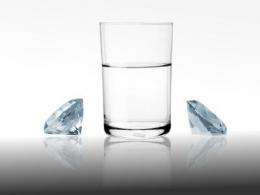
A diamond surrounded by air, and a glass of water. Both contain carbon and oxygen. If they are embedded inside another object, without access for a chemical probe, it is a difficult task to distinguish between even simple chemical bonds. A new synchrotron X-ray technique has made this now possible. Credit: Simo Huotari (University of Helsinki)
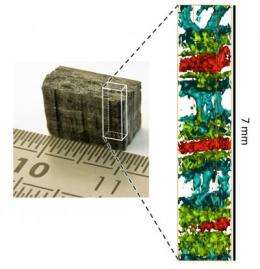
Now an international team of scientists from the University of Helsinki, Finland, and the European Synchrotron Radiation Facility (ESRF), Grenoble, France, has developed a novel technique that is suitable exactly for this purpose. The researchers use extremely bright X-rays from a synchrotron light source to form images of the chemical bond distribution of different carbon forms embedded deep in an opaque material; an achievement previously thought to be impossible without destroying the sample.The left part of the image shows a photograph of the sample, measuring approximately 7 x 10 x 5mm3. The part studied with X-rays was the indicated subvolume of 7 x 2 x 1mm3. The result, a detailed 3D map of chemical bonds, is visualised here as a 2-D cut through the subvolume, shown on the right, where the different colors represent the different chemical carbon bonds present in the sample. Credit: Simo Huotari (Helsinki University). With permission by Nature Materials.
"Now I would love to try this on Martian or moon rocks. Our new technique can see not only which elements are present in any inclusions but also what kind of molecule or crystal they belong to. If the inclusion contains oxygen, we can tell whether the oxygen belongs to a water molecule. If it contains carbon, we can tell whether it is graphite, diamond-like, or some other carbon form. Just imagine finding tiny inclusions of water or diamond inside martian rock samples hidden deep inside the rock", says Simo Huotari from the University of Helsinki.The newly developed method will give insights into the molecular level structure of many other interesting materials ranging, for example, from novel functional nanomaterials to fuel cells and new types of batteries.
More information: Simo Huotari et al., Direct tomography with chemical-bond contrast, Nature Materials advanded online publication, 29 May 2011, DOI:10.1038/NMAT3031
Provided by European Synchrotron Radiation Facility
-
From lemons to lemonade: Reaction uses carbon dioxide to make carbon-based semiconductor,
32 comments
-
Thioridazine kills cancer stem cells in human while avoiding toxic side-effects of conventional cancer treatments,
3 comments
-
SpaceX private rocket blasts off for space station (Update),
42 comments
-
Climate scientists say they have solved riddle of rising sea,
31 comments
-
Research team claims to have found evidence Lake Cheko is impact crater for Tunguska Event,
18 comments
-
What's the rule to covalent character
2 hours ago
-
Schwartz reagent-- NMR/MS/IR
20 hours ago
-
High school chemistry EEI
May 25, 2012
-
oxidation of I- by KMnO4
May 25, 2012
-
Inversion temp
May 25, 2012
-
Hybridization of SnCl3 -
May 25, 2012
- More from Physics Forums - Chemistry
More news stories
New CO2-removing catalyst can take the heat
(Phys.org) -- The current method of removing the greenhouse gas carbon dioxide (CO2) from the flues of coal-fired power plants uses so much energy that no one bothers to use it. So says Roger Aines, principal ...
May 24, 2012 |
5 / 5 (7) |
7
|
High-speed method to aid search for solar energy storage catalysts
Eons ago, nature solved the problem of converting solar energy to fuels by inventing the process of photosynthesis.
May 25, 2012 |
5 / 5 (3) |
4
|
Researchers demonstrate possible primitive mechanism of chemical info self-replication
(Phys.org) -- When scientists think about the replication of information in chemistry, they usually have in mind something akin to what happens in living organisms when DNA gets copied: a double-stranded molecule ...
May 25, 2012 |
5 / 5 (4) |
2
|
Building a better solar panel -- one molecule at a time
(Phys.org) -- One of the fundamental building blocks in modern chemistry, an organometallic chemical compound called ferrocene, has never been structurally defined - until now.
May 25, 2012 |
5 / 5 (3) |
0
|
Discarded data may hold the key to a sharper view of molecules
(Phys.org) -- There's nothing like a new pair of eyeglasses to bring fine details into sharp relief. For scientists who study the large molecules of life from proteins to DNA, the equivalent of new lenses have come in the ...
May 24, 2012 |
4.7 / 5 (3) |
0
|
Browser wars flare in mobile space
The browser wars are heating up again, but this time the fight is for dominance of the mobile Internet.
Nvidia trumpets Tegra 3 phone design wins for 2012
(Phys.org) -- Nvidias competitive war paint has a name, Tegra 3. On the heels of Nvidia announcements about lowering costs of its Tegra 3 processors and Nvidia-enabled tablets running Android Ice Cream ...
Scientist: Evolution debate will soon be history
(AP) -- Richard Leakey predicts skepticism over evolution will soon be history. Not that the avowed atheist has any doubts himself.
Dell tablet leak: 10.1-inch display, two-battery choice
(Phys.org) -- Headline after headline talks about vendors tablets in the wings as likely number-one contenders for the iPad. Such claims have justifiably been taken with a grain of salt, considering ...
SpotterRF debuts Radar Backpack Kit (w/ Video)
(Phys.org) -- SpotterRF has announced a special radar backpack kit designed to enhance situational awareness for soldiers on the ground. The company says its special radar is designed for warfighters as part ...
SpaceX capsule has 'new car' smell, astronauts say (Update)
SpaceX's Dragon cargo vessel smells like a new car, said astronauts at the International Space Station after opening the hatches Saturday following the spacecraft's landmark mission to the orbiting lab.


May 29, 2011
Rank: not rated yet
May 29, 2011
Rank: 5 / 5 (2)
May 29, 2011
Rank: not rated yet
Physorg you KNOW that the comment of "lifewebb" about this spamming is broadly felt and cogent! This spammer is turning your web site into a verbal trash dump worthy of the Trailer Park Boys. It is difficult to maintain a web presence like yours that allows healthy discussion...we know that. If you want people to take you seriously, respect you, you have to ask the 'spam neighbors' to STOP letting their dog crap in your yard - hope you understand my meaning!!!
word-to-ya-muthas