Spitzer photo atlas of galaxy 'train wrecks'
May 25, 2011

The Spitzer photo atlas of galactic 'train wrecks'

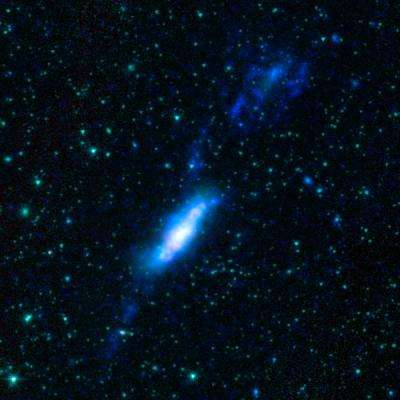
This three-color image of NGC 3448 (left) and its companion UGC 6016 (right) shows far-UV emission from young stars observed by GALEX in blue, heated dust mid-infrared emission observed by Spitzer in red, and stellar near-infrared emission observed by Spitzer in green. This pair of galaxies is only separated by 75,000 light-years, and its UV emission shows a bridge of material between the two galaxies. Credit: NASA / JPL-Caltech / L. Lanz (Harvard-Smithsonian CfA)

(PhysOrg.com) -- Five billion years from now, our Milky Way Galaxy will collide with the Andromeda Galaxy. This will mark a moment of both destruction and creation. The galaxies will lose their separate identities as they merge into one. At the same time, cosmic clouds of gas and dust will smash together, triggering the birth of new stars.

To understand our past and imagine our future, we must understand what happens when galaxies collide. But since galaxy collisions take place over millions to billions of years, we can’t watch a single collision from start to finish. Instead, we must study a variety of colliding galaxies at different stages. By combining recent data from two space
telescopes, astronomers are gaining fresh insights into the collision process.

“We’ve assembled an atlas of galactic ‘train wrecks’ from start to finish. This atlas is the first step in reading the story of how galaxies form, grow, and evolve,” said lead author Lauranne Lanz of the Harvard-Smithsonian Center for Astrophysics (CfA).

Lanz presented her findings today in a press conference at the 218th meeting of the American Astronomical Society.
The Spitzer photo atlas of galactic 'train wrecks'

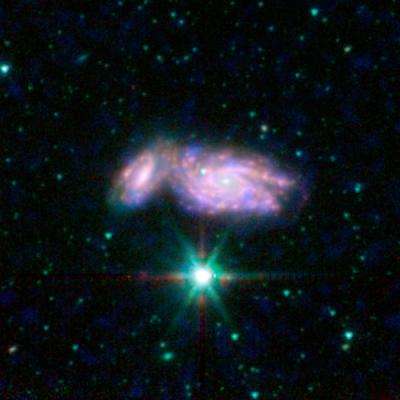
This three-color image of NGC 935 and its companion IC 1801 shows far-UV emission from young stars observed by GALEX in blue, heated dust mid-infrared emission observed by Spitzer in red, and stellar near-infrared emission observed by Spitzer in green. This pair of spiral galaxies is beginning to crash into each other. Credit: NASA / JPL-Caltech / L. Lanz (Harvard-Smithsonian CfA)

The new images combine observations from NASA’s Spitzer Space Telescope, which observes infrared light, and Galaxy Evolution Explorer (GALEX) spacecraft, which observes ultraviolet light. By analyzing information from different parts of the light spectrum, scientists can learn much more than from a single wavelength alone, because they observe different components of a galaxy.

GALEX’s ultraviolet data captures the emission from hot young stars. Spitzer sees the infrared emission from warm dust heated by those stars, as well as from stellar surfaces. Therefore, GALEX’s ultraviolet data and Spitzer’s infrared data highlight areas where stars are forming most rapidly, and together permit a more complete census of the new stars.

In general, galaxy collisions spark star formation. However, some interacting show fewer than others. Lanz and her colleagues want to figure out what differences in physical processes cause these different outcomes. Their findings will also help guide computer simulations of galaxy collisions.
The Spitzer photo atlas of galactic 'train wrecks'

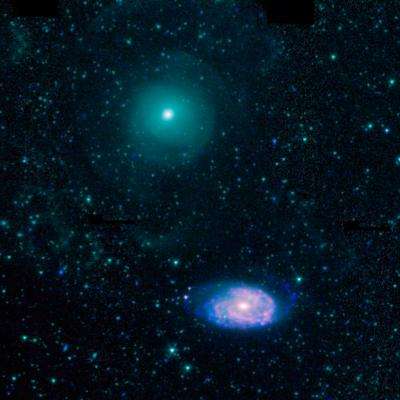
This three-color image of NGC 470 (top) and NGC 474 (bottom) shows far-UV emission from young stars observed by GALEX in blue, heated dust mid-infrared emission observed by Spitzer in red, and stellar near-infrared emission observed by Spitzer in green. These galaxies are likely to be on their first pass past each other and are therefore relatively undisturbed at a separation of 160,000 light-years. Credit: NASA / JPL-Caltech / L. Lanz (Harvard-Smithsonian CfA)

“We’re working with the theorists to give our understanding a reality check,” said Lanz. “Our understanding will really be tested in five billion years, when the Milky Way experiences its own collision.”

Lanz’s co-authors are Nicola Brassington (Univ. of Hertfordshire, UK); Andreas Zezas (Univ. of Crete, Greece); Howard Smith and Matt Ashby (CfA); Christopher Klein (UC Berkeley); and Patrik Jonsson, Lars Hernquist, and Giovanni Fazio (CfA).

Provided by Harvard-Smithsonian Center for Astrophysics search and more info website

Filter


Move the slider to adjust rank threshold, so that you can hide some of the comments.


Display comments: newest first

Mahal_Kita
May 25, 2011

Rank: 1 / 5 (3)
"Our past" and "our future".. This is wrong. It is the warped sense of self-importance of narcissistic personality disorder. Statistically "we" do not even exist in the Universe as we know it.
T2Nav
May 25, 2011

Rank: 5 / 5 (2)
And yet here I am.
Rank 5 /5 (2 votes)
Relevant PhysicsForums posts
  • revamping general concept and cosmological principle
    createdMay 25, 2012
  • Transiting Exoplanet Light Curve
    createdMay 25, 2012
  • Math behind Theoretical Physics
    createdMay 24, 2012
  • Do we know whats at the center of galaxies yet?
    createdMay 23, 2012
  • Structure of the Milky Way?
    createdMay 20, 2012
  • What would it take to terraform Pluto and Charon?
    createdMay 19, 2012
  • More from Physics Forums - General Astronomy

More news stories

SpaceX capsule has 'new car' smell, astronauts say (Update)

SpaceX's Dragon cargo vessel smells like a new car, said astronauts at the International Space Station after opening the hatches Saturday following the spacecraft's landmark mission to the orbiting lab.

Space & Earth / Space Exploration

created 22 hours ago | popularity 4.5 / 5 (20) | comments 2

Australia hails surprise super-telescope decision

Australia has hailed a surprise decision giving it a role in a radio telescope project aimed at revolutionising astronomy, vowing to draw on its decades of experience in space science.

Space & Earth / Astronomy

created 22 hours ago | popularity 5 / 5 (4) | comments 2

Astronomers seize last chance in lifetime for Venus Transit

Astronomers are gearing for one the rarest events in the Solar System: an alignment of Earth, Venus and the Sun that will not be seen for another 105 years.

Space & Earth / Astronomy

created 22 hours ago | popularity 5 / 5 (3) | comments 2

Astronauts enter world's 1st private supply ship

(AP) -- Space station astronauts floated into the Dragon on Saturday, a day after its heralded arrival as the world's first commercial supply ship.

Space & Earth / Space Exploration

created 22 hours ago | popularity 5 / 5 (6) | comments 0

Sophisticated simulations predict future warming

The chances of our planet being hit by a global warming of 3 degrees Celsius by 2050 is as likely as it being hit by an increase of 1.4 degrees, new research shows. Presented in the journal Nature Geoscience, the British study ...

Space & Earth / Earth Sciences

created May 22, 2012 | popularity 4.4 / 5 (9) | comments 51


Browser wars flare in mobile space

The browser wars are heating up again, but this time the fight is for dominance of the mobile Internet.

Nvidia trumpets Tegra 3 phone design wins for 2012

(Phys.org) -- Nvidia’s competitive war paint has a name, Tegra 3. On the heels of Nvidia announcements about lowering costs of its Tegra 3 processors and Nvidia-enabled tablets running Android Ice Cream ...

Scientist: Evolution debate will soon be history

(AP) -- Richard Leakey predicts skepticism over evolution will soon be history. Not that the avowed atheist has any doubts himself.

Dell tablet leak: 10.1-inch display, two-battery choice

(Phys.org) -- Headline after headline talks about vendors’ tablets in the wings as likely number-one contenders for the iPad. Such claims have justifiably been taken with a grain of salt, considering ...

SpotterRF debuts Radar Backpack Kit (w/ Video)

(Phys.org) -- SpotterRF has announced a special radar backpack kit designed to enhance situational awareness for soldiers on the ground. The company says its special radar is designed for warfighters as part ...

Thousands of shellfish found dead in Peru

Thousands of crustaceans were found dead off the coast of Lima following the mystery mass death of dolphins and pelicans, the Peruvian Navy said Friday.