Space tourism craft reaches glide-test milestone (Update)
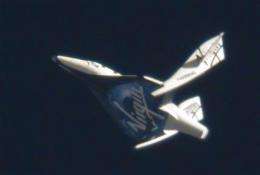
This image provided by the Clay Center Observatory/Virgin Galactic shows SpaceShipTwo in full feather wing mode on a rapid descent from its drop altitude of 51,500 feet over Mojave, Calif., Wednesday May 4, 2011. The craft descended in this configuration at a near vertical angle at a rate of 15,500 feet per minute. The craft was reconfigured to normal glide mode at 33,500 feet. This photograph was taken with high powered telescopes from the ground. (AP Photo/Virgin Galactic/Clay Center Observatory, Mark Greenberg)
High over the Mojave Desert, the stubby-winged SpaceShipTwo bent itself into a near-right angle shape and plunged nearly straight downward for more than a minute before unfolding and gliding to a runway landing before an excited crowd.
The test flight Wednesday marked another milestone in Virgin Galactic's effort to be the first company to carry tourists into space.
"What an awesome way to start the day. SpaceShipTwo looked positively beautiful today on her maiden feathered flight!" Will Pomerantz, Virgin Galactic vice president for special projects, said in a tweet.
During the test, SpaceShipTwo did not fire its rocket engine for a climb into space. Instead, a mothership lifted it to 52,000 feet where it was released. It then rotated its twin tail booms upward 65 degrees, Virgin Galactic said.
As SpaceShipTwo descended almost vertically through the sky, it was slowed by the drag of the folded tail, similar to the way feathers slow a badminton shuttlecock. The reconfiguration will be a critical part of the spaceship's descent through Earth's atmosphere after suborbital trips into space.
At 34,000 feet, pilots returned SpaceShipTwo to its normal configuration and landed it like an airplane. The demonstration from release to touchdown lasted 11 minutes, including 75 seconds in the "feathered" mode.
"It flew stably," said Virgin Galactic chief executive George Whitesides.
SpaceShipTwo is based on Burt Rutan's award-winning SpaceShipOne prototype, which became the first privately financed manned rocket to reach space in 2004.
Rutan retired last month from Scaled Composites, a company he founded that built and is testing SpaceShipTwo for Sir Richard Branson's Virgin Galactic.
SpaceShipTwo's unique re-entry has been touted by aerospace experts as a way to overcome the problem of searing heat that other types of spacecraft face when they plunge back into the atmosphere at high speed.
NASA's space shuttles need a layer of thermal tiles and Russia's Soyuz rockets employ heat shields to insulate against damage during re-entry.
Another key test for SpaceShipTwo will come when engineers start powered flights into space, expected sometime this year. Until now, all the tests have been unpowered glide flights.
No date has been set for the first commercial flight from a custom-built spaceport in New Mexico.
Some 410 people have paid the full $200,000 or a deposit for a chance to experience a few minutes of weightlessness, according to Virgin Galactic.
©2011 The Associated Press. All rights reserved. This material may not be published, broadcast, rewritten or redistributed.
-
From lemons to lemonade: Reaction uses carbon dioxide to make carbon-based semiconductor,
32 comments
-
Thioridazine kills cancer stem cells in human while avoiding toxic side-effects of conventional cancer treatments,
3 comments
-
SpaceX private rocket blasts off for space station (Update),
42 comments
-
Climate scientists say they have solved riddle of rising sea,
31 comments
-
Research team claims to have found evidence Lake Cheko is impact crater for Tunguska Event,
18 comments
-
revamping general concept and cosmological principle
May 25, 2012
-
Transiting Exoplanet Light Curve
May 25, 2012
-
Math behind Theoretical Physics
May 24, 2012
-
Do we know whats at the center of galaxies yet?
May 23, 2012
-
Structure of the Milky Way?
May 20, 2012
-
What would it take to terraform Pluto and Charon?
May 19, 2012
- More from Physics Forums - General Astronomy
More news stories
SpaceX capsule has 'new car' smell, astronauts say (Update)
SpaceX's Dragon cargo vessel smells like a new car, said astronauts at the International Space Station after opening the hatches Saturday following the spacecraft's landmark mission to the orbiting lab.
Space & Earth / Space Exploration
22 hours ago |
4.5 / 5 (20) |
2
Australia hails surprise super-telescope decision
Australia has hailed a surprise decision giving it a role in a radio telescope project aimed at revolutionising astronomy, vowing to draw on its decades of experience in space science.
22 hours ago |
5 / 5 (4) |
2
Astronomers seize last chance in lifetime for Venus Transit
Astronomers are gearing for one the rarest events in the Solar System: an alignment of Earth, Venus and the Sun that will not be seen for another 105 years.
22 hours ago |
5 / 5 (3) |
2
Astronauts enter world's 1st private supply ship
(AP) -- Space station astronauts floated into the Dragon on Saturday, a day after its heralded arrival as the world's first commercial supply ship.
Space & Earth / Space Exploration
22 hours ago |
5 / 5 (6) |
0
Sophisticated simulations predict future warming
The chances of our planet being hit by a global warming of 3 degrees Celsius by 2050 is as likely as it being hit by an increase of 1.4 degrees, new research shows. Presented in the journal Nature Geoscience, the British study ...
Space & Earth / Earth Sciences
May 22, 2012 |
4.4 / 5 (9) |
51
Browser wars flare in mobile space
The browser wars are heating up again, but this time the fight is for dominance of the mobile Internet.
Nvidia trumpets Tegra 3 phone design wins for 2012
(Phys.org) -- Nvidias competitive war paint has a name, Tegra 3. On the heels of Nvidia announcements about lowering costs of its Tegra 3 processors and Nvidia-enabled tablets running Android Ice Cream ...
Scientist: Evolution debate will soon be history
(AP) -- Richard Leakey predicts skepticism over evolution will soon be history. Not that the avowed atheist has any doubts himself.
Dell tablet leak: 10.1-inch display, two-battery choice
(Phys.org) -- Headline after headline talks about vendors tablets in the wings as likely number-one contenders for the iPad. Such claims have justifiably been taken with a grain of salt, considering ...
SpotterRF debuts Radar Backpack Kit (w/ Video)
(Phys.org) -- SpotterRF has announced a special radar backpack kit designed to enhance situational awareness for soldiers on the ground. The company says its special radar is designed for warfighters as part ...
Thousands of shellfish found dead in Peru
Thousands of crustaceans were found dead off the coast of Lima following the mystery mass death of dolphins and pelicans, the Peruvian Navy said Friday.
May 04, 2011
Rank: 1 / 5 (2)
May 04, 2011
Rank: 2 / 5 (4)
May 04, 2011
Rank: 5 / 5 (3)
May 04, 2011
Rank: 4 / 5 (4)
Do you think it would go any quicker if it was NASA doing it?
May 05, 2011
Rank: 1.8 / 5 (5)
May 05, 2011
Rank: 1 / 5 (1)
Yes, NASA did it in 11 years, but employed over 400,000 people, spent (original estimate of $7B) >$25B ~$170B in 2005 dollars), killed 3 astronauts and eventually lost the technology rather than build on it... This business model would not be successful for Virgin Galactic. (source of numbers: wikipedia)
May 05, 2011
Rank: 1.8 / 5 (5)
May 05, 2011
Rank: 5 / 5 (1)
May 06, 2011
Rank: not rated yet
All they will be able to do is lift wealthy paying passengers to the edge of space and set them back down again.